ATTENTION:
for terms Puritans
used in the U.S. and England see Dr Sara
Read's contributions.
........................................
AF "As I
pointed someone to your site to read about
all different names for menstruation because
she asked what AF stands for, I guess it
belongs in your list of words for
menstruation. It is the abbreviation for
Aunt Flo that some women use on Internet,"
writes a Dutch frequent contributor to this
site. "Flo" of course is short for
[menstrual] Flow. (March 2004)
A friend comes to
visit read about a film with this
title
Are you in need?
"When I was in college in Berea, Ohio, if my
female friends or I discreetly asked for a
tampon or a pad, we would get the equally
discreet response, 'Are you in need?'"
writes the 26-year-old contributor from
Parma, Ohio. (April 2001)
A little ketchup with
my steak "I had a boyfriend who
lustily referred to it as 'a little ketchup
with my steak.' Those Arizona boys do like a
little ketchup and a lot of steak. Thought
you might like a little extra positive
terminology for your wonderful site. Thanks,
******* (now a New Yorker)," writes the
contributor. She entitles her e-mail
containing this information "That thing,
that thing." (February 2002)
A snatch box decorated
with red roses (a) "snatch" and
"box" are both vulgar terms meaning "vagina"
in American slang
Ammunition "Hi!
First off, great site! I don't know if
you're still collecting data, but I figured
I'd email you in case you were. When I was a
pre-teen and teen, my dad referred to
tampons as 'photons,' which led to us
calling pads and tampons in general
'ammunition.' So if we were packing for a
trip, he'd always ask 'Do you need to pack
any ammunition?' (I'm 23 and from Oregon.)
Have a great week!" (October 2006)
Antietam
"Hello, I don't know if you are still
collecting these, but the two I most
often use are absent. They have both been
created by me, but are related to
historical circumstances: Antietam: The
Battle of Antietam during the Civil War is
often considered the most costly single-day
battle in terms of life loss on American
soil.
Whenever I refer to that time as 'Antietam'
and somebody raises an eyebrow
in confusion, I get that look on and say
'bloodiest battle of the war.'
[the] Badger is Angry:
This euphemism arises from when I was
studying Greek medical thought in regards to
female anatomy. Plato is quoted as
remarking: 'In the middle of the flanks of
women lies the womb, a female viscus,
closely resembling an animal...' and goes on
to talk about how they would burn incense
under a woman's parts or have the woman
inhale smelling salts to get the internal
creature to move this way or that. A diagram
of these thoughts that I once saw looked
like a badger, and I am also unfortunate to
get very bad cramps, so sometimes I say that
the badger is very angry. I'm sure a million
more things could be said as to why there
are so many
ways we avoid the issue of a bleeding woman
behind so many word screens,
but thank you for collecting them."
(November 2012)
Are you seeing red? (a)
At high tide
"Performance artist Laurie Anderson has a
song 'Red Dress' in which she says 'at high
tide,' her euphemism for menstruation,"
writes the male contributor. (July 2001)
At war "I'm a
college student and my roommate always uses
the term 'at war' when she's on her period.
All of the girls on my hall now use the
term," writes the contributor. (February
2002). In September 2004, a male wrote the
following: "For the entry "at war," I'd like
to add that it may locally have been derived
from an Ani DiFranco song / monologue:
I woke up one
morning
covered in blood like a war
like a warning
that I live in a breakable takeable body ...
I don't recall the title and am not near
my CD collection at the moment, but if you'd
like the reference, just e-mail me back here
and I'll look it up."
Attracting the lesbian
vampires see Moon's
blood
Aunt Aggie
used by a writer to the Would you stop
menstruating if you could? page on
this site (December 2002)
Aunt Fanny from
a contribution to Would
you stop menstruating if you could? :
"My last child almost killed me (through the
birth process), and I had a necessary tubal
ligation in my mid 30s to prevent further
pregnancies. At 43 years old, my periods
have always been irregular, so it is always
a surprise when Aunt
Fannie comes to visit again,
usually after 25-45 days." (April 2010)
Aunt Flo[w] [is
visiting, etc.] (a) Flo is a short
version of the name Florence. A contributor
e-mailed MUM (March 2002), "I traveled to
London on business. Of course, Aunt Flow had to
come along." See also
Gramps. "I am sure that you have
heard this one before, but when I was about
16 or so, if someone had their period and
didn't want to join in an activity or
whatever with us, we would say, "Oh, I'm sorry, I have a
visitor this week, my Aunt FLOW is here!"
and the rest of us would know right away
why. It was a nicer way of saying it.
Instead of "I got pms," plus the boys didn't
know what the heck we were talkin about!
Love your site, D in Germany."
(February 2007)
Aunt Flo sent someone
else in her place "My friend and I
use the term 'Aunt Flo' (which I saw on your
site) for menstruation but have several
related words/phrases which I didn't see
which we use for other aspects. We call pads
or tampons 'welcome
mats.' We call cramps 'muscular
turbulance.' When I got pregnant, I told her
'Aunt Flo sent someone
else in her place.' We use the term
'reservations'
to refer to the time we expect menstruation
to start. Oh, I'm from the U.S." (January
2004)
Aunt from Reading was
in town "I'm from Pennsylvania and
a friend of mine used to say that her 'Aunt
from Reading [a town in Pennsylvania, I
believe pronounced Redding] was in
town'! I loved that and use it all the
time!" (March 2005)
[My] Aunt Flo from Red
River is visiting see below, My Aunt Flo from Red River
is visiting.
Aunt Irma "There's
a British TV show called 'The IT Crowd'
in which an entire episode
is entitled 'Aunt Irma'. It's quite
funny and has a few more euphemisms in
it (I'd highly recommend it). Also I
called it 'inauguration' for a while
when I first began my courses, because
my friends joked that I'd finally been
inaugurated into womanhood. And my
husband just calls it 'icky'". She
later wrote, "I'm actually from
Missouri. The term 'courses' just seems
a little more genteel than 'period' or
'menstruation'; a bit more...
delicate, less
likely to offend or gross out -
although, I suppose you aren't really
easy to gross out about this particular
subject... :D. Admittedly, it is a
seldom used term, however, a lot of
genteel-sounding
language is not really used these days.
:D. Thanks, ****. P.S. I kind of put
that last one in there as a joke (icky),
but the other morning, I was
talking to my husband and he actually
used the phrase 'You're icky right now.'
So I guess it does count."
(November 2012)
Aunt Martha from the title of a
painting by Judy Jones in the Art of
Menstruation series on this Web site; she
said that was the term "we" used for
menstruation (August 2002)
Aunt Ruby
The woman contributor, from King of Prussia,
Pennsylvania (U.S.A.), wrote, "We call it
Aunt Ruby; lots of people say their aunt is
visiting, and we added Ruby after a
character on General Hospital [an American
television program] back in the 1980s. We
always used to laugh at her name and say it
sounded like a period. Now it's my family's
favorite way to refer to it." (2000)
Aunt Sally
"Aunt Sally is one that my friends and I
often use. I have a great aunt named Sally,
who always meant well, but was constantly
messing things up. and overstaying her
welcome. I think that it's a very
appropriate name for such a time. By the
way, I'm 13 years old," reads the e-mail.
(November 2001)
Aunt Tilly is here
(a)
[The] Axe wound "This one is my favorite.
My brother came up with it. He calls it
...The Axe Wound." (July 2008)
Bad week.
"My delicate husband and I refer to it as
'bad week' and I always warn him that I need
to get some 'woman things' from the store. I
am in my early 30's and as a teen we called
it raggin'." (August 2006)
Back in the saddle
again "When I was a teen and the
common protection consisted of the elastic
sanitary belt and pad, we referred to being
'Back in the saddle again.' That was in
Texas and Oklahoma," commented the
contributor. (April 2001) See also a comment
under Period.
Contributed again in March 2005: "My mom
always likes to sing the phrase from
the old song 'back in the saddle again.' -
ha." I believe "cowboy" Gene Autry sang it
on his radio show.
[the] Badger is Angry
see Antietam
Baggage see Ugly
Sister
Band-Aids
"'Your friend': this term is used by my
mother, aunts, and their cousins. And we
need 'Band-Aids' when it gets here."
(November 2002)
The banks of the Nile
are overflowing and running red
from "I'm having my euphemism" by Donna
Lypchuk in the Eye Weekly (4/20/00) at http://www.eye.net/eye/issue/issue_04.20.00/columns/necro.html
(April 2004)
The beast the
contributor writes, "I call it 'the beast.'
*giggle* I just thought it was appropriate
and have been saying it for years. My
girlfriend calls it her 'visitor' or 'being
visited,' but you already have that one."
(July 2001)
Been there, doing
that the
contributor, "some 14 2/3-year-old girl from
Texas," e-mails, "What my friends and I say
when we are on our periods is 'Been there,
doing that.' The 'been there' part offers
consolation to those who recently were on it
or had cramps previously, while the 'doing
that' part refers to the fact that you are
on your period currently. None of the guys
have been able to identify what we are
talking about, so I guess it is a pretty
good nickname for our monthly 'friend.' We
use the expression at school, normally to
give an explanation for doubling over in
class, or as a sign, 'Hey, do you have a
tampon/pad I could use?' Us girlees use it,
and I think the origin came from just joking
around and saying, 'Well, I'm "doing that,"'
and it eventually metamorphazised into 'Been
there, doing that.' Been there, doing that .
. . ." She added, "Just a note for all you
gals out there: I only started a year ago,
so don't worry when you are 12 and you
haven't started! So what if all your friends
started. You can go swimming without
fretting! It's not that big a deal.
Sometimes it's only a big PAIN, (J/K) but
not in the butt." (June 2001)
Being a girl see I hate that blue car (September
2001)
Being a lady
the contributor writes, "I didn't see this
one listed on your site; I saw it some years
ago in a young adult novel that involves
time travel. I don't remember when exactly
it was set, but the terms 'lady days' and
'being a lady' were used, and now I use
those terms for my own (unpublished) writing
which takes place mid-century." (May 2002)
Being a woman
"My partner and I refer to our periods as
'being a woman,' as in 'Are you being a
woman yet?' and 'I'm being a woman.' I can't
even remember the origin - sort of an ironic
outgrowth of all of that 'Girl, you'll be a
woman soon' kind of goosh that becoming
informed about menstruation in the 70s
included," wrote the contributor. (March
2001)
Being drafted see I'm gifted
Being female see Drainage
Being girly see Driving in a red car
Being touched
by the Goddess
see Moon's
blood
Being unwell
the contributor e-mailed (September 2000),
"When I was a teenager in Queens, New York,
in the 1960s, we sometimes referred to
having a period (menstruating) as "being
unwell." "We" were mostly white,
working-class girls going to a public
school. [Germans also say that, "unwohl
sein."]
Being womanly
see Drainage
Big Red
"My friends and I call it 'Big Red,'" writes
the contributor. (December 2001)
[The] big red monster
is in town "I'm a 19-year-old
female from northeast Ohio and I'm writing
to tell you what some of the terms I use
are. Whenever I'm on my period, my fiance
always says "The big red monster is in town"
and whenever he tries to initiate sex during
that time I tell him 'I'm closed for the
holidays '(referring to a time when he tried
to initiate on a holiday). Other fond terms
of it are the 'bitch-maker,' 'Midol
season,' and the 'no-go
zone.'" [March 2005]
Bitchy witchy week
"In 2001, a former roommate and I coined the
term 'Bitchy Witchy Week' for any
menstruation-related snappiness and mess.
'What's the matter with you?' 'It's Bitchy
Witchy Week.' 'Let me just avoid you, then
....' We're both pagan, but aren't entirely
eager to embrace the hormonal
wackiness/mess/pain as a gift rather than a
right bloody inconvenience. We were living
in Phoenix, Arizona, at the time; I've since
seen a few people pick it up via Internet."
(August 2007)
Black towel time
"My Latina girlfriends (from Uruguay, Mexico
and Colombia) and I (U.S.A. with a Mexican
soul) all call it Andrés (from 'él que viene
cada mes' - he who comes every month). My
husband, born in Mexico, refers to tampons
as 'vampiritos' (literally, little vampires,
because they suck blood). We both also refer
to 'black towel time' because we toss one on
the bed to protect the sheets if we want to
play. Great site," writes the contributor.
(August 2002)
B.L.A.S.P.
"Sometimes my sister and I refer to our
periods or the heaviest day as 'bleeding
like a stuck pig' or B.L.A.S.P. for short;
I'll mark my heavy flow day on my personal
menses-tracking calendar as 'BLASP.' Been
using it for many years, don't know if we
made it up or picked it up elsewhere. I'm
39, white and in Doylestown, Pennsylvania."
(May 2003)
Bleed, bleed, bleed
see The joy of
womanhood
Bleedies
"My 4-year-old and I call it 'bleedies.'
There are 'nose bleedies' (she gets those)
and 'peepee bleedies' that only mommies
have." (March 2002)
Bleeding freely from
the crotch "My friends and I
lovingly refer to our periods as 'bleeding
freely from the crotch,'" writes the
contributor. (December 2001)
Bleeding like a stuck
pig see B.L.A.S.P.
Bleeding the
lining of my uterus through my sexual
organs."I have no idea if you're
still updating your collections of
euphemisms [of course]--and
frankly, this is the opposite of a
euphemism anyway--but I always tell my
female friends that I'm
'bleeding the lining of my uterus through
my sexual organs.' It's a
delightfully graphic description of how I
feel at the moment. I'm a 17-year-old San
Diegan (very Southern California)" She later elaborated:
"It definitely captures all the discomforts
of menstruation -- cramping,
irritability, the general feel that
your body is 'out to get you' -- and the
complete lack of interest in anything
involving sex, or pleasing men. Plus, it
sounds like a great justification for
copious consumption of chocolate and general
grumpiness; after all, it's graphic enough
to sound like an injury. 'Bleeding the
lining of your uterus through your sexual
organs' sounds a lot more serious than being
'on your period'; it just /sounds/ more
painful." (November 2007)
Bleeding out my vagina "To MUM. A
term for WOMENstruation:
'Bleeding out my
vagina.' Let's get real,
folks. I use this expression in the Pacific
Northwest of the U.S.A. with my friends,
housemates, family, whomever. For
cramps, I say 'My
uterus hurts.'" See also Blood is fighting its way
out of my vagina, which sounds as if it's
from the same person. (March 2005)
Bleeding out the
hoo-ha see Reasserting
my femininity
Bleeding Uterus
Syndrome (B.U.S.) see I'm on the bus
Blessings of
Lady see Moon's
blood
Blood demon
from an e-mail discussing why the writer
wants to stop menstruating (June 2002)
Blood is fighting its
way out of my vagina "I know
several women in the Pacific Northwest who
use this phrase. It is particularily
effective in clearing a room of men if
announced loudly upon entering. For
those less-euphemistic among us." See also Bleeding out my vagina, which sounds as if it's
from the same person. (July 2005)
#Bloodcannon
"After developing PCOS, 'bitchy witchy week'
[q.v.] was no longer sufficient. The new and
rather more graphic description is
#bloodcannon. My partner-in-crime objects to
this on the philosophical principle that a
simple and factual description of things
which happen may not be in good taste (his
example here is "explosive diarrhea") and
that no, the hashtag does not make it
better. I register his complaint, but after
passing golf ball sized blood clots at
speed, #bloodcannon is still completely
accurate." (September
2014)
Bloody beast
used by an e-mailer to this site's Would you stop
menstruating if you could? page (July
2004)
[The] bloody mess "I
am 39 years old and have always hated 'the
period,' or as I really like to call it,
'THE BLOODY MESS!' I don't refer to it as
'my period' because frankly, I have nothing
to do with it - it just happens." From an
e-mail to Would you
stop menstruating if you could? on
this site. (August 2003)
Bloody Mary
Bloody snot "When
I have my period I call it 'Bloody Snot'
because that's what it looks like to me. I
also call it 'Is There Anything On My Butt?'
because it's always very late, I never know
when its coming and I'm worried that it will
come at the most embarassing times."
(December 2003)
Blowing a fuse
"Blowing a fuse: a term I made up, meaning
leaking from a tampon. The string on the
tampon reminds me of a fuse, and blowing
reminds me of a blow-out on a car with all
the air leaked out." (May 2004)
Blow job season
"Another name a
girl friend of mine and her hubby made up
was that it's Blow Job Season. ****" (April
2008)
Bringing forth life to
pass see Moon's
blood
Broken the contributor writes, "My
husband says I'm 'broken' when I try to
persuade him to have sex during my period."
[I guess the blood is coming from the damage
to the uterus.] (January 2001)
Brown towel night
"A friend of mine calls it 'brown towel
night,' which refers to the clean-up after
she and her boyfriend have sex while she's
menstruating. We use that term now to refer
to the entire period, even if there's no sex
involved!" writes a woman from Michigan
(U.S.A.). (July 2001)
Bullets "I used
to call tampons 'bullets' because that's
what the non-applicator ones look likewhen
they are still wrapped up. So this evolved
to saying "I've been shot" when I had my
period. I've since stopped using disposable
products and using euphemisms in favor of
just stating it plainly. I also view
menstruation as a positive thing now. By the
way, your Web site is wonderful. Thanks for
having it." (October 2001)
BUD "Thanks for
doing such a wonderful site - the Museum. I
loved the list of words and expressions for
menstruation - 'BUS' is my favourite and I
have decided to appropriate it for myself
with a variation: 'BUD' - Bleeding Uterus
Day(s)! As a youngster I used to say, 'I am
on,' now I say period or bleeding. Boring
eh? I have BUD from now on. I have often
wondered how to describe tampons and pads -
I strongly dislike that they are called
'sanitary protection' - like we all need
protection from the unsanitary (i.e. dirty/
germ-ridden) menstrual blood. One of the
things that really amuses me and my partner
is 'panty liners' - we thought that they
should be called something like
'blood-catching knicker liners' but that's a
bit long. I don't much like 'the rag' - I
prefer something that says it exactly how it
is. Could you put together a list of
words/expressions for pads/tampons?"
Unfortunately those terms are mixed among
the others. (August 2005)
B.U.S. see I'm on the bus
BV "I've been
calling it 'BV' for years now - stands for
'Bloody Vagina.' I know it's really gross,
but if you say 'I've got BV' most people
don't really catch on, and when they force
the actual definition out of you, they're
grossed out and intrigued (usually) at the
same time. As far as I know it originated
from my dirty pervert of a friend who
inquired about a girl who took her purse to
the bathroom with her. He asked, 'Why do you
need your purse? Do you have BV or
something?' We were all confused and he
said, 'You know, bloody vagina.' I don't
remember what happened after that, but I'm
pretty sure we all stopped being friends for
like 5 minutes while we got over the fact
that our guy friend comfortably used the
words 'bloody' and 'vagina' in a sentence."
(August 2005)
[The] bus has left see I'm on the bus
Calendar days (a)
Calling vision for my
people "Several Native American
cultures consider women in menses to be at
the HEIGHT of her powers. For instance, the
Lakota tribe would not permit a menstrual
woman anywhere near warriors or healers.
They believed that menstrual blood was so
powerful that just the presence of such
power would weaken the strength of warriors
and interfere with a healer's ability to
heal. The menstrual blood serves to purify,
to cleanse, renew, and it prepares the woman
for higher spiritual accomplishments. The
Yurok, and Lakota tribes practiced monthly
rituals by retreating into MOON lodges with
other menstrual women. There they celebrated
the power of their menstrual blood. SO, at
the height of my power, through the ebb and
flow of life, giving and life-sustaining
blood that flows through me, I isolate
myself from the mundane petty distractions
and instead focus inward. Thus CALLING
VISION for MY PEOPLE. Simple. Get it? Indeed
I do feel more creative, more artistic, more
insightful, and with each monthly cycle I
become more in tune with my connection to
nature, thus accumulating a greater store of
spiritual energy. ERGO, when I menstruate, I
don't see it as negative darkness or as a
curse. Instead I prefer to view the process
in a more positive, healthy attitude: it is
a natural, sacred connection to the cycles
and rhythms of the earth. Menstrual blood is
LIFE GIVING and LIFE SUSTAINING. There are
also native tribes that would return the
sacred life-giving blood back to the earth.
They would sit over seeds and let the sacred
blood flow directly on the seeds or on newly
planted seedlings, which INDEED DOES give
the seeds growing power. I add here to any
who are asking, What? That is sick! NO, NOT
sick at all. For an experiment I suggest
using INSTEAD menstrual cups to collect the
powerful blood into a jar. Fill the
remainder of the jar with water then use the
solution to water your plants. Be sure to
use plain water on other plants for
comparing the difference. IT IS AMAZING how
powerful menstrual blood is. Of course it is
NOT a good idea to disclose this to most
people because our current culture has
deemed MENSTRUAL BLOOD as disgusting and
gross. BELIEVE ME, MY PLANTS are so healthy
it is amazing. Whenever asked how I keep my
plants so strong and healthy, even in the
dead of winter when the house is so dry, I
just say,"It's a secret." Oh, one more
thing: there is NO ODOR whatsoever. I tease
around friends that really know me -
whenever I am calling vision - I act as if
my plants are grabbing at me to get just a
few drops of that SACRED LIFE-GIVING BLOOD.
Hope I haven't grossed you out. If I have,
It IS YOUR conditioned cultural acceptance
of how women in menses are viewed. Look to
the past, into Native American Cultures and
you will find reference to the SACRED POWER
of menstrual blood! Does that answer the
query for you? YEP - "CALLING VISION FOR MY
PEOPLE" - or just "CALLING VISION." Glad you
were interested in the phrase. Need to
re-educate, re-evaluate what so many have
come to see as a negative, gross, dirty
monthly process for women. YET it is a VERY
VERY NATURAL PROCESS. Think about it:
without it, there would be no life! Have a
great day!" (March 2003)
Came into womanhood
probably means the first menstruation,
menarche. From the Pinkham booklet Come into the Kitchen
(1930) and The Happy
Baby.
Can't go swimming (a)
Carrie "Refers
to a late bloomer. (After Steven King's
novel)," writes the contributor. She also
sent End of sentence,
Hoover dam, It, My body hates me, Question
mark or Exclamation point, and
added, "I think that's all. I thought you
might be interested in what my friends and I
call our 'times of the month.' Just in case
you wanted to know, my friends and I are all
about 15 years old and from the northeast of
the U.S. of A." (October 2001)
Catamenia a
medical term; I named the museum newsletter
- no longer published - this so no one would
know what it was when it went through the
mail, otherwise embarrassing the recipient.
Certain days
used in at least one puberty booklet ("Sally and Mary and Kate
wondered . . ." from Modess, 1956)
(July 2007)
Change the guards at
the gate, I need to see Dropping an egg
Charlie
"Hi. My friend and I used to call or periods
'Charlie.' We where both 13 at the time, now
we are 23." (February 2003)
Charlie Brown is in
town "I saw one reference to
Charlie, but my friends and i in Grade 7
used to use the code 'Charlie Brown is in
town' for when we had our period - that way
we
could also ask for any supplies we may be
missing. The Kotex machine [see examples
of dispensers] in our school bathroom
was the source of much embarrassment.
(Peanuts cartoons were very popular in
1960's) - Jennifer. Ps glad to see the site
is still up and running, but the small print
is hard to navigate for baby boomer eyes"
(October 2017)
Chasing waterfalls
see Waterfalls
Cheese sticks
"When my youngest son was about 1 1/2 and
getting into cabinets, my older son, who was
four, came running up to me and said, 'Hurry
Mom, Phillip's getting into your cheese
sticks!' I didn't have a clue what he meant
until I saw my tampons strewn all over. Now
if I send my husband to the store for cheese
sticks, he knows what I mean," writes the
contributor. (September 2002)
Cherry drink see Moon's blood
Cherry topping
see Cotton candy
Chocolate time
"That's what my friend said her grandmother
[probably in her seventies or eighties now]
always calls it. :-)," writes the
contributor (January 2001)
Cigar "From the
age of 13 on, my father was my sole parent.
Needless to say, periods or their
accompanying issues and accoutrement were
not comfortable topics of discussion.
Despite starting my period at age 11,
I didn't understand what it meant or
really even what it was. I
was incredibly embarassed about having
my period at all and would ask him to
buy my 'supplies.' I'm sure he wasn't
thrilled with the task, but he was a good
father and would do it for me without
question. Not long after I moved in
with him, we were at some fancy function,
probably a bar mitzvah, and I was wearing
some kind of clothing that didn't have
pockets deep enough to hide a tampon (I
still refuse to use a purse, so that option
was out of the question). My father kept
them for me, and when I needed one, he came
up with the phrase, 'Do you need a cigar?'
From then on, this became our word for
tampons, morphing into code for my period.
'Dad, could you get me some cigars?' 'I
gotta go buy some cigars,' 'I'm smoking
cigars this week.' Now I know that
in the post-Monica Lewinsky world, this may
have a very different connotation, but this
is what we called it/them. Thank you for
this site, ****." Connecticut. (July 2004)
[The] circus is
closed, the monkey has a nosebleed
see The monkey has a
nosebleed
Closed for
business the contributor writes,
"When I was in high school I used to say
that the 'Red Moon is rising.' Now that I am
married, I tell my husband that I am "Closed
for business," even though that is not
always the case! ;) I am 29 years old,
white, and I live in the Midwest. (May 2002)
Closed for maintenance
"I have often over the years used the
term 'closed for maintenance,' which I don't
think I saw; I can't believe that I am the
only one in the world to have used it, even
though I came up with it on my own," says
the contributor (November 2000). [Sounds
like a sexual meaning: she is not "open" for
intercourse.]
Clyde the
contributor writes, "When I was a teenager
my friends and I referred to our periods as
'Clyde,' as in 'Clyde's here,' or just the
word, accompanied by that curled-lip,
somewhat sick-to-the-stomach expression so
highly developed in the newly menstrual. My
husband and I call my period 'sluicing.'" (April
2001)
Code red "In
case of an emergency, my friends and I call
'CODE RED!' for those moments when you don't
want to let the world know there's a civil
war going on between the North and the
South. North: brain; South: body" (August
2002)
Come sick
"Hello, my name is *******. I'm 47 years
into this world and I think your site is a
real hoot and informative too. I found it on
a link at 'Free will astrology.' My
contribution is 'come sick.' When I was
about 12 years old my fraternal grandmother,
who was an honest-to-goodness card-carrying
gypsy, and was bought from her family by my
grandfather (her folks thought it would be
the best thing they could do for her) and
shipped over here on a cattle boat (I'm told
Granddad was cheap as well as cruel) at the
tender age of 14 to be his wife and bear his
12 children, asked me if I'd 'come sick'
yet. I couldn't imagine what she was talking
about but after a little hushed banter back
and forth between us I figured it out. I
told her yes and she promptly made it clear
in no uncertain terms that I was to 'watch
out for the boys' from now on [good
advice!]. All this as she cut and hung the
best homemade noodles I'm sure I will ever
eat on my mother's kitchen table, in San
Diego, California. I hope you can use it
[it's great!!]. Thanks for the great site.
Best Blessings to all." (September 2001)
Comma the
22-year-old Midwestern college student who
sent this writes, "I used to have a moody
male friend who we used to say was on his
'comma' when he was being moody. That was
because men just had a 'pause' (, - comma)
not a complete stop (. - period) like
women." (May 2001) See also Nosebleed pillow, Placebo effect, Plug and Red Week.
[The] Commies are
coming see Happy escapade
Communists have
invaded the summer house "Really,
does that need any more explanation? Can't
remember who started it, but I'm pretty sure
it was a female, and as soon as they hear
it, folks of both genders love it and use it
with abandon." ****, 23, Durham N.C.
(September 2004) Actually, it's almost
identical to the Norwegian Kommunister i lysthuset - see the entry under
Norway, below - and I wonder if someone
did not get it from this site, especially
since I believe this is the only American
entry containing "communist." So I
e-mailed the contributor and she
responded: "Missed the Norwegian
section -- I just checked for it in the
English part. I'm definitely sure of it --
but I've only 'heard' it online, mostly from
blogging friends. One who currently lives in
California, but has also lived in D.C. and
Australia recently, is the one who comes to
mind as being the one I heard it from
originally."
Congratulations! It's
an egg! "My husband (of seven
months) and I aren't especially eager to
become pregnant yet, so whenever I start my
period, I'll email him or tell him,
'Congratulations! It's an egg!' as opposed
to 'Congratulations! It's a baby!" The first
time I heard that phrase was from a comedian
a few years ago, and it tickled me so much,
I never forgot it. We also use the phrase
"crimson tide," but you have that one
already. I'm 25, and in Atlanta, Georgia.
Regards, **** (November 2003)
Cooter pad see Dead rat
Cooter plug
see Dead rat
Cork see I'm gifted and Reasserting my femininity
Cotton candy "My friends and I
used to call our periods as having 'cotton
candy' with 'cherry topping,' referring to
our cotton-woven pads and our red
cherry-colored periods that topped them."
(May 2004)
Cotton ponies see The eagle has landed
Cotton tail The contributor,
a 45-year-old American woman, writes, "My
friend's husband always used to say 'Have
you got the cotton-tail on?' It comes from
how a Kotex looks on a belt from the back
(look at your mannequin [here it is from the
front]). I
always thought that it sounded kind of
sweet." (April 2001)
Courses (or monthy courses) the
contributor writes, "I don't see [in this
list] the term my grandmother used. She
insisted that 'courses,' or occasionally
'monthly courses,' was the only polite way
to refer to it, if you had to refer to it at
all. Needless to say, polite people didn't.
That whole side of the family is English or
Scots, so I'm assuming it's a regional
thing. [In November 2012 a woman from the
United Kingdom used the word in an e-mail to
me; see the UK contributions, below]"
(December 2000) [My dictionary writes that
it comes from Latin via Old French and
Middle English from a word meaning "to run."
The current French verb "courir" means "to
run."]
Dr Sara Read of Loughborough University,
U.K., (more
from Dr Read) e-mailed me this about
"courses":
There were a
few expressions in use at this time
(including actually 'terms'
itself).
The most common ones were: flowers, courses, and
terms.
However, they were unlikely to be used
in open conversation where instead
women tended to say things like 'those' or 'nature' that
type of thing. The expressions, then,
imply menstruation rather than say it,
so if for example she was telling
another woman she thought she might be
pregnant
she might say, 'I
haven't had those for a while'
and assume that the other woman knew
what she meant. Men tended to be more
direct and say terms or courses 'she hasn't had her
course' for example. They
also used the biblical 'custom of women'
so an older woman might be described
as no longer having the custom of
women, for example.
The whole of Chapter One of my book
[which appears in September 2013] Menstruation
and the Female Body in Early Modern
England is devoted to the
language used for menstruation in the
early modern era.
Cousin Cramps
"I noticed you have a few different versions
of 'Aunt Flo' but when we have family visit
they come with the whole family so for me it
is not just 'Aunt Flo' but also 'Uncle Red'
and 'Cousin Cramps.'" (July 2006)
Cousin Tom the
contributor writes,"My friends and I
frequently refer to our periods as 'Cousin
Tom.' Tom stands for 'Time Of the Month.'
One time I actually got a girl outside the
conversation to believe I had a cousin named
Tom. If our period is late we say that his
plane was delayed." (November 2000)
Cramps
Crimson curse "After dealing with
periods for over a quarter of a century, my
favorite euphemism for menstruation is 'the
crimson curse.' That term, as far as I know,
is original," writes the contributor. (May
2002)
Crimson tide see
also "Surfing
the crimson tide" and "Surfing the crimson wave," below. Many folks have
submitted one of these three variations.
(January 2001)
Cup week Writes the e-mailer, "When
I was a kid, my best friend always called it
her 'unable to swim' because she refused
(and still does) to use tampons. Also, among
many of my friends and myself who all use
The Keeper menstural cup, it became 'cup
week.' I also often use 'moon flux,' which I
think came from either the Mists of Avalon
by Marion Zimmer Bradley, or the Earth's
Children series by Jean M. Auel. I've also
heard 'it's time to empty out' and 'it's
time to get a refill' (referring, I assume,
to refilling a birth control prescription).
By the way, I live in the Philadelphia
[Pennsylvania] area." (May 2002)
[I could] Cure the plague The
contributor writes, "This comes from the
1300s when people would drink menstrual
blood to try to cure themselves of bubonic
plague. " (November 2000)
Curse, the a
woman e-mailed in November, 2000: "Where's
'the curse,' one of the most common of
all?" But read this from a student of the
Irish language (in Los Angeles): "I
am fairly certain the term curse may come
from the Irish 'curse' - pronounced cursa,
actually - meaning 'course' [see Courses, above] -
it is a perfectly good word for menstruation
and has no relation to being 'cursed.' Yes,
it's true - it's in my Irish-English
Dictionary. And many Irish-American women
grew up with the term 'the curse' - I think
it probably adds to the concept of the
burden of womanhood - possbily dating back
to Eve - but curse in
Irish really means courses and applies to
rivers, seasons, and other cyclical events
as well."
(August 2005)
Curse of TOM "I am a female
and amongst my female friends we always
say we have 'the curse of
TOM.' TOM is short for time of month. I
am Caucasian, 19, Nevada" (February
2007)
Custom of women
see Courses
Cut your finger "I have
several American terms used in the
South I haven't seen here. 'Cut your finger.'
I had a friend with several sisters and when
her mother would see tampon wrappers in the
bathroom wastebasket, she'd say, 'Who
cut their finger?' I suppose she wanted to
know whose bad temper to overlook that week.
Also from the same family, "mouse mummies.'
Those were used tampons wrapped up in toilet
paper (like an Egyptian mummy) and put in
the garbage. So sightings of 'mouse mummies'
also alerted her. A personal story that I'll
never forget happened when I was 13, in the
early 1960s. Grades six through nine were in
seperate schools called junior high schools.
Most of the girls were just starting to
menstruate and were embarrassed. Our gym
teacher (physical education) was a nice lady
named Miss Fisher. She made sure there were
Kotex machines in all the girls' restrooms.
Knowing we were all mortally embarrassed
about our new status, she arranged a code
with all the teachers. At that time, you
didn't just get up and leave class to go to
the restroom. The idea was that classes were
only 45 minutes long and breaks between them
were 10 minutes, so just 'hold it.'(I can't
believe we tolerated it but that was before
we began to question authority!) If you just
HAD to leave class (to visit the Kotex
machine) we were assured that if we
told the teacher 'I have to go see Miss
Fisher' that we'd be excused with no
questions asked and not refused permission
to leave. Naturally, this statement was made
by meekly tiptoeing up to the desk and
whispering in the teacher's ear. At
mid-year, a teacher resigned and was
replaced by a young, good-looking male
teacher in his early 20s. Yes, you guessed
it. Nobody told him about the code. When one
of the girls (thank goodness it wasn't me !)
made this whispered, urgent request, the
teacher blurted out loud, 'Why do you
have to go see Miss Fisher right in the
middle of math class??!!' Several of the
boys snickered (they certainly knew), the
poor girl blushed beet red and the rest of
the girls nearly fainted. 'Oh, Sir, you had
better let her go !!!!' we chorused. He let
her go, but begrudgingly! Also, referring to
another page in the site, here's an
explanation of the word 'Hoosier' that
appeared on the sanitary belt box. The state
of Indiana IS known as 'The Hoosier State'
and those who live there are nicknamed
"Hoosiers." The common explanation is that
they were very proud of their state and if
they met a stranger, they always were
curious which state the other person
was from. They would say, 'Who's your
state?' (This was back in the early 1800s;
now we say, 'What state are you from?')
'Who's your' was corrupted into 'Hoosier'
since speakers ran the words together. Love
your site! ~anonymous" (August 2005)
Cycle, having my the 29-year-old Causasian
woman from the Midwest (U.S.A.) writes, "I've
heard that term from so many women all of my
life." (April 2001)
Dam see Due
for the sweatlodge
[The] dam has
burst see I'm
not pregnant (February
2002)
Dead rat "I was rushing one
day when changing a tampon and forgot to
flush the toilet. When I left the bathroom
my husband went in to urinate and started
yelling 'Dead rat, dead rat.' He also came
up with the name 'cooter' as a term for
vagina so he'll sometimes ask if I have a
'cooter pad' or 'cooter plug' on/in." (April
2004)
Decorated with red roses (a) from
World War II
Devil days sent
by a male, who didn't say if these were
actually used, with
High tide, The tide has rolled in, The Girly
Girl thing, The devil's work, The week of
the devil, Muddy waters. (March 2007)
[The] devil's work
see Devil days
Diaper "Stumbled onto that site
by accident ... wow. I was surprised NOT
to see diapers and plugs on the list ... diapers
being pads and plugs being tampons ... or,
not a good day ... referring to the day
all hell breaks loose. Sex on day one -
ok, day four - ok, day two or three ...
not a good day forget it, I'd rather eat
dirt. (late 70's) I saw 'riding the
banana,' that is a good description of
pads. Was also profoundly grateful that I
wasn't around to experience the contraption you described as a rubber
apron with a pad holder attached.
(Sears-Roebuck?) Female, Baltimore, MD "
(February 2009)
Diaper up,
Diapering up "My daughter and I use
the phrase 'Diaper up' or 'Diapering up' for
when we have to use two pads because the
flow is so heavy." (April 2005)
Dot, the the
contributor writes (2000), "In late 1970s,
some enterprising teens called it 'the dot'
to keep others from knowing what they were
talking about when sharing secrets."
Dot, dot, dot
"Hi, I'm a teenager from the U.S. My friends
and I call our periods 'dot dot dot' (sort
of like the dot), and we call pads/tampons
documents. So when we need to change our
pads, we say 'I've got to edit my document.'
Thanks!" (July 2009)
Dotty Spotty "What
a great site! :-D My husband and I refer to
my period as 'Dotty Spotty.'
He will ask me, 'Is Dotty here?'
As far as I know, we're the only ones who
use this name. I'm a student midwife, and I
think I'll share a link to your site with my
preceptors and fellow students. **** Texas"
(June 2006)
Double barrel
technique, [Employing the] "How
about '(Employing the) Double Barrel
Technique!' That's what I call it when
a monthly visitor is so heavy one has to
cram in TWO tampons!!!!" (January 2005)
Dracula's tea bag
the contributor writes, "As a man in his
mid-twenties, I enjoy using the term
'Dracula's tea bag' for tampons. I'm not
sure it fits in your list of names for
menstruation, but I figure it's close
enough." (May 2002)
Dragontime "Dragontime: This
comes from Dragontime: Magic and Mystery of
Menstruation, a book by Luisa Francia. Witching Time: Many
witches believe very strongly in the power
of menstrual blood and use it for their
magical workings. Moon
cycle: This term gives
acknowledgement to the similarity of the
lunar cycle to a woman's menstrual cycle."
(July 2004)
Drainage "When
I am bleeding, I say I am menstruating,
'periodic,' 'being womanly' or 'female,'
'leaking,' 'emptying,' 'draining' or
'drainage' or 'preparing for unborn
children.' It is also called 'painful
femininity' when I have intense cramps or
heavy clotting. I am 18 from Seattle and
proud of bleeding although I hate the
accompanying pain or emotional discomfort.
Thank you for this informative site! I
learned more about myself and gathered more
information and appreciation for other
women." (October 2005)
Draining see Drainage
Drip drop
"I've used this for years for this body
function," writes the contributor. (June
2001)
Drippy faucet
see Waterfalls
Driving in a
red car "Me
and my friend started a saying that,
although may not be popular, is at least
used by us. It's 'Driving in a red car.' The
circumstances surronding the making of this
phrase elude me but we use it a lot.
'Driving' is the period itself. 'Seatbelts'
are pads, 'keys' are tampons, 'driving
through bushes' is mild cramps, 'driving
through a forest' is bad cramps and 'driving
through a red wood forest' is REALLY bad
cramps. Also, me and my dad and step-mom
refer to pads as French bread. We say this
because I needed pads and while we were at
the store my step-mom bought some French
bread too. We had an amusing conversation
about not mixing the two up (such puns as
'getting a yeast infection' arose). I'm 15
and I live in Texas (America) and I'm
currently driving although I haven't hit the
forest yet. Thanks, **** PS) I refer to it
as 'being girly' or needing 'girly products'
when I'm at my mom's house." (March 2004)
Driving through a
forest see Driving
in a red car
Driving through
a redwood forest see Driving in a red car
Driving through
bushes see Driving
in a red car
Dropping an egg "My husband
married himself an openly informative woman
here - he's got all the details down pat
after almost 14 years! So, his pet name for
my menses is 'dropping
an egg.' I think it's too
cute! I'm not comfortable with sexual
activities for the first couple of days, so
Hubby asks if it's 'tool
time' yet to make sure where I am
in the 'egg dropping'
process! I call my tampons 'soldiers' and
the act of needing a bathroom while out (to
change tampons/pads) is 'I need to
change the guards at the gate.'"
(June 2010)
Due for the sweatlodge
the contributor writes, "We always jokingly
refer to it as 'flooding' and our pads or
tampons as 'sandbags.' The first day, our
'floodgates open up.' And, my friends and I
are all converts to the Keeper menstrual
cup, so it's our 'dam.' We also refer to it
as 'the time that men suck' (reference to
the lack of male menstruation) or when we're
'howlin' at the moon,' since we all
menstruate on a lunar cycle, or even are
'due for the sweatlodge,' since that too
happens on a lunar basis." (May 2001)
Dynamite "When
my husband was a young boy, he and his
brothers one day had discovered their
mother's tampons. After inspecting theses
newly discovered devices, they promptly
decided to play 'WAR!' with them. My husband
says they commando-crawled around on their
bellies, ripped the paper from the tubes,
'lit' the fuses and lobbed them at each
other like sticks of dymanite! When his mom
arrived home to find her sons rolling around
their front yard littered with tampons, the
crap really hit the fan. Because of this
wonderful story, I call tampons 'dynamite,'
and the code for my period around here is,
'I'm packin' dynamite!'" (July 2002)
[The] eagle has landed
"Hi. I always tell my husband that 'the
Eagle has landed' when I get my period
[that's what the first person on the moon
radioed back upon landing there]. And I used
to use either 'mouse mattresses' or 'cotton
ponies' - (pads). But now I use the Keeper
menstrual cup which is *so* much better and
easier. *** from Lakeland, Florida. (January
2003)
Earning your red wings
"I have three. One my friends uses 'The red
sled slide' aptly for the her use of pads. I
have very heavy cycles and so I tell my
husband to 'get out the crime scene tape.'
Also, a rather gross term I have heard
military men use for oral sex during
menstruation is 'earning your red wings.' I
really liked your site." She later wrote:
"'Red wings,' as in 'earned her red wings'
when a woman goes down on another woman
when she has her period. I don't know if
this term was ever used for a man going down
on a woman, or if it was strictly a term
used for queer women? I learned this from
a lesbian in her mid-forties, and I
believe she got it from some older queer
friends. It was apparently a common phrase
about 30 years ago? I know she grew up
in central Saskatchewan, Canada, and then
lived in Toronto, Ontario, during the
times of police raides on dyke bars (about
20 years ago?), but this may or may not
be a regional term. Queer culture tends to
come first from larger cities, where
there are larger numbers of queer
people, so she may have picked it up in
Toronto. Also, an Australian friend was
telling me recently that when she first
heard the term 'fanny pack,' she thought it
meant tampon. Here, in North America, it
means a rather ugly little bag worn on a
strap around your waist, mostly by tourists
and my grandmother's friends!, but
apparently in Britain and Australia, the
term fanny is equivilent to pussy or
twat here, so it made sense to her that a
fanny pack would be a tampon that you would
shove into your fanny! I don't know if
anyone has ever actually used the term,
but I thought it was interesting. And, my
very very strict Catholic flemish
grandmother, who feels very strongly about
showing skin and talking about bodies, would
say 'it's time to flush' or 'she needs to
flush.' This actually has nothing to do with
the idea of the period flushing
anything out, that phrase comes from
living on a farm, with a septic tank, where
the sign 'If it's yellow, let it mellow, if
it's brown, flush it down' was common in
bathrooms! Basically, if all you were doing
was urinating, you would throw your toilet
paper into the garbage can, and not flush,
to conserve water. My grandfather was a huge
stickler for this, and if you were too quick
in the bathroom, but still flushed, he would
demand to know why you had flushed. My
grandmother would see my embarassed face and
insist that 'She needs to flush just this
time, it's okay.' I was too embarassed to
have bloody toilet paper in the garbage, so
I always flushed. Anyway, hope you like the
stories! **** (Oh, and I didn't tell you my
age in the last e-mail. I'm in my
mid-twenties)" (August 2004)
(Added January 2015): "Mum, the term
'Earning Red Wings' comes from the Hell's
Angels for whom going down on a menstruating
woman was a right of passage. It was done in
the presence of other members and earned one
an actual set of red wings for their vest.
If they didn't originate, they certainly
mainstreamed the term. Cheers,
Easter Eggs see Easter Time
Easter Time
"My family has
always called it Easter Time,
both to disguise it from strangers and from
the family's children. I don't know why, if
it's some sort of sarcasm. But calling
it Easter naturally leads on to sanitary
pads being called Easter
Eggs, which is a convenient thing
to write on your shopping list." (November
2007)
Em (M) see Emily
Emily
"My girlfriends and I used the term Emily or
Em (M), such as 'Emily
is visiting this week' back in the
early 70s. Love your website. Thanks!" (July
2007)
Emo see Your vagina is emo!
Emptying
see Drainage
End of sentence "Such as, 'I have my
end-of-sentence' (because the punctuation
used most often at the end of a sentnce is
called a period)." See Carrie. (October 2001)
Estrogen
poisoning "One
of my close friends is female-to-male
transgendered and hasn't gotten his
operation to make him fully male yet. So
when its that time of the month, he
calls it 'estrogen poisoning.' We're 18 and
from Chicago, Illinois." (July 2007)
Ethel see In my moon
Eve's
cycle "My boyfriend calls it Eve's
cycle as in Adam and Eve, since
period and painful child birth were a
punishment for eating the forbidden
fruit in the garden of Eden. He is
very Catholic and from az [Arizona] but
moved to the pnw [Pacific Northwest]
when he was a teen." (August 2012)
Exclamation
point or Question mark "Another form of
punctuation used at the end of a
sentence." See
Carrie.
(October 2001)
Expelling my
hysteria "I
like to tell my husband that I am 'expelling
my hysteria.' First, because of the
etymology of the word hysteria (in relation
to the [ancient Greek word for] womb), and
also as a reassurance that in a week, after
it's over, my moods will be normal again.
Thanks!" (May 2004)
Falling off the roof "I noticed you
had some variations of this. I know it's
pretty old-fashioned as noted by whoever
wrote about the camp they went to. I always
interpreted it to mean that one was
suffering from internal bleeding, as in the
same way one might bleed if they had
actually fallen off the roof. It seems like
a horrible thing to imply, like one's period
is similar to a fatal injury - harsh and
cruel and I love that this horror was a
metaphor used 'back in the day.'" (August
2004.) See also
the Kotex booklet for girls "As
one Girl to Another" (1943).
Feminine biology
"Hi, I was just e-mailed this site by a
(male) friend - quite interesting, and
amusing! Usually I just say that I'm 'on the
rag,' a term picked up from my best friend
growing up in Arizona. I'm 26 now, btw. A
term I don't see on your list is: 'feminine
biology,' which I just made up one day, and
find to be a pretty good explanation, though
sometimes it takes the guys a couple seconds
to process :] **** Be the change you wish to
see in the world. - Gandhi." (January 2004)
Fighting the Scarlet
Crusade (title of this email is "Nerdy menstrual Terms")"My
friends and I have always played a lot of
video games, and in several female
orientated communities related to the word
of warcraft I've often seen the term 'Scarlet Onslaught'.
The term comes from a group of non-player
characters with violent/religious leanings
called The Scarlet Onslaught. This is
English speaking uk/american online culture:
Fighting the Scarlet
Crusade, Punctual,
My cup runneth over - reference
both to menstrual cups , and a boss in World
of Warcraft that says that I'm battling scarlets.
Yes, I have used them all." (July 2010)
FHP "When I was
a teen, my mother told me to never call
menstruation 'riding the rag' because it was
vulgar. I had never heard that one until she
told me (she's from the South.) My friends
and I in California loved horses, and we
called it 'riding the red pony.' When my
children were very little, they asked me
what that metal box was, up there on the
women's restroom wall. I read right off the
tampon dispenser, 'It's feminine hygiene
product, Sweetie.' Now that my daughters are
teens, we call pads and tampons 'FHP,' and
menstruating is often referred to as
'needing/using FHP.'" (September 2004)
Fleas the
contributor comments, "In 1892, in Fall
River, Massachusetts, [U.S.A.], Lizzie
Borden testified that she had 'fleas' at the
time of the murders of of her father and
stepmother. This was the accepted euphemism
for menstruation in her day." A writer to
the museum (see News, 1 July 2001) said
Borden had "temporary insanity" caused by
what we call premenstrual syndrome - PMS -
and was washing out her menstrual rags at
the time of the murders. A later e-mailer
said that Lizzy Borden used the words
"mosquito bite," not "fleas" (see Mosquito bite)
(June 2001)
Floodgates open up
see Due for the
sweatlodge
Flooding
see Due for the
sweatlodge and Flooding of biblical
proportions
Flooding of
biblical proportions "I'm a
32-year-old woman from South Carolina. In my
area, women who are having their period
refer to it as 'flooding.' I have even heard
of a woman who said she was having 'flooding
of Biblical proportions'!" (December 2005)
Flo's in town "My fiance and I say
'Flo's in town,' as in referring to an
actual person. When my period is coming to
an end, I say, 'Flo's
packing her bags,' or 'Flo's plane leaves
tomorrow.' We also talk of Flo as a
very rude person who drops in uninvited
every month." (September 2001)
Flow
Flows like a hydrant "When I was in high
school, my friends and I used to mark down
our period days on a calendar in her kitchen
using certain terms. For example, 'Cara
bleeds' or 'Jeanine bleeds.' One day we
noticed that her brother wrote 'Brian flows
like a hydrant.' It stuck. I am a
27-year-old Italian from Chicago." (May
2003)
Flowers see also Issue, Courses. According
to the Oxford English Dictionary, flowers is
an obsolete word for the menstrual
discharge, coming from the French fleurs
(flowers, the plant), "but this is regarded
by French scholars as a corruption of
flueurs [from Latin for "flowing," and
"fluor" is still used in gynecology for a
discharge from the vagina]." The French
scholars seem right to me. The first example
in the OED is from about 1400: "A woman
schal in the harme blede/ For stopping of
her flowrys." French at this time and before
was very influential in England; I believe
French was the language spoken in
Parliament. The dictionary cites an anatomy
text as writing that the word was in disuse
in 1859 in both French and English. It's
been claimed that the menstrual usage comes
from the meaning of flowers used in
fermentation, the fungoid scum on the top of
wine, vinegar, etc., but the OED does not
support this. The OED also does not support
the usage from chemistry, the dried
precipitate from condensation, as in
"flowers of sulfur." The menstrual products
industry often associates the garden flower
with its products, maybe thereby
"euphemizing" an nonacceptable aspect of
femininity with an acceptable one. (June
2002) See also "I've
got my flowers" in the Ireland
section, below.
Fluffing it
"Hello, I wanted to pass along a little bit
of info that I happened to hear. I was at a
swinger's party and was involved with
another couple, along with my husband. When
I invited the woman, who was performing
felattio on my husband, to go ahead and have
my husband perform oral sex on her, she
declined and said that she was "Fluffling
it." New one to me. I guess she was there to
'give and not receive.' **** Pennsylvania,
U.S.A." April 2005). But a
woman writes, "Hi there! Your site
is awesome. I've just stumbled over it and
spent the last four hours stuck there.
Anyhow I was looking at this page:
http://www.mum.org/words.html and saw this
entry [above]. Fluffing isn't a term for
menses (at least in this context); it's a
term for oral sex. 'Fluff girls' in the
adult film industry are those that work off
camera performing oral sex to
maintain/achieve erections during scene
changes, reshoots, etc. Now the REASON the
woman was 'fluffing it' (performing only
oral sex) could have easily been her state
of reproductive being." **** 22, Orlando,
Florida (August 2007)
Flying Baker
(a) a U. S. Navy signal meaning "keep off" -
read more But according to
a former Navy sailor, the flag was red and -
well, I'll let him explain: "Hi, Harry! I
was referred to your site by an article in
the current (Sept. 2003) issue of the
British magazine Prospect. The
article is by Shereen El Feki, healthcare
correspondent for The Economist, and
is titled 'A Quarterly Curse?' Just for
curiosity, I looked for one of the terms I
was familiar with, 'Flying Baker' and
thought I'd give you a little extra
information. When I was in the U.S. Navy
during World War II, the spoken names for
the first four letters of the alphabet were
ABLE, BAKER, CHARLIE, DOG. (they're now
ALFA, BRAVO, CHARLIE, DELTA). The signal flag for the
letter 'B' was, and still is, all red. When a sailor
returned from visiting his wife or girl
friend on liberty or shore leave, and was
asked whether he got laid [had sexual
intercourse], he might have replied, 'No,
she was flying Baker.' He wasn't referring
to the signal 'Keep Off' (I'm not familiar
with the flag being used in that context),
but to the color of menstrual blood, the
same color as the 'B' signal flag. I wonder
whether U.S. Navy sailors nowadays reply to
the same question, 'No, she was flying
Bravo.' [Yes, see the next entry.] It might
be of interest to inquire. Sincerely, ****,
ex-Chief Petty Officer, U.S. Navy" (August
2003)
Flying Bravo
the wife of a retired Coast Guard member
writes, "The word "bravo" is used when
refueling or loading ammunition, and they
fly a big red flag when doing so . . . ."
(May 2001)
Flying her colors
From the e-mailer: "Scanning the letters my
in-laws exchanged during WWII. There are
hundreds & it's unlikely I'll ever read
more than a few bits of a few of them (but I
think it will be a good heritage down
through the grandchildren etc so it's worth
the time).
 "flying
her colors" "flying
her colors"
Anyway, just randomly came across the
phrase 'Suzie couldn't
go today anyway because she was flying her
colors.' I suspect it's an
euphemism for menstruation. Thought you'd be
interested.
It's in about the middle of the attached
page from the letter [dated June 25, 1944 to
a soldier in Europe].
Cheers," (February 2014)
Four-day fun time
"My husband likes to call it '4-day fun
time' when I get my period because he knows
I get so irritated, so he purposely acts
overly happy just to irritate the crap out
of me. And believe me, it works!" (July
2013)
Fred The
contributor writes, "When I was middle
school I was told everyone referred to it as
'Fred.' So we then dubbed tampons as
'Fred's cigars' and pads as 'Fred's bed.' I
don't know anyone outside that group who
called it that, but I still refer to it as
'Fred is coming to town' or 'Fred's
visiting.'" She added, "Life is not about
waiting for the storm to pass, but learning
to dance in the rain!" (December 2012)
Freddy the
contributor writes, "A friend of mine used
to call her period 'Freddy,' telling her
husband, 'I'd love to (do whatever it was),
but I've got Freddy this week.'" (May 2001)
French bread
see Driving in a red
car
Friend, Your
friend see Band-Aids
Fuh, On the Fuh
"'On the Fuh' is a term my mother's friends
came up with when they were menstrual
rookies. It refers to the fact the whenever
you're on your period and you stand up after
sitting for a while, everything just kind of
rushes down- sort of goes 'FUH!' immediately
after which you race to a bathroom to get
rid of the gooky feeling. My mother and her
friends now say that they're on the Fuh
whenever that time of the month rolls
around, and so do I. Christine (you can put
my name in if you'd like). I think your site
is awesome! Vital stats are as follows: I'm
18, female, and living in San Diego, CA,
USA." (April 2002)
Full
stop "My husband calls it my Full
Stop. He's from a country that was British
at one time and the period in punctuation is
called a Full Stop. So I will say, 'My full
stop
has started.'" (January 2012)
G's in the 'hood
A possibly hypothetical construct, much as
those words the Oxford English Dictionary
lists as found only in dictionaries, not in
usage. See My granny
was visiting for the origin. (July
2002)
Gender-specific
"I may not be the only person ever to have
used this one, but am claiming it since it
isn't in your index so far: Gender-specific.
I'm in my 50s and still going strong,
unfortunately, though my cycles have become
very unpredictable. ÝOne of these
"surprises" arrived one day while at work
and I was in all kinds of discomfort. ÝI'm
the only female where I work, and I had to
ask my supervisor permission to leave about
15 minutes early. ÝNaturally, he asked why,
and as I cast about for a polite way of
telling him that he'd understand, I said
'Well, it's ... gender-specific.' Thank
goodness he got it immediately -- I think he
has a daughter or two. Ý Thanks for an
entertaining and informative website. ***,
Tennessee, USA" (September 2009)
George "Hi, I went to
junior high in the mid-1960s in Michigan and
we called our periods 'George.' We loved to
say things like 'George is visiting me this
week' in front of the boys because it would
get their curiousity going. George was used
universally by young girls in my suburban
Detroit community. Please don't use my name
or e-mail address." (January 2006) An earlier visitor also
contributed this: "Hi! I'm 31, from
Texas, and I call my 'monthly friend'
'George.' My friend started that in high
school. We were the only girls at our lunch
table. One day, out of the blue, she asked
me, 'So, has George come to visit you yet?'
I finally figured out what she meant. To
this day, I refer to that time of the month
as George. Also, I call pads 'mattresses' or
'mattressi.' When you think about it, pads
can be a little uncomfortable and feel like
there's a mattress down there. This is a
really interesting site!" (June 2005) Also,
From a letter to Would
you stop menstruating if you could?
page (Writer is from New Hampshire.)
(November 2003)
"I'm 29 and from Texas and we, too, used 'George'
as the term in high school. I usually just
refer to it as 'that
time of the month.' I used to see a
guy who used to call it 'a bloody
waste of fucking time.' He was 36
and from South Africa and Great Britain.
****, DVM." (January 2007)
George is visiting
Lily the West Virginia (U.S.A.)
contributor writes, "In addition to 'My
pussy cat having a nosebleed,' I also say
that 'George is visiting Lily,' or that
'George Clooney is visiting.' This last one
is because of a joke that a friend and I had
while watching ER [an American television
program about a hospital emergency room] one
evening." (April 2001)
George Clooney is
visiting see George
is visiting Lily. (April 2001)
Get the crime scene
tape see Earning
your red wings
Getting my
monthly subscription in the mail "My fiance calls
it 'the monster' and it really fits since
it's almost like me going from Dr. Jekkyl to
Ms. Hyde on that time of the month. I
usually like to refer getting my period as
'getting my monthly subscription in the
mail," especially when we're having girl
talks and we don't want the guys to know
what we're really talking about." (March
2007)
Getting on the bus
see I'm on the bus
Getting the pip
see the Kotex
booklet for girls "As one Girl to
Another" (1943)
The Gift see "I'm gifted."
Gina is sick "My girlfried
calls her vagina Gina. And when she is
having her period she says, Gina is sick.
When she gets waxed, she says Gina just went
to the salon," writes the e-mailer.
(February 2002)
Girl flu see Monthly issue
Girl stuff "Girl stuff, On
the dot (as in period, viz. 'Aunt Dot'),
[the following answers for How heavy is your
flow?] Little Miss, Moon Maid, Stuck pig (a
Firesign Theater reference - they were
making fun of radio commercials with their
Loosner's Drug Store ad for 'sanitary napkin
rings')" Later she wrote, "'On the dot' was
something a friend came up with at summer
camp. We only heard 'Aunt Dot' much later.
Firesign Theater is an American radio comedy
group." (July 2006)
Girl time "I
often say 'girl time' to my husband when
making reference to menstruation. (We also
use the term cotton pony, which you already
have listed)," writes the contributor. (June
2002)
Girl issues "We
always say 'girl issues,'" e-mails the
contributor. (September 2002)
Girls' time "I was an English teacher
in Japan for two years, and often had to
simplify expressions in English to get my
point across. You could say this is a kind
of Pidgin - 'Girls' time' was the term I
used from the beginning, and people always
knew what it meant. I still use it with my
American friends today," writes the
contributor of Uncle Bloody. (August 2001)
Girly flu "Hello! I was so happy
when I stumbled across your site. My
sister was tired of hearing me say that I
was bleeding like a stuck pig & I
decided to Google the expression &
found my way to you. I wanted to share my
families expression 'GIRLY FLU.' My
Depression-era father grew up in a house
full of sisters & had no qualms about
helping his daughters manage through the
terror of puberty. Unlike a lot of my
friends fathers he never cowered away from
washing our unmentionables, picking up any
hygiene products we needed at the store or
sitting beside our mother to explain the
birds & the bees. He couldn't quite
stomach the terminology, however so
'menstrual', 'vagina' & 'tampon' just
became 'lady parts,' & 'lady
products.' He used the expression 'girly
flu' to refer to our menses. If we ever
had to be picked up from school or a
friends house or were feeling ill he would
ask if it was our girly flu & if it
was he wouldn't ask any other questions.
This was something we may have used to our
advantage & we still use the
expression with our own families &
social circles today. I'm not sure if he
coined the expression or heard it
somewhere but I've never heard any one
else use it. Thanks for letting me share!"
Her e-mail is entitled "Dadisms." (April 2011)
[The] girly
girl thing
see Devil
days
Girly products see Driving in a red car
Go with the
flow The male contributor said
"it just sounds right." (March 2008)
Going to change
my cooter plug
"I was floored to find your site
'Words and expressions for menstruation
around the world.' I was trying to find
slang terms to harass my friend who was
surfin' the crimson wave this week. She was
in dire need of a good laugh, as was I. But
there was one term I did not see on your
site. It's a bit lewd, but used none the
less. Whenever I have my period and am out
and about running errands with a good friend
of mine, if I stop to use the restroom, he
likes to announce to everyone that I am
'going to change my cooter plug.' It
certainly an illustrative way to put it, and
quite embarrassing. But what the hell - it
makes me laugh! Much appreciation for the
site, ****** Houston, Texas." (February
2002)
Going to India
"Hey, interesting Web site. I found you by
googling Oklahoma Museum Ass. Go figure that
one out. The Flaming Lips have a song called
"going to India" - it's on the Zureka box
set. Wayne's wife, while trying to explain
'going to Oklahoma' said it was like she
went to India once a month. Check it out,
it's a funny song." (October 2005)
Going to Oklahoma
"I'm a 26-year-old male from Texas. In
college my wife and her friend would use the
term 'Going to Oklahoma' in reference to the
need to cross the Red River which borders
the two states. For example, 'I should be
leaving for Oklahoma tomorrow.' 'Oh, I went
there last week.' Thanks for the site!"
(August 2005)
Going to the house of
the moon from the contributor of Calling vision for my
people (March 2003)
Good news "Once my sister and I
began to date seriously, my mother always
referred to it as 'good news' with a
smile. Since my sister and I both knew we
weren't doing anything to make it news -
good or bad - we just called it our
period," writes a woman from Ohio.
(November 2001)
Gramma
see Not user friendly
Gramps "I have a
co-worker who has always said, 'Aunt Flo is
visiting.' So, one day when Aunt Flo was
visiting me, and I had cramps, I told her,
'Aunt Flo is visiting, and she brought
Gramps with her.' Gramps almost always
visits with Aunt Flo. I can't stand either
of them. Take Care!" See also Aunt Flo is
visiting. (June 2002)
Grandma's here
(a) also said by a woman born in South
Dakota, sister to the woman who says You're not a dad.
(told to me by the contributors March 2015)
Grandma coming to
visit see the Kotex booklet for
girls "As
one Girl to Another" (1943)
(1943)Grandma fell off the roof
"Just found your site and wanted to share
what my family always said when we started
our periods. 'Grandma fell off the roof.'
Yes, my mother, my sister, myself and my
daughters all use this sentence. And I have
no idea where it even came from. My husband
always says something about the river
running wide which I think is completely
moronic and I have no idea why." (August
2009)
Granny "I would
like to submit a funny term my grandmother
(who is 73) uses. She calls menstruation
'granny,' and it was used by the women in
her family. I'm assuming the term was in use
when she was a young girl, so that would be
the 1930s and 1940s, but could back possibly
further than that. Also, her mother was the
local midwife and even delivered three of
her own grandchildren," writes the
contributor. She also wrote, "I just ran
across your site and I can't help but to
laugh and be appalled at the same time."
(August 2001)
Green week "I
have a new way to refer to one's period: A
GREEN WEEK - my old birth control pills had
inert green tablets for the week when my
period would occur. My husband, who is a bit
squeamish about anatomy, has trouble
discussing my period, but has no problem
talking about green weeks." (June 2002)
Gruesome week
"Demographic: 39, married, grew up in
Oregon, USA, now California resident.
'Gruesome week': my way of warning my
slightly squeamish husband that bathroom
trash will be even ickier than usual (I use
pads) and/or that sex is pretty much out at
least until I'm into the lighter-flow stage.
'Red storm rising': haven't actually heard
this one used, but I think it makes sense
for the PMS stage, especially for women
prone to bad mood swings (raising hand)"
(November 2008)
Hanging upside down
from a tree "My mom was born in
Scotland; she came to the U.S.A. when she
was eight years old. She had a wonderful
sense of humor. I don't know if this was her
own joke or if she read it somewhere. If you
told her you had your period and needed a
pad she'd say, 'You can always hang upside
down from a tree.' The meaning was if you
couldn't afford or didn't have menstrual
pads or tampons you'd have to hang upside
down from a tree for seven days until the
flow stopped! *** from Southern CA, age 62."
(May 2003)
Happiness "My
friend and I used to call it that during
middle school/ high school because it was
the EXACT opposite, and having your period
during those *tough* teenage years was hell,
especially when it started in the middle of
class. So we'd just say 'I need something
for my . . . happiness' or 'I'm experiencing
a lot of happiness right now.' (September
2003)
Happy and bleeding
see In celebration (November 2004)
Happy escapade "Happy Escapade: I'm
not sure who or where this came from -- if
it's original to us or if one of us heard it
somewhere -- but this is the (ironic)
moniker of choice among my five sisters and
my high school girlfriends. We also
euphemistically referred to tampons / pads
as party favors:
'Psssst -- do you have any party favors in
your purse? I'm on a happy escapade.' LOL
More recently, I've preferred the euphemism
The Invasion of the
Red Army -- or, along the same
lines, I'll say that the
Commies are coming. There was a
funny graphic in The Onion (satirical
newspaper) a few years ago with a top ten
list of menstruation euphemisms [see below
under {the} Onion],
and that was the only one that stuck in my
mind." (March 2006)
Hating Life see
Not user friendly
(January 2001)
Having a talk with
Father de Bricassat the
Hindu-American contributor writes, "from the
novel and '80s TV mini-series 'The Thorn
Birds.' The main character thinks she's
dying and confesses to her only friend, a
hot Catholic priest, that she's
hemorrhaging." (December 2000)
Having mechanical
difficulties the contributor
writes, "I've never heard anyone else say
this, but I'm fond of saying [the phrase]
and letting bystanders deduce what they
will! ; ) (June 2001)
Having your pixies "Our
family calls it 'having your pixies' or 'the
pixies have come.' A coworker called using a
tampon, 'smoking a white owl.' White Owl is
a brand of small cigar." (February 2003)
Hemorrhaging
"My ex-boyfriend and I always called it
'hemorrhaging.' I guess that is kind of
negative in orientation, but it was intended
as a mocking of the dramatically negative
aspect society has towards menstruation. We
also said 'leaking.' 'I'm leaking' was a
common term. With my current boyfriend, we
just call it menstruating. It's much more
comfortable." (April 2003)
Her lady business
"Please do not use my name, thanks. One of
the girls who attends the school where I
work calls it 'her lady business.' Also, I
remember reading about the trial of Lizzie
Borden. There was a spot of blood on her
petticoat that she explained as coming from
a 'mosquito bite,' which was apparently a
common euphemism for menstruation in
Massachusetts in 1892 (and understood by the
male investigators). You have a cool site,
thanks for putting it up. [The contributor
also wrote something for Would you stop menstruating if you could?] (December
2005)
Her whores are
moanin' "I have a friend whose very
imaginative husband came up with a phrase
for the period of time of her menses. He
referred to the process as 'her whores are
moanin' ' - a descriptive of the hormonally
induced behavior of my friend during those
days. We live in the Midwest USA." (March
2004)
Here comes the crimson
tide see The
banks of the Nile are overflowing and
running red
Herman
"My nickname for it is 'Herman." I don't
exactly know HOW I picked Herman but I use
him as a means of disguising the topic of
discussion. (What would be really intriguing
is to further explore WHY I insist on using
a euphemism.) When my husband and I were
trying to conceive, I could call him at any
time and tell him 'Herman is here,' or 'I
got a call from Herman,' and he'd know we
weren't succesful that month. I think Herman
was just a generic obscure name and neither
of knew anyone who was actually named
Herman, so there you have it."
High tide see Devil days
*Hitting the 57
From a male: "I propose 'Hitting the 57' as
a suitable term for menstruation.
Derivation: One hits the tiny '57' on the
side of a stubborn bottle of Heinz ketchup
to encourage it to pour." [The Oxford
English Dictionary specially notes those
words not known in usage, just as entries in
older dictionaries, so I'll similarly
indicate this theoretical expression by an
*.] (May 2003)
Hoover dam
"Someone who flows heavily." See Carrie. (October
2001)
Howlin' at the moon
see Due for the
sweatlodge
Hummer days
the male contributor writes, "Paulie Shore
optimistically called them 'hummer days.'
His idea, apparently, was that when she was
'closed for business' his girlfriend should
keep him happy with a 'hummer,' his term for
a blow-job [fellatio]. I heard him use this
term on a TV special, but I cannot remember
the name of the show." (April 2001)
Human waterfalls
see Waterfalls
[The] hunt for
red October from a male who
overheard female friends use it (October
2000)
I am on see BUD
I am not
praying "I am American and
was raised Muslim and since women are not
allowed to pray or fast during their periods
we would always say that 'I am not praying'
to indicate menustration." (March 2007)
I am WOMAN! the contributor writes, "My
15-year-old daughter refers to 'The red
dot.' She says a few of her friends who had
their period at the same time in junior high
school would say 'I am WOMAN!' and act like
they were really proud, which I guess is
good; she would say 'Oh, shut up already'
because she didn't feel proud, she just felt
lousy. I've felt lousy and worse than lousy
(try extreme pain and tiredness) for many
years during that time." This woman also
sent in (January 2001) My Uncle Charlie is
visiting, The red dot and Sorry, no sex,
playground's muddy. (January 2001)
I can't churn
the butter today "I recently
started using, 'I can't churn the butter
today' because I found a line from one of my
niece's books that had a list of things
girls couldn't do when they had their 'time
of the month' and one of them was, 'I am not
allowed to churn the butter/cream.' My
mother and I read this and found it funny,
because it was one of a long list of things
a girl wasn't allowed to do. I am in my
teens. Oddly enough I started my period the
day of my sister's wedding, and didn't have
the nerve to ask my sister what was
happening to me; it took me two days to find
out. By the way, GREAT site! I love it and
find it both funny and interesting." (August
2003)
Icky see Aunt Irma
I feel blah "When I was in junior
high school my best friend and I used to
refer to our periods by saying, 'I feel
blah.' It was a good way to explain when
asked, 'How are you?' We also referred to
a tampon as a pencil and a pad as paper,
based on a funny story we read in a teen
magazine about a girl handing a guy in
class a tampon when he asked for a pen.
Signed, Schoolsupplies in Canada."
(September 2001)
I hate that
blue car "My
hubby [husband] and I actually have a
code. When I tell him that I hate that
blue car, he understands that I'm
menstruating. he also uses the term in
discussion with friends. And so far no one
has else has sent in 'being a girl' or 'my
special time.' I often tell others when
asked how I'm feeling, 'I'm being a girl.'
Usually followed by, 'I hate being a
girl.' When discussing menstruation with
my eight-year-old daughter, I always refer
to it as 'my special time, when I'm the
most woman I can be.' I want her to feel
good about it when it becomes a part of
her life." (September 2001)
I have a mouse
in "Hi.
My husband has always teased me when I use
tampons that I 'have a mouse in' cuz he sees
the string which he calls a 'tail.' It's
weird, yeah. :)" (September 2003)
I have company
"I hate the term Aunt Flo, which my husband
teases me about, so I instead say, 'I have
company.'" (March 2005)
I have my full stop [theoretical, perhaps not
yet used]"I just thought of one as
I was reading through the names for
menstruation, and laughing full throttle. I
think I will start using it, except when
visiting the UK: 'I have my full stop.'
["Full stop" in Britain means "period" in
America, that dot stopping a sentence.]
(February 2003)
I having my girl thing see I'm rejoicing in my
womanhood
I have to go
see Miss Fisher see Cut your finger
I'm having an
affair this week "'I'm having an
affair this week.' I guess it's a private
matter, and I let him know that he's not all
I'm dealing with this week in a sense."
(April 2003)
I just need to go [to
the restroom] "I am a male teacher.
A young lady will raise her hand, be called
on and come up to my desk. I ask her, 'What
is it that you need?' 'I need to use the
restroom.' Thereafter follows all of the
obligatory fencing between student and
instructor. Finally one of two things will
occur. 'I just need to go' will be
blurted out, or the young lady will, if she
has a solid, strong personality, state, 'I
need to change something.' Now,
understand, I do not do this to embarrass
them, just to keep down the traffic down
through halls and to the restroom. Anyway,
after many years of experience sometimes you
recognize the way something is said more
than what is said. Hadn't seen any thing
like this on the site so I thought I'd fling
it your way. This is a great site for men or
women. Keep up the great work." "Restroom"
is an American word for the room where
toilets are located. (From an e-mail in
November 2001)
I like my meat rare
see It's that time of
the month
I lost my baby "There was a time
a while back when I thought/hoped I was
pregnant (not really really hoped, but you
know, like, would have been happy), and my
roommates and I were joking about it and one
of my roommates kept asking me if I was
still pregnant, and then one day I said,
"Well, I lost my baby," so now that's my
euphemism of choice but it's not one that I
use out loud, obviously. Please sign me
anonymous. Great site! Thanks!" (September
2006)
I'm battling Scarlets
see Fighting the
Scarlet Crusade
I'm being
visited by my red headed aunt "I'm
born and raised in North Carolina; my mother
was born and raised in Missouri. I was born
in 1942. My mother was born in 1917. My
mother always called it 'the pip.'
I have never known what that word or those
letters stood for except it was her way of
saying she was having her menstrual period.
Also, I had friends who referred to it as 'my red headed aunt fell
off the roof,' or 'I'm being visited by my
red headed aunt.' Mostly it was 'I
have the pip.'" (June 2007)
I'm bleeding see RED LIGHT!
I'm bleeding
all over western North Carolina
"When my mother was going through menopause,
and had heavy and erratic periods, she would
say, 'I'm bleeding all over western North
Carolina,'" writes the New Yorker, who also
contributed "I'm having my full stop."
(February 2003)
I'm boarding the Testy
Train see The
banks of the Nile are overflowing and
running red
I'm closed for
the holidays
see The big red monster is in
town
I'm closed for
maintenance "Menstruating and sex:
Relating to the euphemism that having sex is
'going for a ride' I tell my spouse that:
'I'm closed for renovations,' or 'I'm closed
for maintenance.' When I have cramps, 'my
uterus is angry.' My mom, who was very shy
about this stuff, would ask my sister and I
if we needed any 'supplies' before she left
for the grocery store when we were kids. My
brother totally figured it out despite her
efforts. Michigan, 26 years old" (February
2007)
I'm closed for
renovations see I'm closed for maintenance
I'm crying me a
bloody river see The banks of the Nile are
overflowing and running red
I'm dredging
the Love Canal see The banks of the Nile are
overflowing and running red
I'm dying see "I'm gifted."
I'm gifted The contributor writes, "Here
are some words I and my friends use as
synonyms for menstruation. I do not know if
these are widespread terms; I am pretty
certain a few are not.
Cork: A
tampon. The Gift:
I say 'I'm gifted' when I'm having it, or
'I have not received my gift yet' when
not. I'm Dying:
I think this is funny, but I have an odd
sense of humor. As in, 'Could I steal a
cork? I'm dying.' Being
Drafted: I would be surprised if
anyone else has thought this up, this
comes from a conversation I had with my
boyfriend a long time ago about how women
do not have to sign up for the draft. He
also brought up that we menstruate, which
is the basis of his theory as to why women
aren't drafted. He said, 'You bleed too
much to be in the army; you're drafted
once a month.' So that's what he calls
it." (April 2001)
I'm going through a
detrital phase "I don't know if
you're still collecting and adding, but I
like to use the expression: 'I'm going
through a detrital phase.' I derived it from
the word detritus, which means 'loose
material' or 'a product of disintegration,
destruction, or wearing away.' 'Detrital' is
simply the adjective form of the noun. So
basically, menstrual blood and such are
categorized as debris, or 'detritus.' Of
course, it gets interesting reactions, but
that's what I aim for in the first place!"
(November 2006)
I'm gushin' "My
goodness, what an awesome site of history
and humor. I think I have roughly been on
your site for a good 2 hours now. When it
comes my TOM I have a few sayings: 'It's sticky time!'
(referring to Kotex). 'The
kat is runnin' amok.' 'My uterus is falling
apart!' "Sorry,
no kitty for you." ....an obvious
indication that I'm flowing. "Im gushin'." I also
look forward to getting my 'monthly,' and
that same day I wish it would go away
already. Thank you for such a wonderfully
entertaining read!!!!!!" (Aug 2009)
I'm having a car wreck
down there! see The banks of the Nile are
overflowing and running red
I'm having a
glass of V8 see The banks of the Nile are
overflowing and running red
I'm having my
euphemism today see The banks of the Nile are
overflowing and running red
I'm having my
period "I don't know if you are
still collecting code words for
menstruation, but I always just said 'I'm
having my period' to other women; to men,
'I'm Pinkin'.'" (November 2006)
I'm having my very own
personal St. Valentine's Day Massacre see
The banks of the Nile
are overflowing and running red
I'm in a special place "My name is [withheld, but
it sounds Muslim], I'm a 23-year-old
student from Connecticut. When I have
period, I tell my friend Wendy "I'm in a
special place." (November 2001)
I'm in my state
see Jenny has a red
dress on
I'm just
BLEEDING to death "I'm 16 and have
had my period for three years and in that
time, whenever one of my friends ask me how
I am while I am on my period, I reply,
"Yeah, I'm fine, I'm just BLEEDING to
death!" writes the contributor (February
2002)
I'm not pregnant
from a 29-year-old West Virginian (February
2002)
I'm on auto-drip
"My friend gave me a link to your site after
I posted pictures of my lovely menstration. I read the
phrases people sent in for menstruation, but
I didn't see a couple my b/f and I use. He
uses 'Satan's little cotton fingers' to
refer to tampons and when I'm menstrating we
say I've become little Suzy rotton crotch.
There's also 'My pussy cat is puking up
blood,' 'I'm on auto-drip,' and 'White
undies are out this time of month.' If you
want, I can send you a picture of the
painting I did with acrylics and menstral
blood. Due to be sold sometime soon."
(August 2003)
I'm on my pyramid
see The banks of the
Nile are overflowing and running red
I'm on the bus "My boyfriend and
I always refer to it as 'Bleeding Uterus
Syndrome,' or 'B.U.S.' Therefore, I always
say 'I'm on the bus,' 'getting on the bus,'
or 'the bus has left,' depending on which
part of my cycle I'm at. [At the end of her
e-mail she wrote, 'Only a fool looks for
logic in the chambers of the human heart.']"
(May 2004)
I'm on the Nile
see The banks of the
Nile are overflowing and running red
I'm on the
Texas massacre! [No comments on the
e-mail from September 2004.]
I'm out the Hindu American
contributor writes, "as in 'I'm out of the
temple.' I can't go in because it's against
the Hindu rules." (December 2000)
I'm out of action
"I can't stand the mess of blood everywhere
while having sex," writes the contributor,
who found the MUM site after examining the
history list of where her daughter had been
cyber-surfing. (August 2001)
I'm painting the town
red see The
banks of the Nile are overflowing and
running red
I'm pinkin' see I'm having my period
I'm puctuating
see Punctuating, I'm
I'm pumping death see The banks of the Nile are
overflowing and running red
I'm rebooting
the Ovarian Operating System see The banks of the Nile are
overflowing and running red
I'm regular
"Love the site!! When I was in high school
(upstate New York, 1970s) and we had
swimming in gym class, if you had your
period you just had to respond 'I'm Regular' when they took
attendance and you'd be excused from going
in the water. Some girls were 'Regular'
three out of four weeks!! [signed] ****"
(August 2006)
I'm rejoicing in my
womanhood "Several
years ago when I was the costumer for a
theater, I could not miss a show for any
reason... including severe cramping. So,
between set-ups or changes, I would curl up
on the greenroom couch with a heating pad.
Since we changed actors every 6 weeks or so,
I ended up being asked "Are you ok?" pretty
much every time. 'I'm
rejoicing in my womanhood' would be
my answer... delivered through clenched
teeth! Nowadays, I tend to use my
mum-in-law's term 'I
have my girl thing'.... however,
even though we are finished having children,
my husband always sort of wanted a couple
more... and so to let him know that I've
started I usually say to him, 'Well, your little plan
failed this month.' I have killed
HOURS this week flipping through your site!
It is both funny and horrifying! Thanks for
all your work putting it together! (March
2009)
I'm seducing the
vampires see The
banks of the Nile are overflowing and
running red
I'm sick
cited as old fashioned in the booklet
"Getting to know YOURSELF," 1962, Campana
Corp. (cover);
Campana made Pursettes
tampons
I'm sitting on a nice
merlot see The
banks of the Nile are overflowing and
running red
I'm smoking a
ladies' cigar see The banks of the Nile are
overflowing and running red
I'm suffocating
little white mice "From the days
when I used tampons, it was always, 'I'm
suffocating little white mice.' Or if
my partner was trying to initiate things,
the response was, 'There are strings
attached.'" (June 2005)
I'm T minus nine
months and holding see The banks of the Nile are
overflowing and running red
I'm X "The school I went
to in the U.S.A. had it's own swimming pool
so that meant alot of our sports was based
around swimming. Back then in the 70's alot
of us didn't use tampons so swimming was out
- you'd have to sit on the bleachers and
watch - at roll call you'd have to say 'I'm
X"' I s'pose that was short for 'I'm
eXcused.' When I got to Australia everyone
used tampons so having your period was no
excuse for not swimming! My new friends
teased me about my (big bulky) pad usage and
called it 'sitting on Uncle Billy's knee' -
because my friend had a truly awful
uncle who was always wanting her to straddle
his knee. (She knew how to deal with this
old pervert; she'd fart on him. Big noisy
ones too. I too have learnt the
Art of Strategic Windbreaking.)" (December
2005)
I've got a red eye
see The banks of the
Nile are overflowing and running red
I've got Grover
"This is an expression used by my
sweety and her sister, who are in their 40s.
Unknown etiology." Sent by a man. (October
2006)
I need to change
something See I just need to go [to the
restroom] (November 2001)
I sat on a
tomato "I am
with everyone else who loves your site. We
all sat around and laughed
uproariously! I'll throw in my wife's
euphemism for menstruation. She says, 'I sat
on a tomato.' During her heaviest time
that's how she described the feeling of it
to me, a guy, who can't understand how
uncomfortable this time of the month can be
for a woman. Of course it's also color
appropriate." (May 2007)
I started see Took, tooking
[The] Imperial
Guards are in residence "Coined by an
ex-girlfriend Star Wars fan. Referring of
course to those guys clad in red that hung
around by the side of the Emperor in Return
of the Jedi." (May 2004)
Inauguration
see Aunt Irma
Incapacitated
"This was the excuse my mother gave me as a
young teenager for not going swimming with
some friends. 'I am incapacitated at this
time.' From a 31-year-old Kansan raised in
New Mexico. (September 2001)
In celebration
"My boyfriend and I use the term 'In
celebration' as short for 'In celebration of
my Uterus,' which I believe is a title of an
Anne Sexton poem. We figure that it is a
celebration if we are one more month away
from pregnancy. I also use the term 'happy
and bleeding' from the PJ Harvey song."
(November 2004)
Indisposed
"Back in the day, it was common and expected
for women, especially young women, to stay
home and avoid social gatherings and
activities at 'that time of the month.' If
someone inquired about the girl's absence,
the genteel response would be, 'She is
indisposed.' It
was only used for an absent third person, in
discretely quiet tones. KB, Portland,
USA" (August 2012). German uses a
similar word, unpäßlich, as in "The
Indisposed Woman," "Die unpäßliche Frau,"
the title of a book by Sabine Hering and
Gudrun Maierhof (Pfaffenweiler, Germany,
1991) from which I took information about
Spalt pain tablets from the 1930s as well as
a Nazi magazine cover, both here.
Injured reserves
"My husband gave it the nickname 'injured
reserved.' He is such a sports fantic! This
was his way of asking if we could still do
the 'nasty' since I wouldn't do it then."
(February 2003)
In my moon "My
daughter and I say 'In my moon' when we have
ours. When I was young, my own mother
and I called our periods 'Ethel.' I was
a big I Love Lucy fan back then and I guess
that is where that came from. [Ethel played
on the show.]" (January 2007)
In synch see Synching up
In the abyss "My husband has
coined the phrase when I am on my
cycle, 'In the abyss.' (You should
look up the definition of the abyss in
dictionary.com. It's pretty fun and so
true.) On a side note he also usually
bon voyages me there because just before
that time I seem to be more
amorous. I wonder if this is true for
most women?" [Almost 100 years ago famous
Scottish doctor Marie Stopes showed on a chart
- bottom of page - that it was true
for many women.] (December 2006)
In the house of the
Moon "I was reading about the code
words that people use for menstruation and
wanted to contribute some that I did not see
there. The first one is gross and came from
an old high school friend of mine. He loved
to say outrageous things just to get us
girls mad. He called menstruating 'Making
vampire tea bags.' It is gross, but being a
slightly morbid girl I thought it was
clever. My favorite one that I use is the
'Red Red Krovvy,' which is the slang that is
used to refer to blood from the book/movie
'A Clockwork Orange.' You can say it in
front of people and they are unlikely to
know what you mean unless they have seen the
film or read the book. I am 28 years old and
look at menstruation as an important part of
womanhood. A couple of other ones that I
have heard that I liked were 'In the red
tent,' which I believe comes from a book
called 'The Red Tent,' and 'In the house of
the Moon,' which also comes from a book by
the same name. Another one that I really
like is 'Water of life.' Wiccans believe
that a woman's magical and psychic abilities
are highest when she is menstruating, and
they refer to menstrual fluid as the water
of life. Thanks for having such a great site
on menstruation." (May 2002)
In the red tent
see In the house of
the Moon
[The] Invasion
of the Red Army see Happy Escapade
Is it messy? "As a woman who
studies female sexuality in relation to the
Roman Catholic Church and Mexican American
women I just loved your site. I thought I
would submit another 'word or expression'
that I didn't see mentioned. Whenever my
boyfriend and I get frisky and it's that
time of the month we generally ask/say 'Is
it messy?' 'It's going to be messy.'"
(November 2004)
Is there anything on
my butt? see Bloody
snot
Issue "Hi. I happened
upon your site while doing a search on the
Web for women's underpants! I haven't really
had the opportunity to scour the site, but I
did come across your page of euphemisms for
menses. I noticed you do not have the ones I
commonly use, so I'd like to submit them. I
most often call it '[my] issue,' as in
'unclean issue' or 'issue of her blood.' The
other term I use (although infrequently) is
'[my] flowers.' Both these terms come from
the scriptures of the Holy Bible (Leviticus,
chapters 12 and 15, for example). I am more
inclined to use the latter if I fear strange
ears may be privy to my conversation. My
name is ***, and I'm a 27-year old,
child-free Israelite (not Israeli, but
IsraeITE) wife of eight years. My husband
and I live in the state of Mississippi, in
the U.S.A." (January 2003)
It "No explanation needed,"
writes the contributor. See Carrie. (October 2001). My
Girlfriend back in College was on the pill
and we were pretty committed at the time
so we stopped using condoms after a while.
Always worried that she'd get pregnant so
I'd ask her from time to time if she got
"it". Most of the time I'd ask her was
over the phone with either family or
friends
around so we joked on what would be good
code. So we came up with I'd ask her if
she found my movie or her movie. The
movies we always asked about were "The
Hunt for Red October" "Red Dawn" "Where
the Red Fern Grows" .....etc. Anything
with Blood or Red in the title. But of
course the top movie pick to discuss in
code if she got her period was "There will
be Blood." Thank you, Joe,
USA, Maryland (February 2012)
It is Day (1-5)
of (bleeders') Lunar Calendar See I'm not pregnant (February 2002)
It's arts and
crafts week in panties land the contributor, 21, and
from Mississippi, writes, "I've
recently started saying, 'It's arts and
crafts week in panties land.'" (August 2002)
It's going to be messy
see Is it messy?
It's hunting
season "[Menstruation]
feels good; I have a preference for joyous
sliminess. [She writes this partly as a
contribution to the Stop menstruation page.]
Menarche at sixteen, I was a gymnast and
tomboy and not too keen on the idea. Age of
menarche is directly related to body fat and
gymnasts don't have much of that. The only
person I've known who was older than I when
she started was my coach, age eighteen. It
doesn't bother me much, I eat okay and
exercise. It's one of the reasons women live
longer: we're a more advanced self-cleaning
system. Here's to add to your euphemisms for
menstruation section: It's hunting season.
(Horniness ensues and the quest for the
perfect mate is on.) Love your site."
(January 2003)
It's Lestat time
see The banks of the
Nile are overflowing and running red
It's raining
down south (a)
It's sticky time
see I'm gushin'
It's that time
of the month a woman writes, "When
I was married to my first husband in the
70's, he wanted to have sex whether I was on
my period or not. I would tell him 'No, it's
that time of the month,' and he would say,
'That's okay, I like my meat rare.' This is
definitely the strangest thing I've ever
heard of as someone's interest, especially a
man. I'll say a prayer for you. Have a
bloody good day." (May 2002) See also That time of the month.
It's the blood of St.
Menses "I have no idea how I got to
this site, possibly rotten.com. However, I
will share a term that was used on a
Firesign Theatre album called The 'Tale of
the Giant Rat of Sumatra.' One of the
characters reads the line, 'By the Blood of
St. Menses.' It is quite a funny album, a
parody of a Sherlock Holmes episode. I use
the term, it's the Blood of St. Menses, when
describing women's periods," writes a male.
(July 2004)
It's time see Moon's blood
It's time for
the BIG bag of M&Ms the
29-year-old white Midwesterner writes, "I
once had a boss (Midwestern Caucasian woman
a couple of years older than I was) who
would always say [this]." (April 2001)
It's time to empty out
see Cup week
It's time to
feed the kitty
"I have a friend who, when she
needs to change her tampon, says, 'It's time
to feed the kitty.' The writer's e-mail was
entitled The Thin Red Line. (May 2004)
It's time to get a
refill see Cup
week
It's time to
get my wife's oil changed or My wife's getting her oil
changed this week "I work with all
men as a welder in heavy steel structures
construction and have done so for over 20
years. The two phrases that I hear them use
all the time are 1. 'It's time to get my
wife's oil changed,' or 'My wife's getting
her oil changed this week' and 2., since
hunting is big out here in the West, they
will refer that time of the month as 'Otter Season,'
which stands for OTR - On the Rag - Season.
I also heard this term used all through high
school many years ago." See also OTR, from another contributor.
(February 2004)
I've been shot
See Bullets.
(October 2001)
It's
Tuesday "[W]hen I was on the pill,
my period would start the Tuesday of the
week with the non-active pills like
clockwork. People who knew me well
enough, particularly boyfriends would
understand. :-) (September 2011)
I've got my flowers "flowers"
goes back hundreds of years, apparently
originally a brewing term; it's used also in
German; see below
I've got my friend
I've got the curse cited as old
fashioned in the booklet Getting to know
yourself, 1962, Campana Corp. (cover); Campana
made Pursettes
tampons
I've got the grannies
(a)
Jake "My friends and I started to
call it that not only to be discreet when
discussing it in public but mostly because
who else but a man would make you feel this
way every month!!! Then I proceeded to name
my cat Jake and he turned out to be way out
of control so that just proves our theory
correct. By the way I love this site and I
wish I had found it sooner!!" (November
2003)
Jam and bread
(a)
Jenny has a red dress
on "(Jenny as in GENI-talia); 'My
crimpka poosh' - from the '70s sitcom
'Taxi'; 'Riding the red highway'; 'en
periodo' - Spanish and pretty
straightforward. Used this with my
boyfriend, who was Latino; 'I'm in my
state'; 'Received my monthly statement.'"
(September 2003)
The joy of womanhood "My own little
favorite is 'The joy of momanhood.' For
instance, if a friend/relative comments that
I look peaked I'll say "Yeah, the joy of
womanhood." [The contributor corrected my
substitution of 'piqued' for the correct
'peaked' with the following: 'The word
"peaked" is an American colloquialism for
feeling vaguely but nonspecifically unwell -
you would say, "You look kind of peaked
today." Pronounced like "blessed" or
"learned," as two syllables (most e-mail
apps don't allow for adding accent marks).']
Or if I need to make an emergency run to the
restroom, for example, and I have to ask an
aide to watch my class (I teach 2nd grade) -
'You know, the joy of womanhood.' I'm not
sure how I came up with this, it is only
partly sarcastic as menstruation is
basically a positive thing for me. Never
heard anyone else say it except my friend
and her sisters who picked it up from me.
Haven't seen any of them in a few years so I
don't know if they still say it. Sometimes
when I was just sitting around the house
with my ex-husband, I would say 'bleed bleed
bleed,' just as a general commentary on the
moment. Kind of like saying 'life goes on'
or 'whatever.' Also, I note that you have
'Riding the cotton pony,' but not the
variant 'Riding the cotton stallion.' I will
leave you to speculate on the symbolism of
stallions. (from an African-American,
December 2002)
[The] kat is runnin'
amok see I'm
gushin'
Keys tampons see Driving in a red car
Kill the babies "I'm 21, from
Connecticut, and when my dad or brother
catch me being 'moody' and start to complain
about my attitude, me and mother say 'Would
you look at the calendar?' Also, while in
college in Cambridge, Mass., I was in an
all-girls dorm that was painted red and
within the first month the boys across the
street starting referring to our house as
'the red tent' [the name of a famous book
about menstruation]. My friends and I refer
to cramps by holding our stomaches and
saying, 'Kill the babies,' i.e. we're glad
to have our periods cause we know we're not
pregnant! Love the site,***" (October 2006)
[The] kitty is sick "I refer to my
vagina as my kitty, and when it bleeds, the
kitty is sick. So when my boyfriend is in
the mood, I tell him No, kitty's sick." (May
2004)
Kitty food see
My kitty ran away
(October 2001)
Kotex Many
Americans call menstrual pads Kotex
regardless of brand. Kotex was the first big success
in menstrual napkins in America.
Lady days see Being a lady
Lady in the red
dress (a)
Lailah's kicking me
"I have PCOS, and today I got my period for
the first time in 175 days.
Naturally, I went through your list of
sayings to figure out which one I
should use to post on Facebook, given that a
natural onset period is Ö a
rare and momentous event for me.
I often induce with tea -- Do you have a
link to Sister Zeus any [
http://sisterzeus.com/] where on your site?
That's where I found out how I
could use tea instead of birth control to
keep my cycle regular if/when I
feel like it. I should probably do it
more often; blah blah endometrial
cancer, but I think I enjoy too much the
fact that I can go months without
a period.
I realized today that I've come up with a
few saying myself.
If it's a really bad period, as it often is
if it's been a while since my
last one, I say I'm 'out of practice' --
that is, not used to the cramps
and how lousy it makes me feel.
I also say 'Lailah's kicking me' when I get
cramps -- this is a reference
to http://en.wikipedia.org/wiki/Lailah, the
angel of babies-to-be. Cramps
always feel to me like a little angel is in
my uterus kicking me with tiny
steel-toed boots, so I assume it must be
Lailah and she's mad she didn't
get to teach a fetus the secrets of the
world. :D
I love your site! Keep up the good work. :D"
**** (April 2013)
Leak week A
woman from Florida writes, "I don't remember
how I came up with it but I was on my period
hanging out drinking with my friends. One
guy started talking and saying that he knew
EVERYTHING! So I told him that it was 'leak
week' and to shut up or he was going to piss
me off!" (September 2001)
Leaking see Hemorrhaging and Drainage
Leaky basement
"Here's a term for bleeding: 'leaky
basement'! My friend Cassy thought it up and
her, me, and my boyfriend use it all the
time," writes the contributor. (June 2001)
Leaky faucet
see Waterfalls
Light "I
have no idea of the origin, but growing up
here in the Midwest [U.S.A.] in the 1960s,
girls in junior high school and high school
were excused from having to shower after gym
class when reporting 'light' at roll call
when attendance was taken. I think this also
excused you from swimming class, even though
the use of tampons was common," writes the
contributor. (March 2002)
Little Miss see
Girl stuff
Little visitor
used in a letter to Would
you stop menstruating if you could?
(July 2004)
Lipstick "I
absolutely love your Web site and your
dedication to educating on somewhat of a
'taboo' subject. When reading the different
words and phrases dealing with menstruation,
I was reminded of junior high, when all that
bleeding business was new and embarrassing.
My friends and I used to ask each other
(when in need of a tampon) for lipstick. I
suppose a tube of lipstick and a tampon are
similar in shape, but it turned out to be a
good laugh," writes the woman from College
Station, Texas. (September 2002)
Little enemy
"[T]his is because I dread each time I have
my period because it is painful and not very
pleasent," writes the contributor. (July
2002)
Little Red Riding Hood
is making her way through the woods
"In middle school I said to my friends once
that Little Red Riding Hood was making her
way through the woods. It just stuck, and
I've been using it on occasion ever since.
It seems very visual to me, Little Red
Riding Hood being the blood and the woods
being my body," writes the "26-year-old
originally from the Midwest, now living
smack in the middle of Washington, D.C.!"
(March 2002)
Little Suzy rotton
crotch see I'm
on auto-drip
Losin' streak "As in 'Baby,
better come back the very next week, Can't
you see I'm on a losin' streak' from
'Satisfaction' by the Stones. ****, Showing
my age at 59, Midwife, Atlanta, Georgia"
(January 2006)
Losing my lining "Losing my
lining" - my dear friend Susan came up with
this (she died of uterine cancer, quickly
and unexpectedly) and we'd use it in front
of her husband - it drove him crazy - his
whole body cringed." (November 2003)
Luggage see Ugly Sister
Lunar
the Hindu woman from New Mexico writes, "a
personal fave [favorite] because it denotes
the change in consciousness and reality,
even a re-claiming of 'lunatic' and moon
phraseology (being an all-purpose
physical/emotional/spiritual description.)"
(2001)
M the contributor, formerly a
librarian at a well-known New York museum
who visited the physical MUM shortly after
it opened, writes, "When my cousin Maryann
was in high school 20 years ago and a girl
couldn't use the pool which was required
during gym class because she was having her
period, she would simply say 'M' quietly to
the gym teacher who would excuse her from
going in the pool. The 'M' obviously meant
'I am menstruating.' My cousin and her
friends would use 'M' as a code even outside
of the gym circumstance." (August 2002)
Magazine "I
just saw your Web site. It's hilarious and
informative. I wanted to let you know that
when a couple of friends and I got our
periods, we called it a 'magazine' so nobody
would know what we were referring to. When
it was over, we said our subscription had
expired. And, when it was gonna start, we'd
ask each other, 'Did your magazine come
yet?' This was during high school. If it
matters, I'm a 26-year-old mother of three
in Indiana, U.S.A. I plan on using a few on
the Web site for my daughter and me when
she's old enough." (September 2002)
Maggie on a string
"When I get my period, we refer to it as a
'Maggie on a string'; the string refers to
the tampon. We also call the tampons
bullets, as I saw you already had listed. I
think it is funny that my nick-name Maggie
has been used to refer to menstruation
before. Makes me feel kind of special,
actually :-)," writes the contributor, who
has a Web site called Maggie's Modest
Christian Clothing and grandparents from
Appalachia. (June 2002)
Maggie's drawers
"Doesn't mean menstruation, but: on the
military rifle range, when the shooter
misses the target the spotter in the pit
waves a red flag indicating a miss. That red
flag is called 'Maggie's Drawers,'" e-mails
a male contributor, 2000.
Magic of the month "Hi
- I am in the United Kingdom but love my
American friend ****'s description of a
period as being the 'Magic
of the Month.' I've referred to it
thus ever since. Since looking at your site
I might give 'Communists have invaded the
summer house' a go next time I need to
mention it!" (June 2006)
Making vampire teabags
see In the house of
the Moon
Man-hole cover
"I'm a 42-year-old male and just noticed
your Web address in a book of 'odd museums.'
After reviewing the 'words and expressions'
section of your site, I was surprised to see
that 'man-hole covers' was not listed! I
grew up in the northwest suburbs of Chicago
and, at least among us guys, that was about
the only expression I ever heard
used for pads. (Sometimes just the brand
name Kotex was used for all types of pads.)
Here's another one, not so common: 'tamp-in'
for tampons. There are several types of
concrete anchors that are installed by
drilling a hole and then tamping (tapping)
the anchor in place, afterwards the anchor
is permanently expanded with a bolt. These
are sold under many brand names, but one is
or was called a 'tamp-in.' The sound is the
same, the action similar. I don't know;
maybe that's where it comes from. Thanks for
a funny, informative Web site!" (February
2002)
Martha coming to visit
the contributor
writes, "My wife's family (four
girls) refers to their period as [this]."
(January 2000)
Mattress see George
Mattressi
see George
[The] mean reds
a woman writes, "In the movie 'Breakfast at
Tiffanys,' Holly Golightly, a prostitute,
refers to them as 'the mean reds.'" (March
2001)
Meanstruation
"I claim this one!" chortled the creator of this MUM web
site when he misspelled "menstruation"
on one of these Web pages, since corrected.
"And I'm just a guy!" he rechortled.
(January 2013)
Me bajo la regla
see Period
Men are
demonstrating
"The funniest one I've heard (here
in the Midwest) is 'men are demonstrating.'
I particularly like the 'demon' in there!"
(May 2004)
Menestrate "As
in 'Women menestrate once a month.' As
embarrassing as it may be, I think this word
should be included in your list because 70
percent of American males mistakenly use it
instead of menstruate. People who use this
term are susceptible to saying 'morphidite'
when they mean hermaphrodite. Thanks for
your (in)site." Salem, Oregon (January 2005)
Menseason "It's menseason!
(menses season=menseason)" (October 2003)
Menses
Menstruation
Menstruos see
Mr. Y'know
Midol season see The big red monster is in
town
Mommy's apples
see Potty
Mommy's tail see Drainage
[The] monkey has a nosebleed The male who sent this
writes, "When I was young, menstruation
was referred to by my male friends as 'The
monkey has a nose bleed.' 'Monkey' is a
vulgar term for a woman's vagina." (May
2001) Later, a woman wrote: "First
off, I LOVE the MUM site. I'm just writing
to elaborate on the expression 'the monkey
has a nosebleed' as a reference to
menstruation. A few years ago I heard the
saying, the circus is
closed, the monkey has a nosebleed.
Since that day when referring to having my
'monthly visitor,' I say, 'the circus is
closed, the monkey has a nosebleed.' I don't
think it's a very popular saying however it
sure does get a good laugh from whoever
hears it." (April 2008)
Monsoon season "I always heard 'monsoon
season,' and it seemed appropriate to me.
I am from the southeast U.S.A." (September
2001)
[The] Monster see Getting my monthly
subscription in the mail
[The] Monster
is coming see Rosie Red
Monthlies common word used in
letters to the Would you stop
menstruating if you could? page on this site. (Jul
2004) Used also in a birth-control booklet in 1933 and the Kotex
booklet for girls "As
one Girl to Another"
(1943).
Monthly bill "An ex-girlfriend
used to tell me it was that 'time' by saying
that she got her 'monthly bill.' Thought you
might want to add that ;)" (from a male,
April 2002). But just one day later -
menstruation works in strange ways! -
another e-mail submitted "Her monthly bill
came early," and attributed it to the movie
"Sixteen Candles." (April 2002)
Monthly evacuations (a)
Monthly hurts a
contributor to Would you stop menstruating
if you could? sent this as part of a poem:
The part that makes us female,
Isn't shopping, cooking, or skirts,
Or dating a man
Or wearing a bra
Or getting the monthly hurts.
(November 2004)
Monthly issue
"Monthly issue. Learned from a librarian.
Girl flu. I made it up. I wanted something
short to use at work," writes a New Yorker.
(February 2002)
Monthy monster
from a male who overheard female friends use
it (October 2000)
Monthly return
(a)
Monthly time
see usage in an American patent medicine booklet
(left-hand page) from the decade before 1920
Monthly troubles
(a) see usage in an American patent medicine booklet
(left-hand page) from the decade before 1920
Monthly turns
(a)
Monthly visit from my
friend see Monthly
visitor
Monthly visitor
"I always use 'monthly visitor' or 'monthly
visit from my friend.' I'm surprised that
neither one of those were on your list as I
think they are quite commonly used by woman
of all ages. My mother used it, I use it and
now my daughters are using it. It's a
generational thing," e-mailed the
contributor. (July 2002)
Mookie time "I
first read about your museum in Bust. Sadly,
it took me while to check out your Web site,
but it's truly fantastic. I have another
period nickname for you: My roommate
sophomore year of college calls it 'mookie
time' and tampons were 'mookie sticks.' We
also used to call the a big gush of blood
(like when you got up in the morning after
lying down all night) a 'splooge.' Thanks
and keep up the great work!" **** San Diego,
California (April 2003)
Moonflow see Moon's blood
Moon flux
see Cup week
Moon's blood "Moonflow, moonblood,
moon's blood: all of these refer to
the synchronization of the menstrual cycle
with that of the waxing and waning of the
moon, and also with the association of
menstruation and fertility with the moon
Goddess. Blessings of
Lady: this, like those terms that
reference the moon, acknowledges that
menstruation is a gift of the Goddess, a
blessing that bestows upon women fertility
and the ability to bring forth life. Being touched by the
Goddess (refers to all menses, but
most often used with menarche): This refers
most often to menarche, as it indicates that
it is the touch of the Goddess that
transforms a girl into a woman. Still, it
can be used to refer to menstruation in
general, as it is a testament to the power
and blessings of the Goddess bestowed upon
all women. Bringing
forth life to pass: This refers to
the blood's association with life, and its
being acknowledged as the essence of life.
Not only is a menstruating woman passing on
that which might have become life, she is
returning to the earth the life from her
womb, that it may become again the blood of
the Goddess, flowing through rivers and
seas, to bring life to the world again. Attracting the lesbian
vampires: this is a reference to a
bad joke popularized via the Internet: 'What
did one lesbian vampire say to the other?'
'See you next month!' [See the MUM humor page.] It's time: self
explanatory. It's time for menses, and
everything that comes with it. Thank god/the gods! the
pills/condoms/diaphragm/etc. worked
[again]!: A joyous exclamation
heard by many women and couples who are
ardently attempting not to conceive. Cherry drink: an
allusion to a vulgar children's rhyme about
bodily functions, which my friends and I
found hilarious when we were 10:
Milk, milk,
Lemonade,
Round the corner, chocolate's made.
Stick your finger up the hole; now you've
got a Tootsie Roll! [A Tootsie Roll is an
American candy shaped like a, well, little
turd.]
Each food item was accompanied by pointing
to the body part which might produce
something of the same color. My friends and
I all cracked up when one of us changed the
song to 'Milk, milk, cherry drink ...' and
it was cherry drink from then on. The lady parts problem,
That thing with the lady parts:
from a television show, That 70's Show,
which referred to menopause by the same
term, and which likely is used by many men.
A note on 'red wing.' I've heard this term
used to refer to the act of anyone
performing cunnilingus on a woman during her
menses, not just another woman, as your
contributor for this term speculated. If it
matters, I am 19 years old, Caucasian,
female, pagan, and living in Maryland. Also,
for more information on modern washable
pads, padded period underwear, menstrual
sponges, and menstrual cups, visit the
lunapads website (I noticed you did not
include their products in your washable pads
section [it's on the links page], and they
are my favourite):
http://www.lunapads.com/home.php" (July
2005)
Mooning from a
Hindu woman in New Mexica (U.S.A., December
2000)
Moonblood see Moon's blood
Moon Maid see Girl stuff
Moon-time
from a Hindu woman in New Mexica (U.S.A.,
December 2000); also as Moontime
from the contributor of [The] painters are here."
(March 2002)
Mortimer Menses see Mr. Y'know
Mosquito bite
see Her lady business
Mother Nature's
gift (a)
Mother Nature's
staying in my hotel the contributor
writes, "My friends and I in high school
always used to say [this phrase]. I think we
were confusing several metaphors, but
nevertheless that is the phrase I use to
this day. Or I say, 'My uterine lining is in
the sloughing phase,' from science
textbooks." (May 2001)
Mouse see I have a mouse in
Mouse
mattresses see The eagle has landed
Mouse mummies see Cut your finger
Mousy tail "My husband calls
tampons mousy tails. I was the first woman
he knew who used tampons, as opposed to
pads. He said he could see my mousy tail.
Now, if he is looking for sex and I have my
period I say I'm mousy tail." (July 2007)
Mr. Grumpy "I
live in South Louisiana (Baton Rouge), and
some people down here call a woman's period
'Mr. Grumpy.' Obviously women (or should I
say men?) down here suffer from more severe
PMS than anywhere else, since I've only
heard it here." (March 2002)
Mr. Monthly Cranky
Business "I didn't see 'Mr. Monthly
Cranky Business' anywhere. I first heard
that on the Moby and Matthews radio show in
Houston in the eighties." The contributor
entitled the e-mail "I can't believe I just
spent 10 minutes reading this, but . . ."
(July 2002)
Mr. Y'know "In
high school, my friend called her period 'Mr. Y'know'. He
would visit 3 other girls the rest of the
month, and sometimes he'd get caught up,
which is why he was sometimes late. My
period is named Mortimer Menses.
He doesn't visit anyone else, which is why
he's almost always a little early. He
travels the world in between. My boyfriend
said that anthropomorphizing my period will
make it sad when I go through menopause.
He's probably right. Big blobs of menstrual
fluid are menstruos and
those globs of vaginal fluid you get when
you're ovulating are ovulatoes.
I guess you should leave me anonymous, to
keep my friend's identity anonymous.
Thanks!" (June 2008)
Muddy waters
see Devil days
Muscular
turbulance see Aunt Flo sent someone else
in her place
My Aunt Flo
from Red River is visiting. "My Expression
for Menstruation is something I've borrowed
from others and tried to add to. I say, 'My
Aunt Flo from Red River is visiting.' And if
it's a particularly heavy or uncomfortable
flow, I add, 'And I
have to go to the train station to pick up
all her baggage.' That basically
says it all." (September 2008)
My aunt, Big Red
"My friends and I use this one all the time
when referring to our periods. A lot of
women call their period their aunt, but we
decided to call our period Big red for
obvious reasons. We joke around with the
guys about it all the time. 'My aunt is
visiting, I like to call her Big Red.'"
(August 2001)
My bloods the
Hindu New Mexico (U.S.A.) contributor
writes, "I heard a friend say this the other
day. It was empowering; warrior-like."
(December 2000)
My body hates me "This is what my friend
says," writes the 15-year-old contributor.
See Carrie. (October 2001)
My cousin from
Russia is visiting "We always say 'My
cousin from Russia is visiting!!' I dont
know the origin, but I've said it for 20
years!" (March 2003) In other languages,
Norwegian for example, Russia is associated
with red because of communism, which adopted
red as its color.
My cousin's in town
the contributor writes, "My African-American
friends say 'My cousin's in town.'" Compare
with the "red-headed cousin," below, which
is probably from a Caucasian. (November
2000)
My cousin Pierre is
visiting the informant writes, "In
middle school [about 13-15 years of age] in
the 70s we would say this, Pierre meaning
'period.'" (January 2001)
My cup of joy is
overflowing "Some of my friends and
I use The Keeper [menstrual cup - here], which
somewhat resembles a goblet without the
base. Since the first few days are usually
the heaviest, and thus requiring more
frequent emptying, when we start our period
we say that our cup of joy is overflowing.
This phrase also reminds us that we can
treat our period as a blessing as opposed to
a curse. I've never heard anyone outside our
small circle of friends say this. We all
attend a small college in Ohio [U.S.A.]. I
am 18." (April 2002)
My cup runneth over
see Fighting the
Scarlet Crusade
My friend from
the south is visiting "I'm an
American high-school student (female). An
expression that I sometimes use with my
female friends is 'my friend from the south
is visiting.' I think I'm the only one among
my friends that uses it, though; I've never
heard anyone say it. It doesn't have a real
origin, it's just that our periods are
located 'southwardly' and some people call
it a friend." (September 2001)
My girlie "I
refer to my monthly visitor as 'my girlie.'
She visits every 28 days or so. When asked
to do something I would rather not, as I
want to just take Aleve and eat pizza, I
say, 'Can't, cause my girlie is visiting,'"
writes the vice president of a company.
(January 2002)
My granny was visiting
"My husband was quite amused by the term 'my
granny was visiting,' a term I learned in
junior high. So, having a way with words, he
updated it for today's slang to 'G's in the
'hood,'" e-mails the contributor. (July
2002)
My kitty ran away "When my best
friend and I were in junior high together in
Park Ridge, Illinois, we'd let each other
know that we were having our time by saying
'My kitty ran away.' or if we needed a
tampon we'd ask, 'Do you have any kitty
food? My kitty ran away.' This was so
confusing to anyone who overheard, which
made it so much fun!" (October 2001)
My crimpka poosh
see Jenny has a red
dress on
My little
Monica is weeping see The banks of the Nile are
overflowing and running red
My little
visitor from the context of an
e-mail, September 2000
My magazine see
periodical
My ovaries are
eating my intestines see red flag (July
2001)
My ovaries are
shedding "A friend and I have used
the phrase 'my ovaries are shedding' ever
since we found that it could render most
people into fits of giggles or desgusted
gasps, depending on their views of
menstruation. It's very similar to 'my
ovaries are bleeding' which I saw listed,
and also use, though I enjoy the descriptive
power of 'shedding' and different images
which it creates. I hope that this term was
not already listed - I only read the North
American terms in any great detail. I've
really enjoyed your site. Entertaining and
enlightning." (November 2005)
My period
My pussy cat has a nose bleed (or Esmeralda has a nosebleed)
writes a woman, quoting what she says. Pussy is American
slang for the vulva and/or the vagina.
(January 2001)
My pussy cat is puking
up blood see I'm
on auto-drip
My red-headed
aunt from Red Bank (a)
My red headed aunt
fell off the roof see I'm being visited by my
red headed aunt
My red-headed
cousin from Virginia is here the
contributor e-mailed, "I'm from [the state
of] Maryland (I'm 22 years old) and in
middle school [for children about 13-15
years old] girls would say, 'My red-headed
cousin from [the neighboring state of]
Virginia is here.' I don't know from whom or
where it came!" (January 2001)
My red-headed friend
(a)
My sick time see
usage in an American patent
medicine booklet from the decade
before 1920
My special time
see I hate that blue
car (September 2001)
My time "I
always use the term 'My time,' abbreviated I
guess from 'It's my time of the month.' In
grade school, my girlfriends would say
'Cousin George is here' with tremendous
12-year-old drama," writes the contributor.
(April 2001)
My transmission is
going to fall out see How are your gears
shifting? (May 2002)
My Uncle Charlie is
visiting The contributor writes,
"During the early 1970s in San Antonio,
Texas, parochial school girls attending a
prestigious school for girls used 'My Uncle
Charlie is visiting' as a code phrase for
having their periods." [The same contributor
sent "Sorry, no sex, playground's muddy,"
"The red dot" and "I am woman!"] (January
2001)
My uterus hurts
see Bleeding out my
vagina
My uterus is
angry see I'm
closed for maintenance
My uterus is
bleeding "I tend to tell people
matter-of-factly, 'My uterus is bleeding.'
It's a great way to create awkward silences.
By the way, I'm 16 years old and live in New
Jersey and my uterus is bleeding right now
and I hate hate HATE it." (October 2003)
My uterus is falling
apart! see I'm
gushin'
My Uterus is on
fire "My friends and I always use
'My Uterus is on fire,' or that there is 'A
Volcano in my uterus.' Referring to the
cramps and such." (December 2003)
N/A "When I'm on my period, my
boyfriend refers to me as being 'out of
commission' or 'N/A' (not available)!"
writes the contributor (October 2001)
Nature see Courses
Need supplies
see periodical
Nixon "I have two
contributions for words and expressions used
for menstruation: the first one is 'Nixon,'
which was what some girls called it in
junior high school - and yes, that was way
back when Nixon was president, right around
the time he got in trouble and had to
resign. The second word is 'Rdme,'
pronounced 'ar-dee-mee' - this is a word my
best friend and I made up. I don't remember
that we were consciously aware of the
allusion to 'red-me'; we just wanted a
secret word that only the two of us
understood. (We are still best friends, by
the way, 30 years later :)" (October 2002)
No-go zone see The big red monster is in
town
Nosebleed
pillow "I
sometimes refer my period as the 'nosebleed
pillow. ' The first day I got my period I
woke up and my pillow was covered in blood
and I thought to myself 'this is gonna be a
very eventful day' so that afternoon I got
it and I called my mom and told her about it
and she said 'your nose and your vagina bled
on the same day' (I cried because I didn't
think having my first menstrual was funny)
and later I realized that I never wanted my
brothers to know I had a period ever! (I wanted them to die
thinking I never had a period, which was
ridiculous) [added emphasis] so I
began saying nosebleed pillow when I
addressed my period in front of my brothers.
I would also like to say that I am fifteen
years old and I am from Montclair, New
Jersey, and I got my period in the eighth
grade. I also call my period 'the comma'
because of punctuation. A period is a comma
with no tail." She contributed to Would you stop menstruating if you could? ("I thank
God that he gave women so many gifts") (August
2009)
Not a good day see Diaper
Not PC
compatible (see Not user friendly)
(January 2001)
Not this time
"'Not this time'" is a phrase I use with my
husband. He drives over the road for a
national trucking company and is often out
on average for three weeks. Never fails
though that at least every two or yhree
months, he hits the wrong week to be home. I
developed the phrase as a way to tell him
descreetly that we would not be otherwise
occupied, without the kids catching on. I am
from the Midwest, white and a 28-year-old
mother of 3. (March 2003)
Not tonight, dear,
Miss Scarlett's coming home to Tara
see The banks of the
Nile are overflowing and running red
Not tonight,
Mark Anthony, I'm on my pyramid see
The banks of the Nile
are overflowing and running red
Not user
friendly the contributor writes,
"My friend's husband says she is, 'Not User
Friendly.' My spin on it is 'Not PC
Compatible.' Those are both home-grown slang
terms with a techno-weenie twist. My sister
says she is 'Hating Life.' Otherwise, we
generally use Aunt Flow or Gramma." (January
2001)
"Off" days occurs
in the text of an ad for Beltx belts (for
holding menstrual pads), August 1949 (here)
Off the roof "'Off
the roof' was the phrase used when I was at
summer camp (Camp Strawderman, near Front
Royal, Virginia, U.S.A.,) in the late 60's
and early 70's. The counselors would use it
in a note to excuse us from swimming. I have
no idea where the phrase originated, or how
long it had been used at camp - that one has
been operating since I think the late 30's
or early 40's!" **** in Northern Virginia
(April 2003)
Offering the sacrifice
"'Offering the sacrifice' - as in the Old
Testament of the Bible, spiritual life was
sustained by the shedding of blood, and in
the New Testament, Jesus shed blood so that
we might enter into eternal life. Life,
blood, and sacrifice are all inseperable
realities. I am a 31-year-old Catholic woman
from Tennessee. I love your Web site!"
(August 2003)
Old Faithful
(a) the name of a famous geyser in
Yellowstone National Park, Wyoming, U.S.A.
On my period
"When I'm on my period, my boyfriend refers
to me as being 'out of commission' or 'N/A'
(not available)!" writes the contributor
(October 2001)
On the dot see
Girl stuff
On the Fuh
"'On the Fuh' is a term my mother's friends
came up with when they were menstrual
rookies. It refers to the fact the whenever
you're on your period and you stand up after
sitting for a while, everything just kind of
rushes down - sort of goes 'FUH!'
immediately after which you race to a
bathroom to get rid of the gooky feeling. My
mother and her friends now say that they're
on the Fuh whenever that time of the month
rolls around, and so do I. Christine (you
can put my name in if you'd like). I think
your site is awesome! Vital stats are as
follows: I'm 18, female, and living in San
Diego, CA, USA." (April 2002)
On the plane
"My three-year-old son was in the bathroom
for quite awhile one day. When I went in to
check on him he had out my pads with wings
and when asked what he was doing he said
'I'm playin' with these airplane stickers.'
So now when I tell my husband I need some
planes from the store he knows what to get."
(November 2003.) In A Guide to
Remembering Japanese Characters
(Tuttle, 1988) Kenneth Henshall writes that
the sound FU
can have negative connotations across
several languages, including English,
Chinese and Japanese.
On the rag
One hundred and eighty eggs to go and
counting! see The banks of the Nile are
overflowing and running red
[The]
Onion's
euphemisms for menstruation (below)
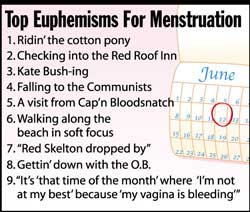 |
Left:
The Onion
"newspaper"'s (27 November 2002)
euphemisms for menstruation.
(Chart borrowed from the Onion;
I'll return it when done.)
Some are
real, some probably bogus -
those incurable joksters!
Read The Onion, a
humor site.
|
OTR The
contributor writes, "OTR is what I always
say. O=on, T=the, R=rag. A funny note: I
dated a lawyer for two years and in legal
briefs they abbreviate On The Record as
OTR, so every time he saw that it would
make him think of what I use it for and
he'd crack up. By the way, I think your
Web site is the greatest!!!! Keep up the
wonderful work!!" (December 2001). See
also Over the rainbow
Otter Season see It's time to get my wife's
oil changed;
see also OTR
Our time See
My kitty ran
away.
(October 2001)
Out of commission see N/A [not available]
(October 2001)
Out of order
"The 'terms of endearment' for the period
have cracked me up. My husband says I'm 'out
of order' and calls tampons 'rip cords,' but
after reading some of the terms, I'll have
to have some new phrases for it. CP, age 34,
from suburban Atlanta, Georgia (U.S.A.);
married, one child" (December 2005)
Out of practice
see Lailah's kicking
me
Over the rainbow "When I was in my
teens I knew a group of girls who referred
to being 'Over The Rainbow,' as the initials
O.T.R. applied to
that phrase as well as the traditional 'On The Rag.'
They used it mostly in mixed company, so
they could be at least partially discreet in
their conversation. ****, 62-year-old male,
Cambria, CA" (August 2009)
Ovulatoes see Mr. Y'know
Package of trouble (a)
Packin' dynamite
see dynamite
Pad straddling
sent by a New Yorker (January 2002)
Painful femininity
see Drainage
Painters
[as part of various phrases] "Mr. Finley,
Hi, I'm 14, a girl (obviously) and in
the Midwest. I remember that when I was in
sixth or seventh grade, there was a book
that listed a reference for periods as, 'having the painters come,
how's the painting, did the painters come,
etc.' I thought it
was really funny, because eventually
everyone, even the guys knew about it and
would tease certain girls by asking them if
the painters came. Well, thanks for you
website, it's really interesting.
Anonymous." (March 2005)
[The] painters are
here "When I was in college in
Moscow, Idaho, [U.S.A.] in the late 1970s,
my dorm-mates and I always referred to our
moontime as 'The painters are here.' Didn't
see it on your list - but forwarded a link
to your site to ALL my girlfriends, sisters,
my Mom, my Grandma. It's great!" enthused
the e-mailer. (March 2002) This expression
also appears in other English-speaking
countries (see below).
Paper see I feel blah
(September 2001)
[Paragraph sign]
"Love your site--sorry I missed the actual,
physical museum [which closed in 1998; see pictures of it].
(I'm a fellow Marylander.) I mark the
expected date of my period in my planner
with a paragraph sign, which looks sort of
like a backward 'P.' I will sometimes refer
to my 'periodic' state as 'Pirates of the
Caribbean is closed for repairs,' after my
single long-ago visit to Disneyland, in
which that ride was never open. I'm 44 and
American. [And please don't use my name!]"
(March 2005)
Passing a liver
"When asked if a friend wanted to go
swimming, she replied with, 'The Red River
is flowing.' She also laughed and said,
'The Sharks are circling.' With cramps, I've
heard the term 'passing a liver.'" (March
2005)
Paul Michael Smith
"I am originally from New Jersey and back in
high school my closest friend and I referred
to our periods as 'Paul Michael Smith is
staying at my house' when we were in front
of other people. The Paul was for 'P,' the
Michael was for 'M,' and the Smith was for
'S.' I will never forget that one."
(December 2003)
Paul Revere's ride
"The phrase 'Paul Revere's ride' is used as
a euphemism for menstruation among my
classmates at an all-girls school. This
phrase materialized from Paul Revere's
famous-yet-fictional cry of 'The British are
coming!' - and the British being 'redcoats,'
it was an obvious thing to use as a symbol,"
writes the contributor. She added, "For the
record, this MUM site is one of the most
interesting Web sites I've come across in a
long time." (August 2001)
Paulette "I
was just on your site and it is very
interesting to see how many women from
various cultures describe their periods as
'Auntie.' My best friend and I have always
used this term, but in college, one of my
floor-mates in the dorms called
it 'Paulette' as in 'Paulette showed up today'
or 'Paulette's here.'
This caught on and in our circle expanded to
'Paulette's here
throwing her luggage/ banging stuff
around, etc.' to mean 'My period's
here - with cramps.' Just thought I'd share.
Great web museum. My friends and I are
Black/African-American and that was about
ten years ago in college." (May 2007)
Pencil see I feel blah
(September 2001)
Period (one of
the most common words) "I'm very boring and
almost always use the word 'period';
occasionally I'll use 'menses' (though my
boyfriend inexplicably had never heard this
word before!) or 'menstruation,' but your
site has inspired me to try to be more
creative! I'm definitely going to make an
effort to put some of these terms into use!
I will say that my favorite expression, and
the only one that I know that isn't
represented on your list, is 'me bajo la
regla' - I saw 'me bajo' on your list and
'la regla' listed under various Latin
languages. 'Me bajo la regla' more or less
translates to 'the rule came down,' I
believe a reference to God cursing women to
menstruate as a punishment to Eve. I think
it's kind of cute and kind of funny -
there's even a patron saint of 'la regla'! I
only use it with my Spanish-speaking
friends, though. For your information, I'm
white, 30 and from the upper Midwest. Keep
up the good work!! Jenn (you can use my name
if you want) P.S. Someone had written in to
your site suggesting that 'back in the
saddle' and 'riding the cotton pony' (a
favorite of a high-school friend of mine)
are related phrases, but other than that
they both refer to menstruation, they're
really not. The former refers to archaic
saddle-esque sanitary napkin belts (has
anyone ever even seen one of those?? [Yes! Here.]) and the
other refers to tampons." (March 2003)
Periodical "At
our house, period turned to periodical
turned to 'my magazine.' Interesting how the
female minds in our family work! (And, of
course, if you stated that you 'needed
supplies' - no further discussion was
necessary.)," writes the contributor from
Iowa. (January 2002)
Periodic state
see [Paragraph sign]
Phew! "I didn't see
this one but then I may have missed it. That
is quite an impressive collection! 'Red fairy' (my
friend in England uses it). I always say 'phew' In other
words, thank whomever that I am not
pregnant. I have enough kids!" (December
2006)
[The] pip "My
grandmother and several of my aunts from
both sides of the family always called it
'The pip,' as in, 'Have you got the Pip?' I
first heard this term about 1964 when I
first started my period at age nine. Also,
when you would get a bump or pimple on your
butt, it was always called a 'Pipjenny.' I'm from
southern Virginia and 48 years old, and
haven't heard it called this anywhere else.
Must have been a regional thing." (May 2002)
Another woman reports this: see I'm being visited by my red
headed aunt (June 2007).
July 2011: "HI, I googled 'Pip'
after seeing it in mother's letters to my
father written when he was in the Navy in
WWII. I had never heard this expression and
she of course did not use it when I started
menstruating. I wasn't even sure if I had
deciphered her handwriting correctly, and as
she passed away last year at age 90, I can
no longer ask her. So, I was happy that my
google led me to your website where 'Pip' is
referenced with the notation of Southern
Virginia. My mother was from Central
Virginia (Richmond) in fact. I think it is
interesting that she used 'Pip' in the
1940's but by the 60's, she did not use it
with me so not only was it regional, but it
was of a certain era. If she had used it
with me, I would have rolled my eyeballs and
thought how uncool she was! I wonder if it
is an acronym with one of the 'p's being
'period.'" [MUM reply: I looked it up and
one meaning is as follows: (n.) One of the
conventional figures or "spots" on playing
cards, dominoes, etc. So it can be a spot - a period? This might
be the origin.]
Pirates of the
Caribbean is closed for repairs see
[Paragraph sign]
[The] pixies
have come see Having your pixies
Placebo effect
the 22-year-old Midwestern college student
who sent this writes, "This comes from the
week of birth control pills that are
placebo. When you take your placebo pills
you start your period." (May 2001)
Please make sense
"My personally coined phrase for PMS for my
wife is: 'Please Make Sense.'" (April 2003)
Plug the
22-year-old Midwestern college student who
sent this (and Placebo effect, Comma and Red
week) writes, "My mother refers to tampons
as 'plugs' and before going grocery shopping
for the week would ask if I was going to be
needing plugs that week." People in the
menstrual products industry use the words
"catamenial plug" for tampon, and that term
appears in technical literature. Of course,
"plug" is what many non-tampon users feel
tampons would do to their vaginas, which
expresses a fear reaching back centuries.
(May 2001)
Plug see Diaper
Plum pudding "PLUM PUDDING is one
my daughter and I use, just because it is so
utterly vulgar, it's funny. RIDING THE
BANANA is a phrase I use because it is
descriptive of what it feels like to be
wearing a pad. The more you think about it,
the nastier it gets. Terrific and funny
site! Thank you!" (November 2002)
[The] plumber is
stopping by today see Waterfalls
[The] plumber
is working on the leak see Waterfalls
[The] plumber
needs a break
see Waterfalls
Photons see Ammunition
Playing hockey "I was at a
hockey game a while ago, and my brother was
joking around and said of the goalie, after
stopping a puck, 'Fastest pads in the west.'
Me and my aunt started laughing, as 'pads'
can really only mean one thing to women, a
bit to my brother's confusion. Relating this
to my best friend (21, I'm 13), we now
sometimes use 'playing hockey' instead of
'on my period.' I just hope I can keep going
to actual hockey games without laughing,
now!" (October 2006)
Plumbing
"That's what my boyfriend has called my
period since 1992. If I am cranky, he asks
if I have 'plumbing problems,' and if I
mention 'plumbing issues,' he knows to steer
clear of me for a few days. He comes from a
family that has only sons, so I suppose
that's why they use the hardware metaphor.
I'm surprised I didn't notice it on your
site," writes the contributor. (February
2002)
Poorly time (a)
Potential Murder
Suspect "I'm 18 from the United
States and my friends and I always refer to
being on our period by saying I'm a
Potential Murder Suspect playing on our
irritability at the time." (September 2009)
Potty
[nonmenstrual] "I have been enthralled by
your site since midnight and it is nearly
six in the morning. I'm sure you receive
multiple e-mails each day from women (and
hopefully other men!) who appreciate your
open approach to a taboo subject, especially
from a male. I suffer from endometriosis and
it has taken my family years to accept it
due to the nature of which my family deals
with anything concerning reproductive or
sexual health, organs, function, or other.
It is strange since my grandmother was a
nurse and my mother had five females out of
her seven births. She refuses to discuss
whether she has experienced menopause and
also hid her menstruation from us. At 18, I
have yet to receive 'the talk' from her or
any form of sexual or menstrual education.
We are still waiting. When I was 11, I had
my period at my aunt's house (a nurse) who
informed me that a man could now plant his
seed in my body and impregnate me. How
confusing! I couldn't figure out if I should
be more proud of being a plant or a 'woman.'
My sisters, the oldest being 29, and I are
far more open with our cycles and sexuality
than the previous generation. Our mother
taught us that our organs, vulva, vagina, et
al were called our 'potty' (which,
incidentally, we also called our urine and
our toilet). She cannot say clinical terms
without whispering them (including breasts,
vagina, clitoris, vulva or menstruation,
period, et cetera). It amazes me that a
woman who experienced eight pregnancies
would not educate her daughters about their
own menstruation. My sister has made sure to
inform her children about the correct terms
or age-appropriate answers for their parts
or any other questions when they arise. Her
son, however, has named her breasts 'mommy's
apples' and her pubic hair 'mommy's tail.'
Since he has not asked the 'correct' terms
for these regions, she does not mind being
referred to as an apple with a tail." The
writer also contributed the words at Drainage. (October
2005)
Preparing for unborn
children see Drainage
Punctual see Fighting the Scarlet
Crusade
Punctuating,
I'm "'I'm Punctuating': My ex used
to refer to my period as my 'comma,' which
grew in to me saying to him that I was
punctuating. 'Moontime': Directly from the
Jean Auel series of books; it gives a more
positive spin on periods. 'Special, womanly
time': A different ex: his very loving way
of referring to my body. He also called my
vagina/vulva a 'sweet honey maker'" (May
2003)
Push-ups "When
my mom was in college in the 70s in
Minnesota, her roommate used the term 'push-ups' for
tampons. To me, it's reminiscent of orange
sherbet popsicles, and a diplomatic way to
make a supplies request. Love your
site." (January 2007)
Pyramid "Hello.
I have another word that I didn't see on the
menstruation list. My sister and I have
started calling it 'pyramid,' which sounds
like period, but guys can't understand it.
It actually started on a Mexico trip about 7
years ago, when my friends and i were
visiting the pyramids. A few years later it
came back to my memory, and we've been using
it ever since. ****, Tampa, Florida" (June
2008)
Question mark or
Exclamation point "Another form of
punctuation used at the end of a
sentence," e-mails the contributor. See Carrie. (October 2001)
[The] rabbit's hopping the
contributor writes, "A rather promiscuous
roommate I once had (a 29-year-old
Midwestern Caucasian) always said, 'the
rabbit's hopping' when she got hers, the
period being more reliable than a stick
test. It's the opposite to the archaic term
'the rabbit died,' which was used to
indicate pregnancy." (April 2001)
Ragdoll "'What
a bloody mess!' 'Shark bait,''Chumming the
waters,''Dying the beard red,' 'I'm a
ragdoll.' Actually a friend of mine and I
would sing the Aerosmith song 'Ragdoll,'
except we would change the words:
Ragdoll
feeling kind of moody!
Ragdoll
bleeding from my booty!
Ragdoll
never had cramps like THIS before!
Also, we worked in a large single room
office and we'd call attention to any woman
who might be on her period by loudly asking,
'Where are you going with your purse? Why
are you taking your purse to the bathroom?'"
(May 2008)
Raggin' see Bad week
Ragtime
the contributor writes, "I'm an American
woman, 44, living in Southern California
since 1976. I worked in a factory in the
late 1980s and one of the foremen, an
unpleasant middle-aged white guy, would say
'It must be ragtime' whenever a female
subordinate caused him grief. Thank God I
didn't work for him!" (February 2001)
Rdme see Nixon (October 2002)
Reapply her
lipstick/borrow lipstick see Red flag (July
2001)
Reasserting my
femininity "Hello. I had a
friend who referred to her period as
'reasserting her femininity,' which always
struck me as hilarious. I currently
live in Ohio, I'm originally from Michigan,
the person who told me this was from
Illinois, and we were both living in Texas
at the time. I'm 38 years old, and if I
could go back in time and give my
12-year-old self a hysterectomy in order to
prevent all these years of bleeding out the
hoo-ha, inconvenience, pain and mood swings,
I would do it in a heartbeat. Oh, and my
mother always just referred to it as 'that
time.' I often refer to tampons as
'corks,' or say I need to 'stick a cork in
it.'"
Received my monthly
statement see Jenny has a red dress on
Red Badge of
Courage "My
friend who is 19 calls her period the 'Red
Badge of Courage,' a reference to the
American Civil War novel that was made into
a movie in the fifties." (July 2010)
Red Bird of Bitchiness
the contributor writes, "It was first used
(so far as I know) by an ex-boyfriend of
mine in high school. One afternoon he
referred to it as the 'Red Bird of
Bitchiness' (as opposed to the Blue Bird of
Happiness). It made me laugh and I liked it
so much I stuck with it. It can be used to
announce PMS - 'The Red Bird has started
migrating' (moving south/downwards
indicating it's getting ready to leave the
body); to announce the start of a period -
'The Red Bird has landed/is nesting'; or, on
rare occasions that a period is late - 'The
Red Bird's migration is delayed.' Some of my
friends have started using this term also;
unlike me, though, they use it because in
public no one can tell what we are referring
to." The writer grew up in a liberal
household, but no one ever mentioned
menstruation. (July 2002)
[The] Red dawn has
arrived see Red
dot of doom
Red dot of doom
"I am not sure if you are still taking
nicknames for periods, but what me and my
friends called it when we were little was
"The Red Dot of Doom" or 'The Red Dawn has
Arrived.' We called it the 'Red Dot of Doom'
when we were little because we were so
terrified of getting it! As for 'The Red
Dawn has Arrived' we used that when talking
about it in school. Sincerely, ****, age 14
Ps. Love the menstrual
cup dress (lol)" (May 2008)
Red Dot Special the contributor
writes, "In middle school and high school
(in the early-to-mid 90s) my friends and I
called our periods 'Red Dot Specials' or
said "I'm on Red Dot Special," after the Stop and Shop
marketing term meaning on sale. (Stop and
Shop is an East-coast
grocery store chain who's symbol is
a big red dot).
This term came about when we noticed one day
that a product called PMS
Tea, an herbal tea for PMS relief,
was actually on Red
Dot Special at Stop and Shop! We
have referred to our periods that way ever
since." (January 2001). Another contributor,
who also contributed My
Uncle Charlie is visiting, I am WOMAN!
and Sorry, no sex,
playground's muddy, writes, "My
15-year-old daughter refers to it as 'The
red dot.'" (January
2001)
[The] red
dragon see Syching
up. Also: "I
have one that I didn't see. My good friend
who's a guy always refers to it as the
'red dragon.' Red as in blood and dragon
as in the girl's temperament at that
time." (April 2008)
Red flag "As a high-school
student," writes the contributor, "my
female friends and I would always check
each other for 'red flags,' unexpected
leaking, and so having our period became
known as having a 'red flag.' If someone
direly needed to change her tampon or
borrow a tampon from someone, she would
say she needed to 'reapply her lipstick'
or 'borrow lipstick.' Now, as a college
student, I refer to an Ani DeFranco song
called 'Blood in the Boardroom' (where she
is actually thankful to have period) and
say 'I can make life, I can make breath.'
For as long as I can remember I have have
called my period (when accompanied by
killer cramps) "my ovaries are eating my
intestines.'" (July 2001)
Red flow of
misery From
an e-mail to the Would you stop
menstruating if you could? page (November 2005)
Red letter day
"My mother and
I refer to the onset as 'red letter day.'
This I imagine was her way of marking the
calendar (for future reference) without
actually having to write something too
revealing," writes the contributor. (July
2001) See also comments about this
expression at Synching up.
RED LIGHT! "I briefly dated a
truckdriver from Atlanta, Georgia [U.S.A.].
He would come visit me in New York City
whenever he was in town and we would usually
get romantic. Well, one time he came to
visit and I had to explain to him that I was
on my period. He shot up his hand in a stop
gesture and exclaimed loudly (with his deep
southern twang) 'RED LIGHT!' From that day
on, my girlfriends and I always yell out
'RAYED LIGHT!' whenever we want to let the
other know we are on our periods. But the
term most of us used before that was simply,
'I'm bleeding.' **** (34, New York City)"
(May 2004)
Red
menace "I can't believe no one
submitted the term, 'Red Menace.' " (August
2010)
Red Moon is rising
see Closed for
business
Red red krovvy see In the house of the Moon
[The] Red River
is flowing see Passing a liver
Red Rum. Red
Rum. see Red
rose in the England section, below.
[The] Red Sea is open a minister of the
religious kind contributed this, writing,
"When I was away at college way
back in the 1960s, my girlfriend would, on
occasion, comfort my anxieties after our
once-a-month weekend visit by telling me
that the 'Red Sea is
open' during our long-distance
telephone conversations. This Biblical
reference had nothing to do with my choice
of vocations, I assure you." (April 2001)
[The] Red sled slide see Earning your red wings
[The] Red Sox
are in town "My
sister and I say that 'the Red Sox are in
town.' We have used this phrase for decades
and it works for us! Lol ["laugh out
loud"]," writes a woman from Pennsylvania
(U.S.A.). The Red Sox is a baseball team
from Boston (U.S.A.) (March 2001)
Red storm
rising see Gruesome
week
[The] red tent
see Kill the babies
Red tide
(a)
Red week from
the 22-year-old Midwestern college student
who sent "Placebo effect." (May 2001)
Red wings see Earning your red wings
[The] redcoats have
landed "When I was growing up as a
teenager in New Haven, Connecticut, during
the 1960s, a very common term was 'the
redcoats have landed' to describe the
arrival of one's period. Redcoats is a nice
pun, since it also refers to a kind of
battle! I notice that you have the
expression in the French section of your
glossery. New Haven, however, was never
characterized by an enormous French
population. I have enjoyed your Web site for
years!" Redcoats were the British troops
whom the American colonists fought in their
war for independence, and the writer lives
in one of the former American colonies.
(September 2003)
Regular
"When I was in Junior and Senior High School
in the Midwest in the late 1950s and 1960s,
our P.E. teachers would take roll at the
beginning of each class. If you were
menstruating, you answered 'regular' rather
than 'here'. That meant you didn't
have to take a shower at the end of class.
Your site is fantastic. Thanks for all
the work you have done." (May 2012)
Reign of the Thin
White Duke "'Reign of the Thin
White Duke' was a term I made up with my
high school girlfriends in suburban Maryland
in the mid-seventies. The Thin White Duke
was David Bowie's persona circa his 'Station
to Station' era and slang for a tampon. We
felt arty saying it and Bowie was good
listening on or off a period. It was
intended to be code, so I don't think any of
our guy friends knew what it meant. Love
your site!" (October 2003)
Reindeer are stomping
on the roof See Santa's bringing the
presents
Reinforcements
the contributor writes, "When I run out of
pads I say I need to get reinforcements - it
sure feels as if I'm fighting a battle. I
also remember my sister calling period 'Old
Man River' - can't you just hear that song?"
The writer referred to her husband as her
"ragtime pal."(June 2001)
Reservations
see Aunt Flo sent
someone else in her place
Riblets "I don't know if
you are still adding other names for
menstruation, but my best friend and I
always use the term Riblets. It spawned from
a Dane Cook joke about getting a call from a
girl you think you may have impregnated and
finding out she got her period. When she
does so you're so happy that you shout
'Riblets on me! Applebees!' So from then on,
she and I refer to getting our periods as
Riblets, as we take it as a sign we are not
pregnant. I am 18 and from southeast USA."
(October 2009)
Riding the banana
see Plum pudding
Riding the
cotton pony spoken by comedian
George Carlin and separately contributed by
an e-mailer in February 2002. "Bidet" also meant
pony in the French of hundreds of years ago,
for a similar reason. See a comment on the
expression under Period.
In 2004 an
e-mailer wrote, "A high school
girlfriend used to refer to a visitation of
her 'friend' as 'riding the cotton pony,'
Cheers, ****, Sunnyvale, California"
Riding the cotton
stallion see The
joy of womanhood
Riding the
cotton toboggan "Riding the cotton
toboggan is what my friends always called
it :)" (October 2004)
Riding the
crimson towel
"Hi there, My
husband coined this one as part of a
humorous haiku, and I love it! I think it's
poetic and especially apropos considering so
many women are returning to using cloth pads
as alternatives to bleached commercial
products. 'Riding the crimson towel.' I
laughed my head off the first time I heard
it, but use it all the time now! Thanks for
the great site, **** Vancouver, BC, Canada
(formerly from Seattle, where the phrase was
born) (August 2003)
Riding the cycle
Riding the rag see FHP
Riding the red ball special submitted
by an American man
Riding the red highway
see Jenny has a red
dress on
Riding the red
pony see FHP
Riding the red
tide (a) "Red tide" is also a
microbiotic affliction that kills fish and
people in the U.S.A.
Riding the white horse
"I'm 54 and my friends and I used to call it
'riding the white horse.' I see you have
'riding the cotton pony' but when we were
skinny little girls wearing the only pads
available, which were enormous and must have
been sticking out a foot or two in front and
back, we're talking horses, NOT ponies."
**** Cedar Rapids, Iowa (January 2004)
Riding the white rat
"I have no dates or origin for this
expression - it's just the one I use all the
time: 'Riding the white rat,'" mails the
contributor. (February 2002)
Rip cords see Out of order
Rocket
the contributor writes, "One word I remember
in middle and high school (mid-to-late
1980s) was the term 'rocket' being used for
a tampon." See also That
time. (April 2001)
Rosie Red "I
can't believe no one has sent in 'Rosie Red' [to Words
and expressions
about
menstruation]. In junior high [on
Long Island, New York] all the girls would
complain of a 'visit from Rosie
Red' in the locker room and it was
used to get out of gym class, often whether
'Rosie Red' was visiting or not! This was in
the late 60s, early 70s. In college, before
they recognized and acknowledged the
symptoms of PMS, I used to tell my roommate
that 'the Monster is coming.'
I didn't keep track of my cycles at all and
didn't even really make the connection until
the first articles on PMS came out -- and I
received newspaper clippings of them from
several different people saying 'Hey, this
is you!' I also like 'spending
a week at the Bates Motel' which my
sister understood immediately, both for its
reference to becoming 'Psycho' and the
implication of blood everywhere." (May 2006)
Rusty beaver "I
didn't see 'rusty beaver' in your list. A
trucker's term." [Beaver is an American
synonym for a woman's genitals.] (July 2005)
St. Menses see It's the blood of St.
Menses
Sally "Hello!! Just stumbled
... on your website, after being curious
about the history of Feminine Hygiene
Products. I'm a 48yr old female, who
decides to look this up after never
hearing of the Cup. 3/4 of my life I
have referred to my 'period' as: SALLY.
Robert Palmer did a song called
'Sneaking Sally through the alley' and
because I see the letter 'S' in red, I
thought it was a perfect match. (Seeing
letters & numbers in certain colors
like: D & 5 are brown, I &
J are yellow, etc.. is something off
subject for MUM, but solidified the 'S'
for my period's name). Anyway, there you
have it: Sally. Regards, *****"
(December 2012)
Sambo Adams "When I was in
5th grade, we referred to periods as Sambo
Adams. I don't know who thought this up or
why." (June 2008)
Sandbag see Due for the sweatlodge
Sanitary
comfort the name used for sanitary
napkin in the February 1907 issue of
Pictorial Review. Read more. (August 2002)
Sanitary napkin rings see Girl stuff
Santa Claus
"I'm from Ohio and when I was in junior high
in the early 70's, my friends referred to it
as 'Santa Claus' (is coming to town, and the
obvious red and white aspect)." (January
2003)
Santa's bringing the
presents "A girl friend of mine and
I call it the time when 'Santa's bringing
the presents.' She also jokingly said once
that cramps occur when the 'reindeer are
stomping on the roof,'" writes the
contributor. (July 2002)
Satan's little cotton
fingers see I'm
on auto-drip
[The] Scarlet 7
"I am 30 and I live in the southern United
States. I had a boyfriend once who called it
'The Scarlet 7.'" (September 2002)
Scarlet Fever
"Upon reading your site I came across names
for menstruation. One I didn't notice was
'Scarlet Fever,' a joke between me and a
friend based on an old old show about
medieval warriors. Upon finding out the only
female character was on her monthly, the
main character asked her 'Are you crazy?
Fighting while you have Scarlet fever?!' it
was a very interesting play on words,
considering for the time the show was done
in people thought of periods as a disease or
an illness or a wound. I find it to be a fun
little phrase that causes a lot of confusion
to people who think you're referring to the
actual illness and not the monthly gift.
Lindsey, USA" (August 2012)
Scarlet Onslaught see
Fighting the Scarlet
Crusade
Scheduled "I read about a
woman who said she was 'scheduled' in a few
days. I am presuming that's what it refers
to." (June 2002)
Scott "In high
school, when we were having our period we
would say, 'Scott's visiting.' At
the time, a slang term for your period was
being 'on the rag.' As our town in
Missouri was known for the Scott Joplin Rag
Time Festival, it was only natural that the
term 'the rag' was associated with Scott
Joplin. Ha! The funniest story was
when our girls basketball team was traveling
and everyone was talking about being visited
by 'Scott.' The male coach declared, 'I'd
like to meet this guy Scott . . . he sure
gets around!' We giggled
about our bewildered coach the rest of
the trip! From U.S.A." (November 2005)
Scourge of Eve
"Hello, Being a theologically minded person,
the term I generally use to refer to 'that
time of the month' is the 'scourge of Eve';
i.e. 'I feel awful, the scourge of Eve is
upon me.' It is, I think, fairly discreet
and general enough that it won't offend or
frighten my (likewise-theologically minded)
guy friends; some of them, I think, use it
without knowing what it means. Then I laugh
at them. But those who use it understanding
what it means don't seem to have a problem
using it. Also I've noticed that it seems to
be tabooish among Americans for young men to
say 'Pre-Menstrual Syndrome,' but 'PMS' is
perfectly acceptable. There does not seem to
be this taboo with my friends (male and
female) in the UK at least. Thanks, ****, an
American (please don't list my name)" (April
2005)
Seat belts see
Driving in a red car
Self-cleaning "At the tail end of my
period, when there is no longer much
blood, but you still need a lightday
[pad], I call it 'self-cleaning,' like the
cycle on an oven. It gets all the gunk out
and then I'm nice and clean again!"
(September 2001)
[The] server is
down "It
Was Inevitable: My sister Lisa, who is a
webmeistress and extreme geek (which also
applies to me) living in Portland, Oregon
(U.S.) (I live in Michigan) began using the
phrase 'the server is down' a few years ago
to describe menstruation. This affords her a
way to nerdily but discreetly inform her
husband of her status. Now that I am dating
a programmer myself, I have been compelled
to started using the phrase, too." (May
2004)
Serviette
Common 19th-early 20th century name for
menstrual pads, from the French for napkin.
See here, for
eample.
Shark week "In 2003 I heard
this on the radio in the U.S. a radio show
was asking callers for amusing terms for
menstruation, and a male caller said this
was what he and his wife always called it.
The origin: he and his wife were watching
'Shark Week' on the Discovery Channel,
fascinated as scientists used bloody meat to
attract various kinds of shark. During a
commercial break his wife used the restroom,
and forgot to flush her used tampon. He then
saw it, was reminded of the chub used to
attract sharks, and asked her what species
of shark she was hoping to attract. I don't
know if anyone else uses this term, but I do
now." (January 2004) A later e-mailer
writes, "My favorite expression for
menstruation is Shark Week. Blood in
the water. I first heard it on a
livejournal community called tmi_chix.
http://community.livejournal.com/tmi_chix/profile
I know it comes from Discovery channel
http://en.wikipedia.org/wiki/Shark_Week but
I don't know who first coined it for use as
an euphemism for menstruation. I do
like it better than Aunt Flo, or surfing the
crimson wave, or any of the others I've
heard or used in the past. It more
accurately describes how vicious an attack
of menses can be for some women. :)"
(November 2006)
[The] Sharks are
circling see Passing
a liver
She has her
red-headed stepsister "I grew up in the southern
part of the U.S.A. and the terms I heard
regarding women's periods are: "She is on
the rag" or "She has her red-headed
stepsister." (October 2006)
Sheep "About 20 years
ago, after hearing the joke about what
elephants use for tampons (sheep) [it's
somewhere deep on this
page], my husband and I began calling
tampons sheep. This
led to using the word 'sheepish'
for having my period. When my husband made
me a cute little wooden box [see a Swedish tampon box]
to store my tampons in, he glued a small
ceramic sheep to the top for a handle, and
we call this the sheep box. These days it
holds Q-tips (cotton swabs) which fit
perfectly. We still call it the sheep box
which one may think very strange unless you
know the history and the joke! If you are
asking for demographics, I'm 48 from the
northeastern U.S." (July 2007)
Shoots "Our bar
screens are littered with 'shoots' as the
boys call the tampon applicators, not to
mention pads and wrappers that get flushed."
From a mail to Would
you stop menstruating if you could? in
October 2009.
Sick at each month (see
usage in an American patent
medicine booklet from the decade
before 1920)
Signor Rossi
"From an Italian-American girl in
Indianapolis, Indiana: 'Signor Rossi --
Italian for 'Mister
Red'" (January 2011)
Slinging the buckskin
"Love your site and I plan to recommend it
to my 18-year-old daughter. I found a link
at the TECH-TV show UNSCREWED site! I am an
over-fifty, white, Southern American male. I
think I was told of this expression for
menstruation by a close male friend who is a
native American Winnebago Indian. I am not
positive where I got it from; it was at
least twenty years ago. Because of the
material used by the Indian women, their
monthlies became know as 'slinging the
buckskin.' Hope you can use it. Keep up the
good work." (July 2003)
Sluicing See Clyde, above.
(April 2001)
Smoking a White Owl
see Having your
pixies
Soldiers see Dropping an egg
Someone is
scraping a melon baller across the walls
of my uterus see Synching up
Somebody's
visiting (a)
Sorry, I'm taking
Carrie to the prom see The banks of the Nile are
overflowing and running red
Sorry, no kitty
for you see I'm gushin'
Sorry, no sex,
playground's muddy "Back in the early
1970s, when my sister had first married and
I was in high school, I heard my sister
refer to 'sorry, no sex, playground's
muddy,' which I thought was pretty funny and
descriptive!" writes the contributor who
also sent in My Uncle
Charlie is visiting, I am WOMAN! and The red dot. (January 2001)
Special,
womanly time see Punctuating, I'm
Spending a week
at the Bates Motel see Rosie Red
Splooge see Mookie time
Stemming the
cotton pony "My
friend says his GF [girlfriend] is 'stemming
the cotton pony.' Stemming is vulgar for
intercourse and is a variation of 'riding
the cotton pony' that emphasizes insertion.
It's a Connecticut [state in the U.S.A.]
thing," writes the contributor. (August
2002)
Stick a cork in it
see Reasserting my
femininity
[The, My] storm
is coming [has arrived] "Hello, I
was suprised not to see this one: My
supervisor and I like to say 'The storm is
coming' or 'The storm has arrived.' Or
sometimes to be more specific I'll say 'My
storm is coming.' Thanks for the site, it's
really cool." (August 2003)
Strings attached "This refers to
the little string that hangs down from a
tampon, but also to the fact that it's not a
good time for intercourse, as in 'not
tonight, I've got strings attached,'"
e-mails the contributor. (July 2002)
Stuck pig see Girl stuff
Stupid Bob
"My friends and I call it 'Stupid Bob.' It
began among those of us who were pro
wrestling fans. One of them really hated a
certain wrestler, whose name was Bob, and
said that the only thing stupider and more
annoying than him was your period. The name
stuck, and has spread to friends of mine who
aren't fans of wrestling." (July 2004)
Supplies see Closed for maintenance
Surfboard
see That time
Surfing see the Australian entry
for the word
Suffering from
the hairy hatchet wound "Well, this is an
expression that I don't care for, but in the
name of research submit: 'suffering from the
hairy hatchet wound.' I grew up an Army brat
and don't remember where I heard it." (March
2003)
Supplies see Cigar
Surfing the
crimson wave used mainly by
American teenage and college-aged females,
says the contributor. Also used in the
American movie "Clueless."
Surfing the crimson
tide see the entry right above.
Also, the University of Alabama football
team adopted the nickname "crimson tide,"
maybe to scare its opponents.
Sweet honey maker
see Punctuating, I'm
Swimming up red
river see That
time
Synching up
"With reference to the way women in close
contact can have their menstrual cycles
synchronize, one's period was always
referred to as 'synching up' or 'being in
synch' on my middle- and high-school
athletic teams. After two or so months of
playing together we'd all be getting our
periods at exactly the same time. If the
coach wanted to know why we were playing
sluggishly that day, we'd say, 'Oh, we're in
synch today,' and everything would be
understood. I've heard other female athletes
use this term as well. I also once knew a
pair of roommates who referred to their
period as 'the red dragon.' I don't know if
they made this up or if it was a reference
to something, but I always rather liked the
connotations of power and mystique. And it's
not quite about menstruation, but by far the
most descriptive phrase for menstrual cramps
I ever heard was, 'Someone is scraping a
melon baller across the walls of my uterus.'
If you've ever had cramps and ever made a
fruit salad, you know *exactly* what this
means. All of these phrases come from New
England, where I'm a 19-year-old female
college student. This is a Web site we were
directed to visit by our professor for a
class in human sexuality [meaning this MUM
site]. It's marvelous! P.S. Regarding the
entry for the euphemism 'red-letter day,'
you might want to add that that's a pun on
the expression 'red-letter day' meaning a
day of great significance or celebration, I
think from the fact that biblical holy days
used to be marked with red ink instead of
black on standard calendars. Not everyone on
my hall was familiar with the phrase. :o)"
(January 2003)
Tail see I
have a mouse in
Taking classes
at 'Bama "Referring to the
University of Alabama and its mascot, the
crimson tide." (May 2004)
Tammy time
"Tammy Time - referring to tampons,
obviously. USA, Atlanta, Georgia" June 2007
Tamp-in See Man-hole cover
(February 2002)
Tampax Many
American women call any tampon Tampax.
Tampax might have have been the first commercial
menstrual tampon and was the biggest
seller for most of its history.
Tampon an
American genealogy researcher e-mailed me in
September, 2006, sent scans of early
American tampons and wrote this: "The
earliest use of the word tampon in
historical newspapers that I can find is
dozens from 1917 -1918 referring to churches
and other groups making bandages for the war
and one type of bandage is tampons [for
inserting into wounds]. Another reference in
Lima, Ohio, 1922, refers to putting tampons
into your nose for a cold and then burning
them because it is more sanitary than
handkerchiefs. In The Chronicle Telegram,
Elyria, Ohio, October 15, 1925, there's an
article about the death of a child that
refers to her nose bleeding and the doctor
saying the tampon in her nose needed to be
changed often. Throughout the 1920s there
are references to tampons used in the nose
along with medication put on the tampon
first to cure the common cold. A 1932
Illinois article praising the benefits of
gelatin to stop hemorrhages recommended
compresses or tampons dipped in gelatin and
applied to the bleeding areas. A 1935 Ohio
article refers to douching and using
medicated tampons to deal with infection
caused by childbirth, the first reference
indicating use in the vagina (though not
using the word) in a public paper. After
satisfying myself that the public used and
knew the word tampon, I then searched for
the earliest ads I could find for tampons in
newspapers (before 1940 only) and those
newspaper images are attached. The earliest
I could find was 1935 Fibs,
and then August 1936, TUX
followed by Oct. 1936 Tampax. I realize that
doesn't prove which was first but thought it
could be helpful in dating, plus I found the
TUX brand that you haven't mentioned on the
Web site that was very early. I also
included ads for B-ettes,
fax,
and Wix." See also
the definition
from a 1900 nurses' dictionary in the U.K.
Tampoon "My
very liberated father has always refered to
my mother's or my menstrual products as
'tampoons' which is a hybrid of tampon and
harpoon. At twelve this mortified me."
(November 2002)
Tears of a
disappointed uterus "The great
Canadian-American physician Sir William
Osler (1849-1919) once referred to the
menstrual flow as '... the tears of a
disappointed uterus.' I guess the
sole purpose of a uterus is to produce a
full term baby, and menstruation shows a
failure to make her goal.
(http://education.vetmed.vt.edu/Curriculum/VM8054/Labs/Lab28/NOTES/OSLER.HTM)"
(May
2007)
[The] Tectonic plates
shifted "My name is *** and Im 17,
and my term comes from a little incident
that happened to me my junior year of high
school. I was in class and on my period. I
went to the bathroom to change my pad and I
discovered that I the pad had moved a bit
and blood was all over my panties and on my
pants. My mother picked me up of course and
grinning at me said, 'So, the tectonic
plates shifted, ay?' Ever since then, that's
what we have used to address our periods."
(January 2003)
Temporarily out of
service "I've generally referred to
it as 'temporarily out of service.' In 'The
Muppet Movie' Fozzie and Kermit fall asleep
in the church where the Electric Mayhem are
practicing, and Dr. Teeth says, 'It looks
like the bear and the frog are temporarily
out of service,'" writes the contributor.
(September 2002)
Terms see Courses
Tetherball "My
friends and I say 'tetherball.' One of my
friends started this when she had terrible
cramps and complained that it felt like
someone was playing tetherball with her
uterus. It stuck, and now we have developed
a complex code language. 'Someone is playing
tetherball with me' means that you have
cramps. 'I'm playing tetherball' means that
you're on your period. 'A tetherball' means
a pad and 'a tetherball with a string'means
a tampon, officially, but we all use tampons
so we just say 'a tetherball' to mean
tampon. It works perfectly and the guys have
no idea what we're talking about! One of my
friends and I get our periods at the same
time, so we say that 'we play tetherball
together.' We're 8th graders (age range
13-15) and I found this website while I was
looking up period euphemisms to send to my
friends. *Please don't use my email address
or name! Thank you!* (February 2009)
Thank God "In
college, we used to call it our 'Thank God,'
as in 'Thank God, I got my period.' At the
time we weren't the best about keeping up
with our birth control, so the only way we
knew we weren't pregnant was when we got our
period. You could hear us in the bathroom
saying 'Thank God.' Eventually we shortened
it to 'I got my Thank God.'" (July 2002)
Thank god/the gods!
The pills/condoms/diaphragm/etc. worked
[again]! see Moon's blood
That day Part of the title of the
Kotex booklet "That day is here again
. . . ," 1944.
The first day
of "I hate men week." "For me, the
first day is always 'the first day of 'I
hate men week.'" The first day is always
pain and it's just unfair that they don't
have anything similar to go through." (May
2006)
That fun time of the
month ironically, from a DepoProvera
user, which stops most periods
That line is busy.
Please try again later See I'm not pregnant (February 2002)
That thing a Brazilian woman
e-mailing me in English called it this;
she did not like menstruating and had
stopped it with birth-control pills.
(January 2003)
That thing with
the lady parts
see Moon's blood
That time "Hey there! I am a
woman living in Southern California, and I
didn't see a common phrase that I use with
my husband when it is 'That time.' If he is
thinking about gettin 'frisky,' I just tell
him, 'Well, you'll be swimming up red river
if you do,' and he gets the message loud and
clear. I remember my friends in school also
calling tampons 'rockets' and pads
'surfboards.' Your site is a real kick!
Thanks for the laughs!" (July 2003) Another
woman writes in April 2005 that she too uses
this; see Reasserting
my femininity. And the contributor of Rosie Red used it in her e-mail
contribution to Would you stop menstruating if you could? in May 2006.
That time of
the month the American weekly
magazine Science News used an abbreviated
version of this in a headline for an article
about heart attacks occurring more often in
the low-estrogen phase of the menstrual
cycle: "It's that time . . . for heart
attacks?" (December 2, 2000; Vol. 158, p.
366) See also It's
that time of the month.
The lady parts problem see Moon's blood
The red flag is up (a)
The flowers a
term going back hundreds of years,
apparently originally a brewing term; it's
used also in German; see below
The misery (a)
The moon (a)
The nuisance (a)
The pink elephants
have come "I enjoy your site very
much, and appreciate how you have treated
this very serious subject with an
appropriate mixture of science and humor
that combine well. I was reading the page
about euphemisms for menstruation, and have
one that does not appear on your list. When
I was in high school in the late 1980s, my
friend and I (both of whom suffered from
severe cramps, sometimes so bad that we
would have to go home) described those days
as 'the pink elephants have come' since we
felt like they were stomping on our
midsections. On especially bad days, the
pink elephants would be joined by little men
carrying red flags. I haven't used these
expressions since high school, but some of
the things on your page brought back those
memories. If you're collecting the data, I'm
writing from South Florida, and am 31 years
old. Thank you for a wonderful site, and
please give the museum cats some scratching
on the neck from me." (March 2003)
The reds are in
(a)
The plague (a)
The red-letter day
The reds (a)
The topiary garden's
flooded the 29-year-old white
Midwesterner writes, "Topiary garden being a
satirical name from my college years in
response to all the trimming, shaping, and
waxing done on a Friday evening before going
to the bar. I think the flooded part is
self-explanatory." (April 2001)
The visitations
(a)
The wound of Eve that
never heals "I was reading a book
where they called it 'The wound of Eve that
never heals.' I thought that was a cute
description, although not extremely
discreet," writes the contributor. (January
2002)
There are strings
attached see I'm
suffocating little white mice
There's a red
tide in Clam Harbour see The banks of the Nile are
overflowing and running red
There's a
volcano in the cradle of civilization
see The banks of the
Nile are overflowing and running red
There's a war
in Virginia submitted by a college
student in the Midwest as used by a friend.
(April 2002)
There's blood on the
saddle see The
banks of the Nile are overflowing and
running red
Those see Courses
Those days in the text of an ad for
Exquisite Form Double Feature Garter belt
(21 February 1955 - here). Also in Growing Up and Liking
It (1949)
(The) Tide "I still bleed for 7-8
days and that first day is always the Tide
but as long as I have it I will love it and
cherish it." From a letter to "Would you stop
menstruating if you could?" (November
2002)
[The] tide has rolled
in see Devil
days
Tide's in (a)
Tide's out (a)
Time to ram a tam
"When I was in college in New Jersey nearly
40 years ago I had a girl friend who
belonged to a sorority. Many of the girls
used the expression 'time to ram a tam' to
denote when it was time to either insert a
tampon because they just got their period or
because they'd had their period for a time
and it was time to change their tampon."
(November 2004)
Took, tooking
"My friend Becky and I call tampons 'tooks.'
She and her cousin made that term up just so
they could have a secret term to refer them
by. If I'm ragging it I'll ask her if I can
have a took, and vice versa. So we now call
being on our periods 'tooking.' Sometimes we
just say 'I started' or we'll ask if the
other has started, or we'll ask if the other
needs a took. We're both in college, btw [by
the way]." (April 2003)
Tool time see Dropping an egg
Tom "Me
and my friends (boys and girls) say 'Tom' -
like the name Tom. Meaning 'Time of Month.'
It's cool cuz the boys know what were
talkin' about. Age 16, Boston, Mass." (May
2002)
Too much sauce on the
fish taco "My friend came up with
this years ago, and it's totally gross, but
I think it's accurate as well." (January
2003)
Too wet to plow
(a)
Torpedoes "I
came across your Web site and find it very
informative and amazing! My husband likes to
refer to tampons as torpedos. I didn't see
that one listed so I thought I was share.
**** age 29, Georgia" (September 2004)
[My] transmission leak
"My boyfriend and I called it
'MyÝtransmission leak' cause he was a
mechanic and tranny fluid is red :) Ý Bec"
(February 2011)
Trolling for vampires
"My sister heard this used by a male radio
talk show host. We've been using it since,
sometimes just saying 'trolling' (around
people who know what we're talking about)."
(January 2003)
[A] Trying physical
condition Words in an ad for Hickory
menstrual pad belts, 1926 (December 2010)
Tying on the rag
"My mother from Philadelphia used the phrase
explaining that rags
were placed in panties before pads were
invented." (October 2010)
Ugly sister "My Husband calls my
period 'Ugly Sister.' And Tampons/pads are
called her 'Baggage or luggage.' Referring
to how ugly my mood gets during that time.
Calling my mood the ugly side of me. He
says, 'Is your Ugly Sister Here?' or when it
has been 5-6 days he will say, 'Hasn't your
Ugly Sister left yet?' Or 'When is your Ugly
Sister going to leave? I want my wife back!'
When I need supplies I say, 'I'm Going to
pick up sissy's baggage/luggage at the
airport.' Or I will ask my Daughter if I
need to go to the airport to pick up any
'Luggage' for her. I now use these terms
with my 11 yr old daughter when we are
around other people and need to talk in
code. Love your site it is fun to look at
all the diff names we call it. I am 38 and
live in Portland Oregon." (October 2009)
Unable to swim
see Cup week
Uncle Bloody
"Used by my friends and me in Michigan. Most
people who speak English get the point of
this one since aunt
seems to be a common term in menstruation
talk anyway," writes the contributor of Girls' time.
(August 2001)
Uncle Red see Cousin Cramps
Under the
weather (a)
Unwanted guest
"Now I know some scientific people are going
to say menstruation is important for the
female body, but hey, if it's a pain every
month for the 'unwanted guest' to arrive
then what's the point?" From a letter to "Would you stop
menstruating if you could?" on this
site. (November 2002)
Unwell, being
the contributor e-mailed (September 2000),
"When I was a teenager in Queens, New York,
in the 1960s, we sometimes referred to
having a period (menstruating) as 'being
unwell.' "We" were mostly white,
working-class girls going to a public
school.' " [Germans say something similar:
"unwohl sein."] And
also in the Kotex booklet for girls "As
one Girl to Another"
(1943).
Uterine Jihad "It's a euphemism for
menstruation, particularly one with bad
cramps. I don't know the origin, but I've
seen if floating around a few message boards
for a couple of years now." (October 2008)
Visit from the
Cardinal (from the woman who
submitted "closed for maintenance," above)
(November 2000)
Visit of the French
lady, the the e-mailer who
contributed this (November 2000) wrote, "I
read an interesting chapter in the book Aristocrats by
Stella Tilyard; it seems to fit with your
information about women in the past having
less periods. They had a wonderful euphemism
for it: "the visit of the French lady."
[A] volcano in my
uterus see My
uterus is on fire
Walking along
the beach in soft focus "Just a
contribution from my neck of the woods. An
ex-girlfriend of mine used to refer to it as
'Walking along the beach in soft focus.'
This, I believe, is an allusion to the ads
for all hygiene products that show a woman
running through a field, or across a beach,
in a flowing white dress, and generally
looking as little like a woman in the depths
of deep muscle cramping as possible." See
also this entry under Onion,
above. (May 2004)
[The] walls of my
uterus are shedding and it hurts "My
friend Heather and I used to work at a
retirement home and whenever we would have
our period we would walk up to each other
and say, 'Hi. My name is Heather and the
walls of my uterus are shedding and it
hurts,' writes the contributor. (August
2002)
Water of life
see In the house of
the Moon
Waterfalls "When I was in
middle school we called it 'waterfalls' or
'chasing waterfalls' or 'human waterfall.'
It was also during the same time TLC
released their song 'Waterfalls' so I think
that's how it started. Now that I am in
college, I tend to say terms associated with
a leaky faucet such as 'the plumber is
stopping by today.' As my period decreases
in flow it's called a 'leaky faucet' and
then a 'drippy faucet.' When I use a tampon
I say 'the plumber is working on the leak,'
so when I have to change my tampon I say
'the plumber needs a break.'" (May 2003)
[The] week of the
devil see Devil
Days
Weeping womb
(a)
We don't know who our
fourth roommate is "I am in college
and moving into an apartment with two other
girls, and we'll have a random roommate for
our fourth as we must have four. Two of my
roommates were always worried they was
pregnant, and we joked about how our fourth
room would have to be a baby room with the
roommate being one of their babies. While
having lunch with many adults who didn't
know she was having sex, one of my roomies
subtlely laid down our fears and showed her
excitement at having her period by
mentioning that we didn't know who the
fourth roommate was going to be after all."
Norman, Oklahoma, U.S.A. (April 2004)
Welcome mat see
Aunt Flo sent someone
else in her place
Well, your
little plan failed this month see I'm rejoicing in my
womanhood
Wing-Wang "If you are still
accepting submissions for menstruating
euphemisms (!), I usually say that I'm on my
'wing-wang.' It's just pure silliness other
than the fact that it is a twist on the way
men name their penises. It throws people
off; know one knows what I'm talking about
until I explain, and I love it because no
one else says it. Now my sisters and friends
know exactly what I'm talking about when I
say this. **** Oakland, CA" (August 2010)
With Moses
"Back in high school, in my Christian Youth
Group, the girls made up a Biblical
reference to their periods. They would refer
to a girl in menses as being 'with Moses.'
Obviously, they did this so us guys wouldn't
overhear them talking about personal
matters. But one day I inadvertently cracked
the code. I was sitting around talking with
two female friends, and one said to the
other, 'I'm with Moses now and it's such a
pain,' to which I innocently replied, 'I
don't get it. What's so painful about
parting the Red Sea?' The RED Sea. I
immediately realized what they were talking
about, and they made me swear never to tell
any of the other guys in our youth group
what their code meant. I guess the secret is
out now. -M-, 27, Las Vegas, Nevada."
(October 2002)
White cylinder week
(a)
White undies are out
this time of month see I'm on auto-drip
Why Sally can't
swim "It
refers to the filmstrip that the 6th grade
girls had to watch in the cafeteria. The
nurse covered the windows with newspaper so
the boys couldn't look in. We had to bring
our mothers. The nurse showed a filmstrip
that showed all the kids in the pool, except
for Sally - she had her period. Then they
passed around sanitary napkins and the
horrible belts. Our moms had to show us how
to use them. All I could think of was how
some day I wouldn't be able to swim and that
was really bad because I had a pool in my
backyard." (March 2004)
Woman things see
Bad week
Womenstruation
see Bleeding out my
vagina
World War III "World
War III [WW III] MY New boyfriend was used
to having sex while a female was on her
period, and i was not. He was initiating
having sex and i was trying to think of a
way to tell him i was on my period.
Eventually i JUST told him and he said SO...
it was the heaviest day of my flow so i
blurted out 'if we have sex it's gonna look
like World War III.' That eventually became
our code word. Ex: do u really want to
witness WW III? IT'S LOOKIN LIKE WW III DOWN
THERE! FEMALE. 22. AMERICA" (June 2010)
Would you look at the
calendar? see Kill the babies
Wounded "You left out 'wounded.' It is
decidedly American. Cheers," (January 2007)
Wrong time of the
month
[Well,] your little plan failed this month
see I'm rejoicing in
my womanhood
You're not a dad
a woman born in
South Dakota and now living in San
Francisco tells this to her husband when
she has her period. She said her sister says
Grandma's here. (told to me in person
March 2015)
Your vagina is
emo! "A male friend of mine and I
were chatting online about my love life. It
had been a long time since I had had sex at
that point, and I mentioned that I was on my
period. My friend exclaimed, 'Your vagina is emo! It's
so desperate for attention, it's bleeding!'
In our generation, the term 'emo' usually
stands for 'emotional' and is often
(stereotypically) used when describing those
who seek attention; one method to seek
attention is to cut one's wrists (though
there are cutters who do it and are not
trying to seek attention as well). So, in
his mind, my girly parts wanted attention so
badly that they resorted to bleeding to seek
attention. I still like to use this term
often, since most people haven't heard it
from other sources. I don't think it has
caught on, but it's a catchy phrase for
today's youth! By the way, I'm 22 right now,
but I got my first period when I was 10. I
found the museum's page through a link in a
flickr group about menstruation. And yes, my
vagina is emo as we speak, hehe. Thanks so
much, **** (February 2009)
Latino
American
En periodo see Jenny has a red dress on
Is it messy? "As a woman who
studies female sexuality in relation to the
Roman Catholic Church and Mexican-American
women I just loved your site. I thought I
would submit another 'word or expression'
that I didn't see mentioned. Whenever my
boyfriend and I get frisky and it's that
time of the month we generally ask/say 'Is
it messy?' 'It's going to be messy.'" (See
also the listings under America, above)
(November 2004)
It's going to be messy
see Is it messy?
An
e-mail follows (July 2005) with dozens -
hundreds? - of American expressions. It'll
take a while to put them in the regular
section - I started to! - but I didn't
want to deprive you now of the experience.
I had my first period at ten. I'm
fifty now; do the math. At this point,
the euphemisms have their own
euphemisms. Both friends and family
were well-read and fond of puns and word
play. I also went to an all-girl school
for three years. Our ability to share
freely was equaled by our fear of talking
about the subject in front of males.
I'll try not to repeat what is already on
the site (It's marvelous, by the way!).
My mom used to buy the super pads. It
was like walking with the Sunday edition of
the New York Times between your legs, so we
called them the NY Times or the Sunday
Edition. We asked her to buy the
Detroit or local daily instead. We
would describe the flow by what section we
needed. Business section meant
ordinary, funnies meant an unusual period,
and Parade (a very small section) meant a
panty liner. Tampons became the
special advertising insert. PMS was
getting ready to do the NY Times
crossword. This led to headlines for
the section; most of these were references
to other terms you have already included.
Ragtime music got a similar treatment in
that it started out as just that phrase but
became more varied and less direct.
Mom knew more of the musicians and writers,
so we just guessed when she mentioned
someone new. I still think of Modess
and Midol sometimes when Scott Joplin's name
comes up in conversation.
The Canadian flag is white with a large red
maple leaf. This lead to: saluting the
Canadian flag, defecting to Canada, crossing
the bridge into Canada, taking the tunnel to
Windsor (from Detroit, Michigan, USA), it's
hockey night in Canada (This expression is
similar to the US pre-game question, 'Are
you ready for some football?')
Washing machines have cycles, so there is a
set of descriptions involving rinse and
spin. This leads to agitation
settings. 'I was hoping for a light
load on gentle but got jeans on heavy
duty.' I think WC Fields referred to
it when he described a woman who should be
forgiven because her washing machine was
broken.
Songs you could sing or hum were good for
code: Red Sails in the Sunset, Here Comes
Peter Cottontail, The Bunny Hop, Walk Like
an Egyptian, The House of the Rising Sun
(Japanese flag), Maple Leaf Rag, O Canada!
(Red maple leaf on white flag), The Red, Red
Robin Goes Bob Bob Bobbing Along, Remember
the Red River Valley.
Offensive to our Jewish friends. No
Jews allowed (well, some Jewish guys still
did). Won't be having the Rabbi over
for dinner tonight. Not Kosher.
Not Kosher for Passover (Also draws in the
image of lamb's blood on the door frames).
Because there would be no need for a rabbit
test: The bunny lived! Another
rabbit's life is spared! Peter Rabbit
is hopping. Br'er Rabbit's is laughing
again. Hopping down the bunny
trail. Here come Flopsy and Mopsy.
It's not Easter but the rabbit's
celebrating anyway.
Not pregnant: Don't need to rewrite the
will this week. Came dangerously close
to the gene pool but am currently toweling
off. The pediatricians are getting
worried about losing future customers, so
Dr. Blank is busy drawing Binky, learning
more about the dynamic opportunities in the
heating and cooling industry, taking in a
boarder, etc.
Different brands' slogans, commercial copy,
pseudotext from instructional pamphlets,
etc: I'm even absorbing the worry (Rely),
Because, millions of women have and you can,
too, doing all of the things I can do the
rest of the month, enjoying favorite
activities like tennis and swimming
without worry! Because an egg did not
become fertilized and implant itself, I am
experiencing a normal shedding of the
uterine lining.
Wearing or reading The Red Badge of
Courage.
She's not colorfast this week. Once
at the beach, my friend's 'friend' came
early and caught her unprepared. She
didn't have her own car with her to go to
the store. I showed her where we kept
the stash and told her to use what she
needed. The next day we went out on
the lake in small, inflatable rafts.
She had a brand-new red hooded sweatshirt
tied around her waist. As we were
getting into the raft, she leaned over and
dipped part of the shirt into the
lake. The dye from the material ran
bright red against the yellow raft. In
an offended hostess voice, I reminded her
that, as a guest, she was welcome to use
whatever she needed. We were still
trying to push off from the beach while both
curled up in the fetal position
laughing. That made our butts drag on
the sand so we had even less chance of
getting the raft launched. Waves came
over the side and the raft filled higher and
higher with reddish pink water. The
guys paddled back to help us and see what we
were laughing about. I think they
figured it out.
Bad clam season: red tides were supposed to
make seafood poisonous.
My car's stalled at a red light means a
longer than normal period.
Making pink lemonade (blood and urine
mixed).
Visiting the red planet. Off to Mars.
Any conversation including the words light,
regular, and super means you need a
tampon. 'It would be super if you
could turn on the light for me just the
regular ones.' 'Could Superman see in
regular light?'
At some offices, the employer thoughtfully
provides a free supply. Thus, women
refer to 'certain paper products only
available in the ladies room.' One of
my office mates was already in the stall
when she discovered a need. She made a
noise that I recognized and I asked her if
she needed me to hand her something.
Through the crack in the door she saw me
reach for a tampon, and said, 'No, the
little square box.' Months later she
had occasion to tell me she was having
cramps and referred to the incident.
'I'm using what's in those little square
boxes.' Of course, when the jerk from
accounting approaches, a wise woman mentions
tampons by name, directly, and loud enough
for him to hear while he has time to turn
and run.
Screamed loudly into dorm hallway, 'I need
SERIOUS DRUGS and a HEATING PAD!'
Synchronizing up was common in the dorm so
PMS hit the floor like a tornado
sometimes. It coincided with midterms
once, and a floor mate dismissed a loud
fight between two roommates as, 'They'll be
friends again by next week. They're
fighting over the heating pad.'
Disposal issues fall under the term girl
garbage. As in, 'Where do you put your
girl garbage?'
Shopping for enzymatic laundry soap.
I have special girl stuff to do. This
means 'No, I can't wait until the next rest
stop.'
Fish and then restock the pond means
changing a tampon.
Based on jokes:
I'm missing (only wearing) one sock.
[How can you tell a Whatever woman at the
beach? She's wearing white
socks. How can you tell if she's
having her period? She's only wearing
one sock. What kills Whatever
women? Toxic Sock Syndrome. ]
Egyptian Flu Shot. The Egyptian Flu
makes you a mummy. I don't remember
calling it the Egyptian Flow but that makes
sense now. We did add Walk Like an
Egyptian to the song list, though.
Typewriter's fixed. You think your
typewriter's pregnant because it skipped a
period.
I was surprised that more terms involving
mouse mattresses were not listed.
Keeping the mouse up nights, making the
mouse sleep on the floor or the couch, being
a mouseketeer, Mickey Mouse gestures,
etc. Heavy periods meant evacuating
all of the mice (due to extreme flooding, of
course).
With reference to other items on this page:
As for the communists invading the summer
house, we called it the red army and it
invaded the southlands.
Strings attached was common in Michigan in
the '70s as was ram a tam by non-sorority
women.
I was hospitalized in England and they
referred to the pads by the brand name Dr
Whites.
I would have sent this information a few
years earlier but I didn't realize
that you were still collecting
data. I was raised during a time when
cramps meant you were unhappy with your
gender or maybe a lesbian. If
an MD had met one woman who didn't have
problems, he (there weren't many women
doctors then) was certain that the rest of
us must be mentally ill. My mother
didn't tell me about cramps because she
didn't want to put ideas into my head.
I was pretty upset to have the 'wonderful
time' described by those pamphlets
repeatedly marred by the
same strange set of symptoms three
times in a row. I was even more upset
to find that these symptoms were going to
accompany each and every
period. I'd need a heating pad,
supply of hot tea, and a barf bucket for two
or three days every month - for decades to
come! I remember sitting down with a
calendar and trying to imagine how many life
events were going to be ruined from that
moment on.
I learned to hate those starched,
white-dressed women who stood beside
the man in the lab coat while he explained
to me that it was all imaginary. Some
of them would catch me alone and whisper
things about aspirin and whiskey, but most
would smile that every 28 days like
clockwork smile. I knew they weren't
going to help the women's rights movement
any. At least no one tries to
impose their symptom-free vision on us any
more. I think that women who have
never had uncomfortable experiences with
menstruation have less reason to create
humor around the subject. They miss
out on a certain bond we fellow sufferers
have. Perhaps it is the other way
around now, and women who don't get PMS or
cramps feel less womanly. I hope
not. It would be nice if we could just
be ourselves, just be the women we are
playing the hands we were dealt instead of
being judgmental towards each other.
Thanks for the great site!
Yours,
[Later she added:]
Yes, these have all been uttered at some
point. Most were short-lived until I
typed them. The average length in use
for the less popular was three to
days. It did take quite a while to
search my organic database for these
terms. I had started a list when I
discovered your site a few years back but I
lost or deleted it. Every once in a
while, I'd remember another one and add it
to this new document. In re-reviewing
the list, I noticed that you might want to
include that the Canadian flag's center
portion is white with red. The flag
also has red at each side.
And, yes, indeed, my family members are a
sharp-tongued breed. My mother was an
English teacher; my father sent our first
puns to a cartoonist who illustrated them
and published them in a panel next to the
Family Circus. Friends at the girls
school would spend days conversing only in
song lyrics. On weekend trips to the
cottage, we'd often pick a theme and do
jokes on it from Friday night until Sunday
afternoon. (Please do not ask about
the deck hand with the chip on his shoulder
and his Old Maid Ante with her face flushed
from drinking gin!) College was
another time for song parodies and
repetitive jokes. I have had
deliberately bad poetry published. It
was only normal that this bodily function
become fodder for wordplay.
From my friend (who recently figured out
why there was so much emphasis on removing
bloodstains in detergent ads and now
understands the reference to enzymatic
detergents) I received a pair of the Martha
Stewart Mules slippers made from maxi pads
to which I did not see a reference on your
site. If you would like them, I would
be happy to mail them to you with the
semi-amusing instructions for making
them. They may not fit into an
ordinary PO box as they are made of four
fully re-inflated pads.
As for my opinion on why you started this
project, there is often just one reason a
straight man does anything: to meet chicks!
Yours,
Argentina
Andrés (porque viene
una vez por mes) "A male name that
rhymes with the rest of the verse that
translates, 'Andrés (because it comes once a
month).'" The woman contributor writes that
this is "in Castellano (Spanish spoken in
Argentina).'" (September 2001)
La regla menstruation, from
the contributor of Andrés
Australia
*"Nancy,"
from Australia, sent the ones with an
asterisk. She wrote, "My Dad, being from
Germany, used to call it 'red week.'"
Aunt Rose "Hi.
What a great site! Keep up the good work!
What my friends and I in Australia have
called menstruation: 'The red coats are
coming' or 'The English are coming' which I
suppose reflects old colonial
anti-English/anti-establishment sentiments.
'The communists have invaded' is in a pretty
similar vein I suppose. 'I feel like a bowl
of soup' - referring to the bloated fluid
retention feeling often associated with it
(kinda goopy!), AND because you often feel
like your comfort foods (for me it's often
warm soup) 'Aunt Rose' - pretty obvious
'having an earache' - why else can't you
swim!?!? 'Out-of-date baby batter'- for the
actual blood and tissue. Yup. Hope these
bring a smile to someone's face. Giggle.
Kind regards." (May 2007)
Betty An
Australian woman living in the U.S.A.
writes, "A few more euphemisms for the list:
in my family the period was generally
referred to as 'Betty'.
If it was a bad one, 'Betty's a
bitch'. We called tampons 'plugs' - since I'm
the oldest of 5 girls plugs and pads were a
regular on our grocery list! One thing I
miss from Australia was the brand of
unbleached, unscented cotton pads and
tampons. They were the only ones I didn't
react to - I'm sensitive or allergic to a
lot of things and have problems with yeast,
especially in summer." (August 2007)
(The) 28th day (April 2001)
Bum bags see George (second entry for it)
Bunnies "What a great
website you have! A sense of pride in being
female is what you've given me this day.
Would like to submit something for the
"Words" page under the Australia section:
Bunny time - for some reason my mum always
called pads "bunnies". Her reason was it
saved embarrassment, such as "I need to buy
some bunnies". I've passed it along to my
teen daughter, and we both refer to them as
bunnies, hence bunny time." (January 2006)
Bunny time see
Bunnies
Charlie*
[The]
communists have invaded see Aunt Rose
Cracker time "Apparently my
sister-in-law coined this phrase when she
noticed that a red-coloured tampon looks
rather like a 'penny banger' (a particular
type of fireworks). This would have been
about 30-35 years ago in Melbourne,
Australia," writes the Australian
contributor. (April 2001)
CSI: Uterus "One that's caught
my eye is 'CSI: Uterus' and its derivatives
- a modern joke for a modern world? I'm
twenty-one and Australian, but have seen
CSI: Uterus only used online in various
blogging communities. Also, 'riding the
cotton pony' is an oldie; those of us who
use a DivaCup or MoonCup can now say the
'silicon pony.' Loving the site - M."
(January 2006)
Daisies "In one Sydney
girls' school napkins are affectionately
referred to as daisies," Germaine
Greer is quoted as saying in The Female
Eunuch by an American folklorist. (February
2002)
Drain the sump
"After a sometimes hilarious, sometimes
disgusted, sometimes enchanted scroll
through your wonderful list of words, we
figured out there was one you'd missed, and
thought we'd add something. 'To drain the
sump,' related to 'up on blocks,' referring
to draining the old oil out of the engine
sump (part of regular automotive maintenance
known as a 'grease and oil change'). We
think it's a typically Australian
expression, along with 'riding the white
surfboard' and 'raising the Japanese flag.'
Hope you like 'em! [At the end of her mail
is 'That crazed girl, Improvising her music,
Her poetry, Dancing upon the shore - W.B.
Yeats']" (January 2005)
Doo-dads* "We
use that one in our family: 'We're on our
doo-dads.'"
[The] English are
coming see Aunt
Rose
Fanny pack
see Earned your red
wings in the America section
(possibly not actually used in Australia)
Flag of Japan "At
school we called it Fred.
My daughter refers to the 'Flag of Japan'.
Also sanitary pads were referred to as 'Surfboards.'"
(April 2011)
Fred the
Australian woman who contributed the entries
for New Guinea writes that she and her
friends use this term. (June 2001) See also
Flag of Japan for
another Australian's contribution.
George The
26-year-old Queensland contributor writes,
"'George' as in 'George is coming this
weekend.' I had a friend who used to use
this term until she got a boyfriend named
George. Then she called it 'Basil.' After
she broke up with him she went back to
calling it 'George'!" (December 2001) A SECOND writer
tells about HER George: "Have been enjoying
your site and this section in particular.
When we were at school my friend and I also
used to call our periods 'George'. We needed
a way to refer to them in public. I had a
teddy bear when I was young called George
Washington, and I think that's where we got
the idea. So you can imagine my surprise to
see it already listed here. I don't know why
we made the association, probably because it
was a word we never used otherwise, so we
would both know what we were talking about.
She also showed me the shopping list on her
fridge years later when she lived with her
boyfriend, where he had noted tampons down
as 'vag. bungs'.
I have very heavy periods and I just call it
my 'river of blood'.
I'm 35 and from Sydney, Australia. What your
other contributor said about 'fanny packs'
is true. Here we call those things 'bum bags'. I never
thought of tampons when I heard the phrase
for the first time. Just remembered, my
sister-in-law told me that when my brother
wants sex from her during her period, she
tells him 'Shop's shut.'
A similar theme to others in your list.
Thanks again for the great site." (May 2006)
Haemmorhaging*
"That's what I called it when I first got
them; I was rather shocked about that."
Hairbrush "A
friend of mine went to a different primary
school, and she and her schoolfriends would
say, 'Do you have a hairbrush?' to see if
someone had gotten their period yet. I'm not
quite sure of where it came from, but let me
tell you, it was funny when one day we asked
our guy friend, 'Do you have a hairbrush?'
and he said, 'No, but I do have a
comb'!!!!!! ;) chortles the contributor."
(March 2002)
Having an earache
see Aunt Rose
I'm bleeding* "Well, that's
pretty obvious, huh?"
I feel like a bowl of
soup see Aunt
Rose
I've got the
flags out "My favourite term for
menstruation is 'got the flags out.'
For example, 'Let's drink beer. I'm sorry
dear, but tonight I've got the flags out.'"
Sent by a male. (July 2005)
I've got the painters
in the contributor comments that
the sentence refers to two extremely
different activities, and she doesn't know
why it's applied to menstruation. The
English also use it (see below). (April
2001)
Menstruama The
contributor of Raspberry dip writes "also we
say 'menstruama' as in, How was your day?
"Oh, it was awful, it was menstruama city.'"
(January 2006)
Monthlies the
contributor writes, "Used by my mother in
the 1970s and 1980s (maybe earlier, I wasn't
around, and maybe she still uses the word).
She was trying to be more modern about it
all, but my mother's voice would drop as she
whispered, 'She's got her monthlies'
(knowing look). In Australia in the 1980s
'Women's Weekly' magazine changed to being
published monthly. This caused no end of
jokes that the name could hardly be changed
to the 'Women's Monthly.'" (May 2001)
[There's a] mouse in
the house the Australian
contributor writes, "My friend believes
tampons look like little mice (with the
cotton tail) and so at that special time of
the month she says 'There's a mouse in the
house.'" (August 2002)
My special time of the
month the 23-year-old Australian
contributor writes, "I made this one up
myself because I feel so happy when I have
my period." She added, "And even I don't
live near my family anymore, I will often
ring my mother when my period arrives to
celebrate! I say, 'It's my special time.'"
(July 2001)
Off games "Hi,
I was looking at your site after my wife
came across the term 'AF' on some Australian
web sites, and I said I'd try to find out
what it means. Thank-you for such an
enlightening site. The origins of some of
the terms for menstruation are really
fascinating. I thought you might like to
hear another one which is very "British". In
the old days, if a girl at school was
menstruating, she could be excused from
sports or PE at school by bringing in a note
to the school. Hence some women (now mostly
in their fifties or older I would think)
would use the expression 'Off Games' to
indicate that they were menstruating. The
expression has stuck even in adult life.
Hope you are pleased to have another to add
to the list. **** (August 2006)
On the rags*
Out-of-date
baby batter see Aunt Rose
Pal The Brisbane contributor
writes, "My Mum used to ask us if we had
our Pals. I don't know if it had any
history behind it. What a strange term.
The last thing I would call a period is a
Pal." (December 2001)
Plug see Betty
Ragamuffin the contributor from
Melbourne writes, "My boyfriend and I use
the phrase, 'Are you a ragamuffin yet?'
meaning 'Have you got your period yet?' or
'I've got my ragamuffins' meaning 'I've
got my period.' We also use the term 'Tim
Tam' as code for tampon. 'Have you got any
Tim Tams?' These terms originated in the
1990s." (July 2001)
Raising the
Japanese flag see Drain the sump
Raspberry dip "My mother is
French and she always says 'Tante Rose,'
which means Aunt Rose, as in, 'Is your Aunty
Rose visiting?' 'Raspberry dip' is a common
phrase for having intercourse during
menstruation. As in, 'We enjoy afternoon
delight (sex) even if it's a raspberry dip.'
Some friends and I say 'I need to visit the
mud-hut' as a reference to when the women
used to seclude themselves during their
periods [they still do in some places]. I am
a 31-year-old female from Australia."
(January 2006)
[The] red coats are
coming see Aunt
Rose
Riding the red
bike*
Riding the
white surfboard see Drain the sump
River of blood
see George (second entry for it)
Shop's shut see
George (second entry for it)
Silicon pony see CSI: Uterus
Sitting on
Uncle Billy's knee "The school I went
to in the U.S.A. had its own swimming pool
so that meant a lot of our sports were based
around swimming. Back then in the 70s a lot
of us didn't use tampons so swimming was out
- you'd have to sit on the bleachers and
watch - at roll call you'd have to say 'I'm
X,' I s'pose that was short for 'I'm
eXcused.' When I got to Australia everyone
used tampons so having your period was no
excuse for not swimming! My new friends
teased me about my (big bulky) pad usage and
called it 'sitting on Uncle Billy's knee' -
because my friend had a truly awful
uncle who was always wanting her to straddle
his knee. (She knew how to deal with this
old pervert; she'd fart on him. Big noisy
ones too. I too have learnt the
Art of Strategic Windbreaking.)" (December
2005)
[That] special time of
the month see There's a mouse in the
house.
Surfboard See Flag of Japan
Surfing "I am a
25-year-old Caucasian female from Texas who
has befriended a wonderful 23-year-old from
Australia due to a similar interest in a
computer game. We were discussing our lives
one night and she told me that she and her
friends called it 'surfing' because at the
time the pads that we used looked like
surfboards. Now when we are in our little
chat room we talk about our surfing trips.
So the origination would be in Australia,
but people from all over use it now because
of our little circle of friends." (May 2002)
The Periods*
Tante Rose see Raspberry dip
Tim Tam tampon see ragamuffin (July
2001)
Up on blocks "My friends and I
use this term for having our period, meaning
we're temporarily out of action. You can't
drive a car with no wheels if it's up on
blocks, can you?? It's easier to explain
that you're having your period in a
classroom full of aspiring mechanics and
being the only girl, made things a little
difficult. I found your Web site to be
extremely interesting and informative. Thank
you for making this Web site accessible to
everyone. It's great," writes the
contributor. (August 2002)
Vag. bungs see
see George (second entry for it)
Belgium
Marie is op bezoek
[Flemish] "Mary is visiting." From the
contributor of Mijn
maandstonden, Marie komt, etc.
(October 2001)
Marie komt [Flemish] "Mary is coming,"
from the contributor of Mijn maanstonden
(October 2001)
Mijn maandstonden [Flemish] my monthly "moments' the contributor writes,
"In Flanders (the Flemish-speaking part of
Belgium) we commonly say [this]. You don't
really need to start a new category -
Flemish is exactly the same language as
Dutch, which they speak in the
Netherlands." She also contributed Mijn regels. (June 2001)
Mijn regels [Flemish] my rules (See Mijn maandstonden) (June 2001)
Brazil
(d=from a male Brazilian
[2000], who wrote that these come from
southern Brazil, between São Paulo to
Porto Alegre; the translations are his)
Chegaram meus primos
de Lagoa Vermelha see Lua vermelha
Chico (d) from the name Francisco, the code
girls used to use starting at the beginning
of the century. This is an expression used
everywhere in Brazil today.
Ele desceu (d)
it has gone down
Estou chovendo
"I lived in Brazil for a short while, and
here are two Portuguese phrases for
menstruation I learned: 'Estou chovendo' =
'I'm raining' and 'Estou
com Chico' = 'I'm with Chico'
(oddly, a male name); akin to visitor,
friend, etc. My Brazilian girlfriends loved
the phrase 'Aunt Flo' by the way!" (March
2005)
Estou com Chico see Estou chovendo
Estou tampando
a boquinha da garrafa "I just wanted to
add another one from Brazil (I'm Brazilian).
My close friends and I tend to say 'Estou
tampando a boquinha da garrafa,' - 'I'm
putting a cork in the bottle' (especially a
bottle of red wine. As my grandmother used
to say, red wine cures cramps :-))" (July
2002)
Eu estou naqueles dias (d) I'm in those days
Lua vermelha "My name is Eliana
and I live in the south of Brazil. Here are
some expressions I know: Lua vermelha = red
moon. Naqueles dias
= in those days. Visita
= visitor. Chegaram
meus primos de Lagoa Vermelha = My
cousins from Red Lake arrived (in the state
of Rio Grande do Sul exists a city with that
name, so I believe that's an expression used
only in that state). Regras=
rules." (March 2007)
Menstruação (d)
Menarca (d)
only for very young girls
Naqueles dias see Lua vermelha
O visitante
(d) the visitor
Pineapple "I have a great
girlfriend form Recife, Brazil. **** has
always called it 'her pineapple' because it
drops when it's ripe." (February 2006)
Regras see Lua vermelha
Sangria inútil
(d) useless bleeding
Another writer
added (July 2003), "[It's] Elsimar
Coutinho's very own catchphrase, 'sangria
inutil' ('useless bloodletting'). [Coutinho
wrote 'Is Menstruation Obsolete?,' a book
advocating women's stopping menstruation for
the sake of their health, etc; read excerpts].
It's the title for the Portuguese version of
'Is Menstruation Obsolete?' And now the
catchphrase is ingrained and used to
describe menstruation. Cute, eh?" She added,
"I am looking at the words and expressions
section of mum.org, at the translation
contribution I made. Great. I suggest,
though, that you keep the origin of the
former contributor up there, i.e., the man
from Porto Alegre. I have heard the term
'useless bloodletting' used a bunch of times
to refer to menstruation, all of them by
men. No exception. That might be
significant. Another interesting thing is
that three of the terms you have posted
(five if you count 'boi' and 'paquete,'
meaning 'bull' and 'packet,' respectively)
are masculine words, Portuguese having
gender-specific nouns. This site of yours is
making me think a lot!"
Visita see Lua vermelha
Canada
(see also French Canada,
below)
Are the police
visiting? the contributor writes, "Hey, Just
thought I'd add one. I'm Canadian
but my boyfriend is from Jamaica.
Whenever I tell him we can't do
'anything' right now he says, 'Why, are
the police visiting?' It cracks me up."
(May 2012)
Aunt Flo from Red River was visiting the
contributor e-mails, "A few years back my
sister talking about her prom and how horrid
it was (how can they ever be anything less
then completely mortifying, but anyway . .
.). I asked why and she said, 'Aunt Flo from
Red River was visiting.' This was the first
time I ever heard this expression but it has
since become my favorite way to describe
menstruating." (June 2001)
Baby blanket "My
mom told me they used to actually use rags
when she was a teen! Her friends and she
used to call them 'dolly blankets' or 'baby
blankets,' as in 'Do you have any dolly
blankets? The Cardinal's visit came early.'
I can't imagine all that she went through;
she is 67 now (2002)," writes the
correspondent, who also contributed "I'm on
the rag," "Ragging," and "The Cardinal is
coming for a visit." (March 2002)
Big red cookie
"Hi, I'm not sure if you're still collecting
these but I have a few I think you'd enjoy.
I'm a 14 year old girl in Ontario, Canada.
I've had my period for almost 5 years and me
and my friends have a few terms we use. Big red cookie: Me
and my bestfriend first used this when we
were on our period. I don't really remember
why, but I guess it was just a good thing to
use as a code name so no-one knew what we
were talking about. We always had a good
laugh when we said it too. There's a crime scene in
my pants!: This is what me and one
of my friends say when we first start our
period to let each other know that we
started it and that we had a heavy flow. CSI: Vagina: I love
using this one with 'There's a crime scene
in my pants!'. I tell everyone this when I'm
on my period, it's amazing watching their
reactions :D There's
a person inside me using a chainsaw
slicing every inch of my uterus to bits:
I tell this one to my boyfriend whenever he
asks me how bad my cramps are and they're
really bad. I like being descriptive and
honest, especially during my period. Also if
someone asks me why I'm so moody and they
don't know I'm on my period, I tell them
this. Bloody Miracle:
I just recently started saying this because
it means I'm not pregnant :D I hope you
liked them :D" (May 2011)
Blood bank see
Rag box
Bloody Miracle see Big red cookie
Bottomless-pit-for-a-stomach
days see I'm
occupied
(June 2001)
[The] Cardinal
is coming for a visit See Baby blanket. (March 2002)
Charlie "I am 54 years
old. We moved to Canada when I was 14
and there I learned to refer to one's period
as 'Charlie'. Seems like this
expression has been around awhile, both
north and south of the U.S./Can. border!"
(October 2005)
Charlie Brown is in
town "In grade seven, my friends
and I used to use a code word to talk about
our periods: Charlie Brown is in town. That
way, you knew why someone couldn't come out
to play, or refused to participate in gym,
or whatever. 1966.... Kanata, Ontario."
Charlie Brown is
visiting "'On the rag': my American
mother used to say, New Jersey, 30-40's.
'Charlie Brown is visiting' is what we used
to say in grade school near Ottawa, Ontario,
so we could talk about it in mixed company.
Boys didn't want to hear about periods or
blood. My brother-in-law will still say,
'too much information' if we discuss how we
are feeling while menstruating. My Jewish
neighbour told me her grandmother slapped
her when she got her period, that it was a
ritual to slap the curse out of a girl and
compensate for Eve's crime. She said her
mother didn't have the heart to do it
herself. She was deaf, and she became deaf
at age six." (January 2006)
Crampies "I'd like to
include this under Canadian and Japanese
euphemisms. My Japanese friend refers
to her period as 'My one period' and I found
it so charming I never bothered to correct
her (that she didn't need to use
'one'). So now we'll be chatting online
and she'll write 'I feel tired - today I
have my one period!' I love it!! I'm
Canadian and while growing up, 'on the rag'
or 'that time of the month' were most
commonly used among my friends. My mum
sometimes says 'Do you have your monthly?'
which I noticed another contributor
wrote. Nowadays I just call it my (one)
period or 'crampies.'" (November 2004)
CSI: Vagina see
Big Rd Cookie
Dolly blanket See Baby blanket. (March 2002)
Daddy favours
see The magic I
Doc, you don't
need to prick my arm, just wait for about
five minutes . . . . see The magic I
Do you have
your monthly?
see Crampies
[The] drips see Rag box
Experiencing
technical difficulties "Hi, I thought you might
like to add my personal period
euphemisms to your collection. My
husband works as a technician at a
casino (we live in Canada) and when we
were first married, I would tell him I
was 'experiencing technical
difficulties' or just that I was
'technically difficult,' My mother, bless her,
simply says 'Muffy is sick.'" (April
2016)
Foundry day "My mother has
really heavy periods, and she always uses
the term "foundry day," meaning that she's
losing so much iron, her body's like a
foundry. I don't know where she got it from
or when she started using it, but she's
always said it. When I was a teenager I met
a really incredible woman who inspired me
greatly, and she always used the term "on my
moon" or "have my moon" and I just kind of
picked it up from her. When I got my tattoo
of a moon, that was part of the symbolism
behind it. I'm from Vancouver, B.C., Canada,
though my mother grew up in Manitoba, so the
foundry day thing may be a prairie thing;
the slang there is very different sometimes!
Thanks! I love the list!" (August 2004)
Have my moon
see Foundry day
How are your
gears shifting? "I wrote you awhile
ago with my favourite menstruation
euphemism, "My transmission is going to fall
out." My husband has expanded on the theme
and has started asking how my engine is
running, how my gears are shifting, whether
my transmission fluid is leaking, or if my
transmission is still loose. (We just had an
engine mount replaced on our car, so I
imagine a reference to that is going to make
it into the vocabulary pretty soon.)" The
contributor has a bachelor's degree in
mechanical engineering. (May 2002)
How is your engine
running? see How
are your gears shifting?
Hulk "My dad used to
call 'HULK' a woman on pms 'cause it doesn't
take much for her to turn big, green and
very dangerous. I'm a 18 years old girl from
Montreal (Canada)." (May 2004)
Included "My
friends and I used to talk about periods and
stuff when we were younger before some of us
had started getting our periods. Well, as we
grew up some of us started before others and
the ones who hadn't got theirs yet felt left
out so we made up the term 'unincluded.'
When one of my close friends first got her
period the moment I saw her she whispered to
me, 'I'm included now.' So saying 'I'm
included' has been our code phrase for
saying we were on our periods ever since. By
the way, I'm a 15-year-old from Vancouver,
B.C., Canada." (August 2004)
I'm broke "I
didn't see 'I'm in
debt.' That's what I use
with my husband. Or 'I'm broke'
cus when you're in debt or broke, the books
are written in red!" (May 2006)
I'm in debt see
I'm broke.
I'm occupied
the contributor writes, "I'm 27 and from the
Canadian prairies, and for a few years I've
been using the term 'I'm occupied' to denote
my period. I used this with my boyfriend at
times when I was using a tampon. It meant
that there was no room for him in there! (.
. . And also has the implication that I'm
too busy something else to have sex.) I also
have a day or two before my period when I
feel the need to eat all the time. I call
these my 'bottomless-pit-for-a-stomach
days.'" (June 2001)
I'm on the rag
see Baby blanket. (March 2002)
I'm seducing vampires the
contributor writes, "I'd just like to share
some phrases my Canadian friends and I use
for menstruation" (February 2001)
I'm taking Carrie to
the prom sent
by the contributor of I'm seducing vampires
(February 2001)
Is your crotch
bleeding again? "Hello! I'm very
pleased to see that there's an actual museum
of menstruation! It's about time women
opened up and talked about their periods.
However, my friends and i are very blantant,
to-the-point, and OPEN people, so we have
our own terminology of periods. Here goes
(p.s., I'm in Canada): Is your crotch
bleeding again? There's a massacre in your
pants, You're rebooting your ovarian
operating system, Your endometrium is
shedding. Lol, hope that helps!!" (November
2005)
Is your transmission
fluid leaking? see How are your gears
shifting?
Is your
transmission still loose? see How are your gears
shifting?
It feels like
your transmission is going to drop out
"I was just reading the 'euphemisms'
section, and something one of the Americans
wrote, 'having mechanical
difficulties,'reminded me of something one
of my university friends used to say. We
were talking about our periods and trying to
describe the particular sensation of having
a very heavy flow day and feeling, for some
reason, as if you have to keep your legs
clenched together at all times in order to
prevent the blood (and possibly your uterus
as well) from gushing right through the pad
and flooding out the legs of your pants. She
said, 'It feels like your transmission is
going to drop out.' As a mechanical
engineering student, I found this
description particularly apt. By the way, I
am a 25-year-old Canadian." See her later
contributions under How
are your gears shifting? (October
2001)
Monthly miracle
the contributor writes, "I quite enjoyed the
list! I'm from Canada, but the differences
between us and the U.S. don't seem to be
very great in this case. My family
peculiarity is to call it your 'Monthly
Miracle,' a combination of sarcasm (as it's
anything but) and the fact that it was a
'miracle' you weren't pregnant. It's
apparently slang my mother used in the
1960's. The most common thing to use is to
say 'that time' or 'that time of the month'
as any woman will understand what you mean.
For males, I often refer to my cramps as
'the other sort of stomach ache' (Usually
because they'll ask how I am and I'll say 'I
have a stomach ache' and they'll say 'Oh,
take this -' and I'll say 'No, the other
sort of stomach ache'). Or if it's headaches
from my period it'll be, of course, 'the
other sort of headache.' I only use that for
males because I've found us ladies can be
quite vocal and graphic in describing just
how rough our periods are to each other, but
men just can't handle it. I suspect one of
these days that'll be a new slang and all
I'll have to say is I'm 'the other sort.'
Not quite yet, though . . . ." See also That time, That time of the month,
and The other sort of
headache. (August 2002)
Monthly statement
"My uncle (a fellow from the Island of
Newfoundland in Canada) has always called a
period a 'Monthly Statement'. Considering he
had a lot of sisters and only had daughters
in his own family, plus growing up being
adored by his nieces, we always thought we
had the best expressions for girly things. I
wasn't surprised too when my brother picked
this up. He confused his wife once when I
couldn't visit them because I was having a
bad time of it and when she asked why I
couldn't visit he told her I just got my
monthly statement and her response was 'She's not coming over
because she got her Visa bill?' My
brother died laughing and it was a good
while before he could explain to her what he
meant." (April 2010)
[The] Moody Monthly "My
husband and I use a number of different
phrases. One is The Moody Monthly ('You've
got your Moody Monthly'). The Moody Monthly
is actually the name of a newsletter, or
magazine from a college (Moody College,
named after its founder, D. L. Moody) in
Chicago, Illinois. It is also an apt name
for our periods, all things considered.
Another one we use is 'The manner of women.'
This comes from the Bible, when a woman was
hiding idols under the saddle of her camel,
and claimed she couldn't get up because 'The
manner of women is upon me.' I have also
used 'on the flow' or 'on my flow.' Don't
know exactly how they started, but it just
came out of my mouth once!" writes the
contributor. (January 2002)
Mr. Friendly
"It was always 'Mr. Friendly' for my mother
and I - and now my boyfriend and all my past
and current roommates. I don't know the
origin, but I'd hazard a guess that my
mother made it up herself. She paired a nice
touch of irony (Mr. Friendly was never very
friendly to my mother or I; both of us
are/were prone to awful cramps, and both of
us started menstruating at 10!) with a
little misandry (odd that something so
uniquely feminine was always associated with
the male gender in our household). I'm a
Canadian in my mid-twenties. Thanks for the
good laughs!" (September 2003)
Muffy is sick
see Experiencing
technical difficulties
My one period
see crampies
On my moon
see Foundry day
On the flow
(or rag) see Moody Monthly
On the rag
"My friends and I (in Canada) always say
that," writes the contributor (February
2001)
[The] Japs have
attacked "I thought I would send a
contribution of a term my girlfriend and I
used during our teens in the early to mid
1980s. Since most teen girls of that time
used pads, the red on the white reminded us
of a Japanese flag. So we'd say 'The Japs
have attacked' or just ask each other, 'Japs attacked?'"
Looking back at that, it sounds horribly
racist. Anyways, we're from Canada."
(November 2001)
Rag box "Hi,
Have been enjoying your site, there is too
much information there to absorb (!) in one
go. I'm from Canada. The euphemism section
caught my eye. I was in an all-girls'
boarding school in high school, and we were
each assigned various chores, which we
called housework. If your housework included
cleaning the toilets and emptying the small
garbage cans in each toilet stall (often
over-full with soiled pads and tampons
because of the synchrony of girls living
together), you considered yourself
particularly unlucky to have to empty the 'rag box.' I find
this a great and descriptive name for that
particular kind of small garbage with a lid
can found in bathroom stalls. Also, in
junior high school, one particular friend
and I called our periods 'TD' for 'The Drips' (we were
very into two-letter abbreviations at the
time). There is a bank in Canada called TD
Bank, so combining their name with our code
it was a 'blood bank,'
which we found oh-so-punny at the time!"
(June 2006)
Ragging See Baby blanket. (March 2002)
Red flag week
a woman e-mailer says it's also used in
Scotland (September 2000) Volcano the
contributor from a university in Canada
writes, "Mine is quiet heavy and explosive
so I have affectionately nicknamed it
'volcano,' as at time is feels like I have
molten lava between my legs! My friends have
picked up on it and although we are not
prone to euphemisms as we feel no shame in
being women, we have found 'volcano' to be
an apt description." (March 2001)
Sloughing "My
boyfriend and I always use 'sloughing,'
pronounced 'shluff,' from Shakespeare's
'sloughing off this mortail coil.' Usage:
'Darling, are you sloughing? I'll make some
herbal tea.' *** in Toronto." "Sloughing" is
also a term for expelling the uterine lining
during menstruation - or when reptiles shed
their skin. (June 2003)
TD see Rag box
Tears of a
disappointed uterus "The great
Canadian-American physician Sir William
Osler (1849-1919) once referred to the
menstrual flow as '... the tears of a
disappointed uterus.' I guess the
sole purpose of a uterus is to produce a
full term baby, and menstruation shows a
failure to make her goal.
(http://education.vetmed.vt.edu/Curriculum/VM8054/Labs/Lab28/NOTES/OSLER.HTM)"
(May
2007)
Technically difficult
see Experiencing
technical difficulties
That time see Monthly miracle
That time of
the month see
Monthly miracle
The drips see Rag box
The magic I "I'm not sure if
you're still updating, but I've a few more
expresisons to add. I'm not sure if they're
original or not, but they're funny
nonetheless. 'The Soviets are coming.' (I
assume referring to the red of the blood).
'Daddy favours' are female products,
tampons, pads, etc, but I've only used those
with my dad. 'Puppy pads" are the thick pads
that have to be folded into fourths and have
two sets of wings, not just one. I like
those. 'The magic I' is ibuprofen, one of
the few things that gets me through the
painful cramping. 'There's a legion of
little vampires following me round and
they're looking for a meal and....' 'Doc,
you don't need to prick my arm, just wait
for about five minutes with the vial....'
Sorry if any of these seem to be over the
top. Thanks for listening, and I enjoy your
site!" (December 2009)
The manner of women
see Moody Monthly
The other sort
of stomach ache (headache) see Monthly miracle
The Soviets are
coming see The magic I
The tomato boat The contributor
writes, "As in 'the tomato boat's coming
in.' A woman I used to work with years ago
used this expression and I've always
remembered it because it seems nonsensical
and yet any woman would know instantly what
you meant if you said it. I'm a 37-year-old
Canadian. Love your site!" (January 2002)
There's a crime scene
in my pants! see Big red cookie
There's a
legion of little vampires following me
round and they're looking for a meal and .
. . . see The
Magic I
There's a
massacre in your pants see Is your crotch bleeding
again?
There's a
person inside me using a chainsaw slicing
every inch of my uterus to bits see Big red cookie
TNSFF "My SIL and I use
the term 'TNSFF' instead
of saying we are on our periods. I know it
doesn't roll off the tongue but you get used
to it. When we were in college, there was a
commercial in Canada and probably the U.S.,
as well. It was for a feminine hygiene
product, possibly a douche or something. I
can't remember now. Anyway, a daughter and
her mother are sitting outside and the
daughter asks her mom if she ever gets That Not So Fresh Feeling
--- TNSFF. There were a whole group of us
that used this term because we all hated
that commercial so we basically made fun of
it by saying we were having that not so
fresh feeling and it eventually got
shortened to the initials. [See what happens when
you're not so fresh!]" (May 2008)
Underwear time "My husband has
always affectionately called my period
'Underwear Time' or U.T. because that is the
only time of the month that I wear underwear
to bed. Great website! I'm from Canada by
the way." (December 2006)
Unincluded see
Included
You're
rebooting your ovarian operating system see Is your crotch bleeding
again?
Your
endometrium is shedding see Is your crotch bleeding
again?
China
Auntie see Mother's eldest sister
Da Yi Ma see Regular
holiday
Fred see MC
Have you seen
Fred yet? see MC
I feel a bit
uncomfortable
see MC
Li Jia
see Regular holiday
Little red sister has come "Hi. I
thought you might like to know that two
traditional Chinese terms for menstruation
are 'Little red sister has come' and 'The
red general has grasped the door,'" wrote a
male New Yorker, a publisher specializing in
Asian literature (June 1998)
M "Hi, First of
all, I want to thank you for setting up such
an informative and fascinating web site. I
enjoy browsing through it a lot! I also want
to contribute a little to the list of
expressions for menstruation on your
website. In Hong Kong (where most of us
speak Cantonese instead of
Mandarin/Putonghua like in the rest of
China), we often use the letter 'M' as an euphemism
for period, as in 'M napkins',
'M pain', 'My M has come'. I'm
pretty sure the letter stands for
'menstruation'. The expression 'Auntie/Mother's eldest
sister/Senior Aunt' (same
characters as 'Da Yi Ma' in Mandarin, but in
Cantonese we pronounce them as 'Daai Yi Ma')
seems to be growing out of fashion and is
not much used by young people anymore. My
mother used to refer to menstruation as 'that thing' (e.g. 'Has that thing of yours
come?'), and when she talks to my
grandma she would usually call it 'unclean/dirty thing',
as in 'I think her dirty thing
has cleared' (= 'I think her period
has ended'). I hate the expression, because,
well, it makes me feel dirty. I hope this
rambling e-mail would be of use to you :)
**** (June 2008)
MC "Firstly
thank you for this wonderful website which I
just discovered today. I'd like to add a
couple of phrases to the Chinese section,
although I'm not sure if they are only
specific to Taiwan. The term that seems to
be used professionally is 'MC' which I assume
stands for 'monthly cycle'. Many young women
call it 'my good
friend' (the contributor gave
apparently the actual Chinese for each
expression but they did not appear coreectly
in my e-mail) or sometimes simply 'that'. We also
often say 'I feel a
bit uncomfortable.' When I was at
primary school in England a group of my
(pre-menstrual) friends decided to christen
it 'Fred' as a
convenient way of checking whether anyone
had got their first period 'Have you seen Fred yet?'Are
there culturally specific words/phrases for
one's first period? My friend wrote me a
letter stating that 'something
had happened to her', and her
mother told her 'she
wasn't a little girl anymore'. My mother asked me if I
knew about periods, then sent me to see my
sister! Once again, thank you for
the website." (December 2007)
Monthly experience [translated from
Chinese, of course] "In Chinese, we say
MONTHLY EXPERIENCE. And it's the formal term
for menstruation. I personally (here in the
U.S.) use RIDE THE COTTON PONY, probably a
derivative of IN THE SADDLE AGAIN," writes
the contributor. (June 2002)
Mother's eldest sister
"In Hong Kong (in Cantonese), women
have called menstruation 'mother's eldest
sister' or 'auntie' colloquially. Pads are
called 'mother's eldest sister napkins.'
Regards, ****" (May 2007) But the
contributor of M writes, "The expression 'Auntie/Mother's eldest
sister/Senior Aunt' (same
characters as 'Da Yi Ma' in Mandarin, but in
Cantonese we pronounce them as 'Daai Yi Ma')
seems to be growing out of fashion and is
not much used by young people anymore. [June
2008]"
My good friend see MC
[The] red general has
grasped the door See Little red sister has come
Red dragon as in "Taming the red dragon,"
which a reader described as a way of
eliminating menstruation by massaging the
nipples, which in some women causes
lactation, which in turn usually stops
menstruation. (December 2003)
Regular holiday "Hi, there are
words widely used in China not mentioned at
site, 1. Regular holiday [In Chinese
pronuciation, "Li Jia"]; 2. Senior aunt [In
Chinese pronuciation, "Da Yi Ma"] Sorry my
translation might not be perfect In
addition, I know my previous girlfriend
called the cotton pony "white bread," but I
guessed it is not widely used at all.
Sincerely yours,****" (August 2004)
Senior aunt see Regular holiday
She wasn't a
little girl anymore see MC
Something had
happened to her see MC
That see MC
That thing see M
Unclean/dirty
thing see M
White bread see Regular holiday
Colombia
Andrés "My
Latina girlfriends (from Uruguay, Mexico and
Colombia) and I (U.S.A. with a Mexican soul)
all call it Andrés (from 'él que viene cada
mes' - he who comes every month). My
husband, born in Mexico, refers to tampons
as 'vampiritos' (literally, little vampires,
because they suck blood). We both also refer
to 'black towel time' because we toss one on
the bed to protect the sheets if we want to
play. Great site," writes the contributor.
(August 2002)
Croatia
Things "In
Croatia, the word 'menstruation' is pretty
much obsolete in everyday language.
Everybody just calls it 'things.' As in: 'I have things,' 'I still
haven't gotten my things.' I've
never understood why, though." (January
2007)
Czech
Republic and Czechoslovakia
Jahodovy Proces
"My Czech ex-girlfriend used two slang terms
for menstrual periods: 'Jahodovy Proces'
(Strawberry Process) and 'Privniho Maj' (The
First of Kveten, called poetically, and more
understandably, May 1st), a day when
pre-Velvet Revolution Prague was bedecked
with red flags," writes the contributor.
"Please make my contribution anonymous. I
will be SO busted if she ever finds me
putting her words on the Web." (July 2002)
In February, 2007, a woman wrote, "Re: Jahodovy proces:
I would translate 'proces' more as 'trial.'
[as in German "Der Prozeß," which is the
name of Kafka's "The Trial"] Re: 'Prvniho Maje':
The translation is listed as the 'First of
Kveten.' 'Kveten' is just the normal Czech
word for the month of May (Maj is rarely
used, though it is the Slovak word). Kveten,
incidentally, is also related to the word
'flower.' The first of May is these days
more a day for lovers to go to the top of
Petrin hill, although there's still a fair
bit of red. :-)"
Privniho Maj The First of Kveten (see Jahodovy Proces)
Denmark
A
Danish woman studying physics in
Copenhagen sent the entries marked with *
in March 2006.
Der bliver malet i
entreen*
The hallway is being painted
Der er kommunister i
lysthuset*
There are communists in the funhouse
Jeg flager rødt (i
den nedre region)* The red flag is
up (in the lower regions)
Jeg har det røde* I have the red
(thing)
Jeg har mændenes
frustration*
I've got the male frustration
Jeg koger jordbær* I'm boiling
strawberries
Man er ikke rigtig
sømand før man har sejlet på det Røde
Hav*
You are not a real sailor before you've
sailed the Red Sea
England,
Great Britain
(United Kingdom, also; find
Wales, Scotland, Ireland & Northern
Ireland towards the bottom of the page. Yes,
I know the categories overlap.)
A bloody waste of
fucking time "I'm 29 and from
Texas and we, too, used 'George'
as the term in high school. I usually just
refer to it as 'that time of the
month.' I used to see a guy who
used to call it 'a bloody waste
of fucking time.' He was 36 and
from South Africa and Great Britain. ****,
DVM."
Are you on? See TTOM (February
2002) See also On
Arsenal
are playing at home "About
30 years ago in UK, Warwick, Warwickshire, I
worked with an older woman about 40ish (I
was mid 20s then) and she always used the
words 'The
flag is flying' when she had her
period. About 20 - 25 years ago my husband
used the term 'Arsenal are playing at home'
where 'The Arsenal' are a successful London
soccer team who play in a red and white kit.
I read a book from the 1990s about the Hopi
on the third mesa (Arizona?) in western USA
and the women living there used cotton
washable pads soaked in a moon pot of cold
water before proper washing.† The water in
the pot was emptied directly back onto
mother earth as a gift for her." (February
2012)
Blobbing "My usual term for
menstruation is 'on the blob,' [see below]
it might be a Plymouth (Devon, UK) thing as
a school friend used to refer to it as
'blobbing.'" (February 2008)
Blowjob time "[B]ecause most
women don't want to have sex during their
period," writes the contributor. She also
writes, "Hi, I am 21 and live in the U.K.
and I thought I would contribute the various
slang names I have heard for menstruation. 'Tammy's here'
(Tammy being slang for a tampon). 'I'm on, or I've come on.'
'Women's problems.'
'The Reds are playing
at home' (referring to the England
football team). 'Phasing'
(to do with the cycles of the moon). 'The painters and
decorators are in.' 'Hairy axe wound'
(what the vagina looks like during a
period). 'La moment de
la lune' (I don't know if this is
spelt right, but when I was in school we had
a French exchange student over. One day she
came up to me in the toilets and asked if I
had anything, for (she did not know the
English word) her 'la moment de la lune'
(which translates as 'the moment of the
moon'), I guessed what she meant although I
had not heard the phrase before, and it has
always stuck with me.)" (October 2003)
Charlies [for tampons]
A comment to a Gail Collins New York Times column
produced this synonym. I quote (from
commentator "celia") the part that the Times
deleted:
Can we all please remember that
the current heir to the throne cheated on
his first wife with his current wife, is
known to have said to his then mistress
that he wished he were her tampon and that
women in Britain for some time after that
conversation was made public called their
tampons Charlies.
And all on the taxpayer's dime without
being accountable to the public.
Really?
That's what you want? [July 2013]
Come in a car see Red rose What does this mean??
Come on
An e-mailer to the "Would you stop
menstruating if you could?" page used this
term when describing her first period: 'I'd
been feeling vaguely ill all day, but when I
found out I'd 'come on' for the first time I
was elated! It was just about painless, and
I felt I was now grown up. . . . Better
still to not have bleeding, and not bleeding
on your clothes when you don't realise
you've come on!" (August 2004)
Country cousins have
arrived see Tummy
trouble
Courses Dr
Sara Read (more
from Dr Read) of Loughborough University
e-mailed me the following in response to a
TV inquiry I received about the words
Puritans (17th century) used:
There were a
few expressions in use at this time
(including actually 'terms'
itself).
The most common ones were: flowers, courses, and
terms.
However, they were unlikely to be used
in open conversation where instead
women tended to say things like 'those' or 'nature' that
type of thing. The expressions, then,
imply menstruation rather than say it,
so if for example she was telling
another woman she thought she might be
pregnant
she might say, 'I
haven't had those for a while'
and assume that the other woman knew
what she meant. Men tended to be more
direct and say terms or courses 'she hasn't had her
course' for example. They
also used the biblical 'custom of women'
so an older woman might be described
as no longer having the custom of
women, for example.
The whole of Chapter One of my book
[which appears in September 2013] Menstruation
and the Female Body in Early Modern
England is devoted to the
language used for menstruation in the
early modern era.
[The] curse see My friend
Custom of women see
Courses
Down time "From when a
(mechanical) plant is shut down/closed for
repairs," contributed the male who also sent
"In phase" and "My steak is raw." (January
2002)
Fairy hammocks
"British comedienne Jo Brand referred to
sanitary towels as 'Fairy Hammocks'. It's
the most ridiculous name, especially from
the mouth of Ms Brand. I have used the
phrase ever since; my shopping list will
have the word 'Fairies' or just 'FH'; I know
if I ever drop the list I won't be
embarrassed. Love the site! **** U.K."
(August 2004)
Fanny pack see
Earned your red wings
in the America section (possibly not
actually used in the U.K.)
(The) Flag
is flying "About 30 years ago in
UK, Warwick, Warwickshire, I worked with an
older woman about 40ish (I was mid 20s then)
and she always used the words 'The flag is
flying' when she had her period. About 20 -
25 years ago my husband used the term 'Arsenal are
playing at home' where 'The
Arsenal' are a successful London soccer team
who play in a red and white kit. I read a
book from the 1990s about the Hopi on the
third mesa (Arizona?) in western USA and the
women living there used cotton washable pads
soaked in a moon pot of cold water before
proper washing.† The water in the pot was
emptied directly back onto mother earth as a
gift for her." (February 2012)
Flowers see Courses
Flying the Japanese
flag "I'm a male from England. One
I've heard quite often is 'Flying the
Japanese Flag' - for obvious reasons."
(November 2002)
Full stop "My
girlfriend in Norwich, England used the term
'full-stop.' It was a double entendre, as
the term is interchangeable there with
'period' for an end-of-sentence marker, and
as it was also likely to put off previous
male friends from pursuing a sexual
encounter. I'm male, from the U.S. Pacific
Northwest. [At the end of the e-mail was
"All that is gold does not glitter, Not all
those who wander are lost"] (January 2005)
Geneese "Dear
Curator, I visited the Museum of
Menstruation today, very interesting I must
say and perhaps I have a new term for you to
add under the British/U.K. section. When I
was a newly menstruating teenager myself and
a group of friends used to call it 'geneese'
sung to the tune of Blondie's song 'Denis,
Denis' as in:
Geneese, Geneese, you are my special
friend,
Geneese Geneese, you're with me now and
then,
Geneese Genee-eese I'm so in love with you
- o, o, doobeedoooo
So when we had our periods we would say,
'Geneese is here at the moment' or some
such. I'm not sure that this really merits
inclusion as we were only a small group that
employed the term, but anyway, keep up the
good work." (November 2002)
Girlie week "My
British fiance calls it 'Girlie Week,' which
I see is not listed under your England
heading! Too funny! Regards, **** (New
Jersey)" (January 2004)
Hairy axe wound see Blowjob time
Having the rags
on see Tummy trouble
I'm bleeding
profusely from my vagina see Nosebleed
I'm having the
red painters in "Don't know where
it comes from. I discovered this expression
in a book by Louise Rennison, British
writer. Guess it was 'Angus, Thongs and
Full-Frontal Snogging' or 'It's OK, I'm
Wearing Really Big Knickers.'" (December
2005)
I'm in season "I'm in England, my
partner is in the U.S.A.; he found the link
to your site and I thought I'd share what we
call my periods. It's either 'I'm in season'
or 'I'm on heat.' He's wonderfully open
minded about it, but his mother was a
nurse!" (September 2001)
I'm on, or I've come
on see Blowjob time
I'm on heat
see "I'm in season." (September 2001)
I'm on my rags
"As girls (starting our periods around 1990)
we would say 'I'm on my rags.' North East of
England." (July 2003)
I've come on or
Have you come on? see Nosebleed
I've got the
decorators in see Liverpool are playing at
home Also contributed again: "Hi,
I live in London (UK), I'm 25. My
boyfriend's sister -who's in her late
thirties - always says 'I've got the
decorators in.' I normally just say I've got
my period, but Im always in so much pain I
don't care who knows!" (December 2005)
I've got the painters
in see Nosebleed
I've got the
rellies (relatives) round to stay
see Liverpool are
playing at home
In phase "A
reference to the lunar cycle," writes the
male contributor, who also contributed "Down
time" and "My steak is raw." (January 2002)
Ladies' nappies
"My frind in England tells me that in the
late 60's her sister and other friends used
the expression 'Ladies Nappies' (diapers) to
explain them to the young sons." (August
2005)
Little Albert is still
a terrible myth see My friend
Liverpool are
playing at home "This refers to
the English football team (soccer to
Americans) who play in red. Or 'I've
got the decorators in' and 'I've got the
rellies (relatives) round to stay.' I love
the Web site, although my boyfriend is
absolutely incredulous that it exists
and that there are other people who,
like me, find it all such a fascinating
topic. ****, Liverpool, England" (November
2005)
Manchester United are playing at home "Couldn't help but
chuckle at your most comprehensive list
of slang from around the World, relating
to the 'monthly', a source of amusement
to me and my circle of female friends.
If I may, I'd like to quote a couple of
English ones, well known at that...
"Man[chester] U[nited] are playing at
home" - The English Premier League's
foremost football team ('soccer' in the
U.S) nicknamed the "Red Devils".
Football Association tradition dictates
that a football team play in their
'usual' team strip when at home, and
have a variety of style of kits when
playing away, hence, 'Man Utd are
playing at home'.
Trooping the
Colour - used in other
countries according to relevance but, in
this case, relates to the Grenadier
Guards, who 'Troop the Colour' at
Buckingham Palace, the home of HM Queen
Elizabeth II. An example of their
red tunics would be the soldiers in the
film 'Zulu', with Michael Caine &
Stanley Baker.
An old joke, though crude, going around
is that if the Earth spun 30 times
faster, then the men would get paid
every day and all the women would bleed
to death."
Regards, [a male name] (April 2013)
Man United are playing at home! a woman writes that her
friend says this (October 2000)
Mousehouse "Hello!
A couple of British contributions for your
impressive euphemisms collection: 1. 'On the
blob' - at school it was accepted for being
on your period to be described so, 2. and
the presence of a tampon(tail, mouse) as
noticed by my boyf[riend], means he refers
to me, and my period, as 'mousehouse'. You
have a wonderful website!" (January 2008)
My aunt parked her red
Porsche outside see Red rose
My friend "I
thought you might be interested in something
I've noticed about English terms. We always
referred to it as 'the curse,' but among
working-class wives, it was known as 'my
friend.' This would confuse some doctors
whose first language was not English; a
woman would say 'I've got my friend with me'
and the doctor would wonder where this
person was! This would have started back in
the nineteeth century; for middle-to-upper
class women, their period was 'a curse' - a
painful waste of time, but for working-class
women, who had far more children and little
access to contraception, their period was a
welcome 'friend' - which showed they had
escaped pregnancy that month. This is a
brilliant site - I'm laughing so much at the
terms used for menstruation, the men in the
house ask what I'm finding so funny (in an
arch sort of way) and once I tell them they
say 'Eeeeew Yuck' and run. English men of my
age group seem to be like that about
periods. Before I married, I used to say to
my fiance when my period started, 'Little
Albert is still a terrible myth,' meaning I
wasn't pregnant. My Mother always used to
listen when I was on the phone and she newer
twigged that phrase! All the best, ***"
(June 2003)
My steak is raw A male contributed this
and wrote, "This one took me a long time
to understand! Especially as it came from
a house-mate at University. Assumably a
reference to the way blood oozes out from
a steak. Ewww! BTW - I'm from the UK and,
and as you can probably guess from the
naivete of some of the comments, male."
(January 2002)
Nature see Courses
Nosebleed "I have a friend
whose code to her boyfriend (while she still
lived at home with her parents) about
whether she had her period or not, and
therefore whether they would have sex or
not, was whether or not she had a
'nosebleed.' One of myfriends says, 'I've
got the painters in.' When I was at school
(80s/90s) we'd usually say ''I've come on'
or 'Have you come on?' Very vague, but we
all understood each other! Nowadays I'm less
coy and just often say 'I'm bleeding
profusely from my vagina' :) Also, I used to
live in France, where they would say 'J'ai
les Anglaises.' None of my French friends
knew exactly where this originated from
though they speculated it was a reference to
the red jackets which the guards at
Buckingham palace wear. Hope this helps!
**** (who is currently bleeding profusely
from her vagina.)" (November 2003)
Off games The e-mailer from the
U.K. writes, "Dunno if a bloke has
any business submitting synonyms for
menstruation, but this is one I have heard.
'Off Games' is sometimes used by English
women, particularly if they went to boarding
school. Many boarding schools maintain a
list of who is available to play sport and
who isn't On Games and Off Games.
Menstruation is the most common reason for
getting Off Games (at an all-girl school),
so 'Off Games' has come to mean
menstruation. Citations on the Web are few
and far between: Menstruation synonyms: http://www.sex-lexis.com/SYNONYMS/MENSTRUATION.htm
lists it. Nigella Lawson in the Guardian:
http://www.guardian.co.uk/Columnists/Column/0,5673,382824,00.html
doesn't use it as a synonym for menstruation
but demonstrates how it came about. The only
paper print reference I can think of off the
top of my head is that a suspect in one of
Colin Dexter's Inspector Morse novels I
can't remember which one, and I don't have
them to hand to check uses the
abbreviation 'O.G.' in her diary. Inspector
Morse (the bachelor detective) wonders what
it means; his married sidekick (Sergeant
Lewis) tells him. Kind regards, . . . ."
(July 2002)
On "'On' - as
in 'I've been on for a week' or 'I came on
yesterday.' Have heard it often from lots of
different people - all Brits I think
though." (February 2003) See also Are you on?
On blob The English woman
contributor writes, "One of the most
common phrases used is 'On Blob'; also
"Red Flag Day." (November 2000)
On the blob contributed by a woman
who said she has heard it often [2000].
Later (December 2000) another contributor
wrote, "Friends of
mine call it the 'blob.' They say, 'I am
on the blob' or 'I have got the blob.'" In
March 2003 an e-mailer wrote,"I'm a
17-year-old caucasian and live in London,
England. A lot of the teenage boys I know
use the term 'on the blob' to mean on your
period. All the girls I know don't like it,
so the guys generally say it to irritate us
whenever we are 'on the blob'. Its mainly
people from London and the North of England
that tend to say it." See
also
Blobbling and
Mousehouse.
[The] painters and decoraters
are in see Blowjob time
Phasing see Blowjob time
Red fairy "I didn't see
this one but then I may have missed it. That
is quite an impressive collection! 'Red fairy' (my
friend in England uses it). I always say 'phew' In other
words, thank whomever that I am not
pregnant. I have enough kids!" (December
2006)
Red flag day
See "On blob," above (November 2000)
[The old] Red rose
"Dear Mr. HF, I found your site while
researching cups
for a particularly long road trip my partner
and I are planning. Although I haven't
really looked around much (been 'stuck' on
the euphemisms page for ages!), I think it's
a brilliant resource for first-timers and
golden oldies, alike, so well done you. My
partner and I would like to contribute a
euphemism or two. He came up with 'The old Red Rose,'
Rose being another word for vagina. Also, I
know of 'Red Rum. Red
Rum.' from Stephen King's The
Shining, red being an obvious reference to
blood, and it's also very fitting of a
girl's desire to commit murder at those
times! Plus the river of blood on the
stairwell always reminds my of my Womanlies! I just
wanted to share a little story also, because
I think your site has just solved a decade's
old mystery for me. I used to travel by bus
to school, and one day a 'friend' - I say
'friend' because she was quite obviously
trying to set me up to look foolish in front
of the older girls - invited me to sit on
the prestigious back seat. So then she
proceeded to bombard me with questions about
sex and periods, one of which was "Can/Do I come in a car?"
Now, knowing that no matter what I said, I
was probably in for some sort of ridicule, I
replied very carefully, "I go to school on a
bus." Peels of laughter ensued, not sure
whether in reference to the B.U.S. [see the
American section, above], or because it was
completely obvious that I had no clue what
was being asked really. Having read through
most of your Words for Menstruation page, I
think I have finally worked out, that they
were asking if I had sex while on my period.
I saw the phrases: Granny
came in a red Ferrari, and My Aunt parked her red
Porsche outside [both in the South Africa
section]; and it finally clicked
into place. Obviously, being almost 30 now,
I've since lost touch with said 'friend' and
can't - not sure I would, if I had the
chance either - ask her what she meant, but
maybe someone else has some idea of what 'Come in a car'
actually means [E-mail
if you know]. Thanks for helping me while
away a red afternoon, **** 28, Hampshire,
UK." (May 2008)
[The] Reds are playing at home see Blowjob time
She's got the
painters in (used mainly by males)
the male contributor writes, "As you develop
your site and your research, it would be
interesting to try to identify
slang words and phrases used mainly by men
and those used mainly by women, to see how
they differ." Good idea! (2001)
Taking her first steps
down the path to becoming a woman
"I was recently sent an email by a British
lady who explained that she couldn't phone
me because of a family crisis. 'My young daughter was
taking her first steps down the path to
becoming a woman.' Strangely enough
however gentle and poetic this phrase it
freaked me out. Perhaps because I am a
biologist and prefer to be open about bodily
functions. My problem. I also thoroughly
dislike some of the common and earthier
American phrases ('on the rag') etc. I am
amazed by the diversity, and amused by the
inventiveness, of your list." He later wrote, "I
was just listening to your interview on the
web. Here is something you might consider
but may, I think, be too controversial. I
assure you I am a professional biologist and
I have considered this subject over many
years. I have also mentioned it to many
girlfriends and proved it to their
satisfaction on several occasions. I can detect when some
ladies are having a period. I will call it a
'smell' but it isn't - it is not unpleasant but
it is distinct - it is a 'feeling' - a
tickle - like a sneeze on the way in my
nose/nasal area. I have been able
to do it all my life (although when I was
young I didn't know what it was). I assumed
that everybody could do it. The most common
time it happens is at the check-out at the
supermarket. I can only do it with
about 10% or less of females. To give an
example - I walked into an office where my
girlfriend was working and my nose tickled.
Later I said to her "Of course you were all
having your period." She
was appalled - but I explained my
ability and she admitted that all the girls
(4) in the office had synchronised their
cycles. Although I could not detect
hers I could detect one or more of the other
ladies. Here is the
interesting thing. I have never dated a
lady who's period I could detect in this
way. I am, somehow, 'put-off' by ladies
whose cycle I could detect.
Furthermore, I could do it with my mother -
"You smell funny!" (no sisters). The
possible biological explanation of this is
actually quite well established. Many
mammals select mates that are 'different' -
it is a form of out-breeding (to avoid
in-breeding depression). The argument is that
breeding with mates that have a very
similar immune-systems will detrimental to
the off-spring. It is known in
several mammals that this outbreeding to
avoid similarity in HLA antigens is done by
smell. Be assured that I am not talking
about incest here - in the population of
human females some, by chance, will have
similar HLA antigens to me and it would be
advantageous if I avoided mating with them.
I offer you this as an observation. I wonder
if any other males can do it? (March 2010)
Tammy's here
"Tammy being slang for a tampon," writes the
contributor of many expressions; see Blowjob time
(October 2003)
Terms see Courses
The Red Baron's coming
in to land "Refers to Baron von
Richthofen, a legendary and much-feared
World War I German air ace who flew a red
tri-plane. I heard the phrase used by an
English woman to her husband a couple of
years ago." (November 2001)
[The] sock is here "My
friends and I sometimes say 'The sock is here'
because when I first started, I once
complained that it felt like I had a sock
trapped in my underwear," writes an English
14-year-old. (April 2006)
Those see Courses
Trooping the
Colour see
Manchester United are playing at home
TTOM That
time of the month "My best mate
calls it 'TTOM' - basically 'That time of
the month,' except she always abbreviates
it. Another mate is a fan of Clueless &
calls it 'Surfing the crimson wave' (but u
have that one). Another mate is really
subtle about the whole period thing (NOT!)
& has a habit of shouting across the
classroom, 'Are you on?,' normally in the
middle of an argument & when the other
person storms off, she sits there saying 'I
knew she was!' One of my mates (who is
blonde & a little ditzy!) was trying get
change for the tampon machine & was
asking around & someone said, "Oh, you
need to use *that* machine(!)," she replied,
"No, I need change for the tampon machine!"
- unfortunately she wasn't joking. P.S. A
note to any girls my age who are still using
pads: don't be scared of using tampons. I
was, but when I started using them a year
ago, I've never switched back to pads.
Tampons are *so* much easier! Luv, *** 15
(nearly 16) years old. UK
Tummy trouble
"By accident, I came across your site and
offer an answer to 'Would you give up
menstruation?' and three English
euphemisms: My late wife during a protracted
illness found that her menstrual flow had
dried to a trickle. She once cried to me,
'Oh David, I wish I could have a proper
period!' Her euphemism for her monthly
period was 'tummy trouble' and I think some
of her friends (in Southern England) used
it. During my National Service, I became
aware that many men crudely referred to the
state as 'having the rags on,' whilst a girl
friend of that time (1949) said that her
'country cousins had arrived.' Hope these
add to the sum total of human knowledge
about that mysterious, wonderful - but messy
condition." (September 2004)
Womanlies see Red rose
Womb juice "I used to refer to it
as 'Womb Juice' to my husband, or
'Leaking womb juice'. It came after a
conversation where milk was 'udder
juice'". (February 2014)
Women's
problems see Blowjob time
Finland
Entries with * sent from a
woman, March 2006.
Äksyt päivät
being-mean days, "refers to PMS,"
writes the sender of Minulla
on kuukautiset, Ne and Mondikset . . . (January
2002)
Alkaako kalle Does Kalle start?
"Hi! Our drummer Salli (17) [the e-mail is
from a band in Finland that specializes in
menstrual music, and finds writing the tune
more difficult than writing the words; read
their letter on the 28 July 2003 news page]
remembered some other expressions: Moonikset (it's
just one version of mondikset,
menkat, etc.
I've heard only my almost 50-year-old mother
using it but surely everybody understands
it. Personally I hate this word.) Mulla on kalle (I
have Kalle [a common boy's name] /Alkaako kalle (does
Kalle start) / En mä
voi kun kalle tulee (I can't,
because Kalle is coming.) These I haven't
heard before. I guess young people use
them.) Come to think of it it's actually
pretty weird why there are so few euphemisms
for menstruating in Finnish. Or then me and
my friends just don't know them. I'll let
you know if I hear something new. Outi (at
the bottom of the e-mail is Tehään vaikka
vallankumous, mutta syyään eka) (July 2003)
Bad Moon Risin*
"Refers to the CCR song, self-explaining."
En mä voi ku'n kalle
tulee see Alkaako
kalle
Hanna-täti
käymässä*"'Aunt Hanna is visiting'.
The female thing."
Hedelmällisyystesti* "'The fertility
test'. Having periods equals being fertile.
Medical student expression."
HIFK pelaa tänään*
"'HIFK (Helsinki IFK) plays today'. Female
hockey slang. The colour of team HIFK is
red."
Hilloviikot
"The jam weeks'. Strawberry jam is red."
Hullun lehmän tauti*"'Mad cow
disease'. Male expression, very derogatory."
Huoltopäivä*"'The
overhaul day'. Male expression."
Japanin lippu salossa* "'Japanese flag
on pole'. Red ball on white field.
Conversely, the Japanese flag is sometimes
derogatorily referred as 'panty shield'".
Kausihuolto*
"'The periodical overhaul'. Heard from a
female engineer."
Ketsuppiviikko*
"'The Ketchup Week'. 'You'll get ketchup on
your beef' said to overtly anxious
boyfriend."
Lappu luukulla* "'Notice on the
booth'. Refers to panty shields on vagina,
implying 'no service today'".
Liputuspäivä*"'The
flag-flying day'. Flags are flown as
expression of special occassions."
Kukintapäivä*
"'The blooming day'; literally 'day of
pushing flowers'. Roses are red, violets
blue . . . ."
Kuukautiset*"Literally
'the monthlies'. The everyday and medical
expression for having menstruation."
Kalle* "A male
name (same as English name Charles). Usually
with lowercase, 'kalle'".
Känkkäränkkäpäivä* "'Troublemaker
day'. 'Känkkäränkkä' = troublemaker, rhymes
with 'menkka.'"
Menkat, menskat,
mensut*:
"Short from 'menstruaatio' (menstruation).
Neutral expression."
Menkkapäivät*
"Composed from 'menkka' (short from
'menstruaatio') and 'päivät' (days)"
Menkkaränkkäpäivä*
"A variation of Känkkäränkkäpäivä"
Minulla on
kuukautiset "This is the formal way
to say I have my periods," writes the
contributor. "I'm a 19-year-old female and I
live in Finland. I found your Web site
address from a Finnish womens magazine. It
was interesting to find out how many ways
there are in the world to say that 'I have
my period.'" This contributor also sent Äksyt päivät, Mondikset .
. ., and Ne. (January 2002)
Mondikset, menkat aka
mensut, punaiset päivät, rättiviikko,
retuviikko, vuotopäivät, sidepäivät
all mean "period," writes the contributor of
Minulla on
kuukautiset, Äksyt päivät and Ne. "These are the
words that I can remember, but I know that
there are a lot more of them. I was suprised
that there weren't any Finnish words in your
Web site. I guess there aren't many Finnish
women who know about your Web site, which is
really unfortunate. But I will send you some
more of these when I get to know some more.
Your Web site is wonderful. Keep up the good
work :). Greetings from Finland." (January
2002)
Mondikset*
"From Swedish 'månad', month. The monthly
thing."
Moonikset see Alkaako kalle
Moonikset*
"From English 'moon'. The monthly thing."
Mulla on kalle see Alkaako kalle
Munia*
"'To lay eggs'. Eggs are chickens' periods."
Nähdä punaista* "Literally 'to
see red'. Both to concretely see blood and
to be easily irritated."
Naisen paras ystävä
women's best friend,
from the contributor of Alkaako kalle (July 2003)
Ne It, from the contributor of
Minulla on
kuukautiset,
etc.
Ne*
"Literally 'those'. The unspeakable thing."
Ne päivät*
"'Those days'. The unspeakable days."
Olla hainsyöttinä*"'To
be shark bait'. Sharks have keen taste on
blood. Swimmeresses' expression."
Öljynvaihto*"'Oil
change'. Male expression referring to
automobiles."
Pahat päivät*
"'The nasty days'. Self-evident."
Pulmapäivät* "Literally 'the
troubled days'. Euphemistic expression."
Punaiset päivät*"'The
red days'. Compare 'nähdä punaista.'"
Punkkupäivät
"'Plonk days'. Word 'punkku' (plonk) refers
to cheap red wine."
Puolukkapäivät
lingonberry days "Well,
lingonberries are red and common in Finland.
I think that this is mostly used by not very
old women and I think that most of people
know what it means," writes the Finnish
contributor. (March 2002)
Pyykkipäivät* "'The laundry
days.' Self-explaining."
Rasti almanakassa*
"'The check mark in calendar'. Usually male
expression."
Rättiviikot* "Rag weeks.
Refers to menstruational pads."
Saban kuningatar
käymässä* "'The Queen of
Sheba is visiting". Refers to menstrual pad
trademark Saba."
Se aika kuusta*
"'That time of the month'. The unspeakable
stint."
Sinusta ei tullut isää*
"'You didn't become a father'. Usually said
to uneasy boyfriend."
Teepussipäivät*
"'Tea bag days'. Refers to tampons."
Tytön paras kaveri*
"'Girl's best friend'. No more having
periods means you are no more fertile."
Vuoto
"Literally 'the leak'".
In Flemish
It's time to flush
see Earning your red
wings in the America section
France
(A French male contributed, commented
upon and translated the words with an
asterisk (*).
J'ai les Anglaises
see Nosebleed
under the category England, above
La moment de la lune A contributor from the
United Kingom writes, "I don't know
if this is spelt right, but when I was in
school we had a French exchange student
over. One day she came up to me in the
toilets and asked if I had anything, for
(she did not know the English word) her 'la
moment de la lune' (which translates as 'the
moment of the moon'), I guessed what she
meant although I had not heard the phrase
before, and it has always stuck with me."
(October 2003)
La saison des fraises
"I'm
from France and I thought I could give a
little contribution to the 'Words and
Expressions' list. My boyfriend always
refers to the menses as "la saison des
fraises," which is I guess very similar to
Strawberry Jam Time. The accurate
translation would be Strawberry Season."
(October 2005)
Le débarquement des Malouines the
contributor wrote, "Dans les années 83-84,
on disait entre adolescentes (et
adolescent): le débarquement des Malouines
en références à la guerre des Malouines." A
Frenchwoman living in Canada kindly
translated it: "During the years 83-84, we
used to say among us teenagers, the debarkment to the
Falklands, in reference to the
Falkland war." (March 2001)
Le sorbet aux
mûres de Mathieu A French woman writes, "We
and some friends used to say 'Le sorbet aux
mûres de Mathieu' which means 'Matthew's
blackberry ice cream,' since one day one of
our friends called Mathieu had made
blackberry ice cream and when it started
melting, it just looked like blood and
endometrium and with the other girl we
looked at each other just thinking the same
thing. Since then, we have used that term.
One of my friends (a boy) used to call the
periods 'Les petits indiens' (the little
Indians) for an unknown reaseon. We also say
"Les reds arrivent," using the English term.
An old term used in France (but not anymore
to my knowledge) was "Voir" (to see). For
example, a women who had not had her periods
for a while would say "Je ne vois plus
depuis . . . ." "I have not seen since . . .
." (February 2006)
Les anglais sont
arrivés! "Expression
'Les anglais sont arrivés!' meaning, 'I just
got my period.' Used in France by
women. My translation: 'The
English have arrived!' The 'red-coat'
description given by one of your other
contributors makes sense to me, but I don't
know the origin for sure." (January 2006)
Les Anglais ont
débarqué* "In the French section,
the expression 'les anglais ont débarqué':
it is used all over Marie-Antoinette's (wife
of Louis XVI, both decapitated during the
revolution) correspondance with her mother."
(January 2006) Another contributor writes:
"Quite old-fashioned; it means literally
that 'the English navy
has arrived,' thus linking France's
age-old enemy with menstrual blood," says
the French contributor.
But an Australian writes (September 2000), "I noted the French phrase
'Les anglais ont debarque,' which you say
links menstrual blood with the age-old
enemy of the French. In fact, I believe
that the 'les anglais' are mentioned here
not because they are the enemy of the
French but because they wore red jackets,
the 'redcoats.' For what it's worth, I
believe that the English wore red so that
the enemy couldn't see the blood on their
jackets if they were wounded."
Les ours*
literally, "The bears."
("Don't ever ask me the origin of that one,"
says the contributor.)
Les petits indiens
see Le sorbet aux
mûres de Mathieu
Les reds
arrivent see Le
sorbet aux mûres de Mathieu
Pattes à cul
or patacul the contributor said, "Pour
designer les serviettes hygièniques, les
'pattes à cul' ou 'patacul,' je ne sais pas
comment l'écrire." A French woman living in
Canada translates it as "To refer to the
hygienic pads, the 'sextab,'
I don't know how to spell it." She comments
further, "I've never heard the . . . words
that this fellow country person of mine
mentions!" (March 2001)
Ragnagnas the contributor wrote, "Autrement,
plus gentil, les ragnagnas, qui dénote
l'état grognons dans lequel on se trouve
pendant ses menstruations." The translator,
a Frenchwoman living in Canada, renders it
so: "Otherwise, a nicer one is the ragnagnas, which
underlines the cranky
mood of the menstruation time." The
translator continues, "I would say that
'ragnagnas' is fairly common; it is a
variation on 'ragnes' that you mention on
this site and has some humorous
connotations. I believe 'ragnagnas' might be
more common than 'ragnes,' even though the
proper name 'règles' is of course the most
common of all." (March 2001)
Les ragnes*
"Slangish word, adapted from
'règles,'"writes the contributor. [I know
this is a coincidence, but the first three
letters are what women used to use in many
parts of the world - and still do.]
Les règles* rules or standards;
compare the English word "to regulate." See
the similar German word, below.
Tante Rose An
Australian writes, "My mother is French and
she always says 'Tante Rose,' which means
Aunt Rose, as in, 'Is your Aunty Rose
visiting?'" (January 2006)
Voir see Le sorbet aux mûres de
Mathieu
French Canada (Quebec)
(*a
woman in Quebec sent these, and which, she
said, "we used when I was a teenager.")
Avoir ses affaires*
(January 2001)
Elle est dans ses
crottes* she
is in her shit "Men said this to
each other talking about a woman who is
menstruating or who is in bad humour, a very
vulgar expression" (January 2001)
être indisposée* (January
2001) German and American also use similar
expressions
Etre menstruée
to be menstruating"
(May 2009)
Etre sur ma semaine /
avoir ma semaine
being on the week of
your period (May 2009)
Les Allemands sont en
ville* the
Germans are in town, "in reference
at the last world war probably" (January
2001)
Le général rouge est
en ville* the
red general is in town (January
2001)
Les chutes Niagara*
"meaning it was abundant" (January 2001)
Germany
(b=from Die unpäßliche Frau;
book information is at the bottom
of this page). Harry Finley translated the
words.
In April 2001 a German
e-mailed about these expressions:
Dear Mr. Finley!
When I first visited your Web site of
menstruation I was very impressed that
there are so many expressions for the
worst days in women's life. But what you
wrote about German expressions is not
really "funny." The German expressions
are not the words young people would use
one week a month. I am German and I
think that the expressions are those of
some adults. Well,
the mostly used words in Germany are
all translated from the American or
Canadian expressions (like "riding on
the red wave"). So please
complete the list of German expressions!
Greetings from Germany
Auslaufmodell discontinued item "Ein Begriff
zwischen meinem Freund und mir, da ich
'auslaufe,' aber hoffentlich
nicht wirklich ein 'Auslaufmodell' bin
(Teekesselchen)." My translation: "A term
between me and my boyfriend, because I leak,
but I hope I'm not really a discontinued
item (little tea pot)." "Auslaufen" can mean
"leak" and "become discontinued," as, for
example, a tea pot. (January 2004)
Der rote König the red king Germaine Greer is
quoted as attributing this to German girls
in The Female Eunuch by an American
folklorist. (February 2002)
Die Blume the
flower; used also in English (b)
Die Roten kommen the reds are coming
(b)
Eine
Strafe Gottes A Dutch writer
interviewed women (and me too) for a
forthcoming book about menstruation, among
whom this woman: "A German lady, a
restaurant keeper, I have interviewed, calls
menstruation 'Eine Strafe Gottes': A
punishment of God. Maybe you can use it for
your list. And have you ever seen this funny
sketch of The Frantics? I did not
found
the link on your website, so maybe you have
missed it (although I can hardly imagine you
missing anything...)
http://www.youtube.com/watch?v=e2-nBQMWimc "
(September 2011)
Es ist wieder rote
Woche "It's red week again." German
woman, 34, childless, from Hamburg sent this
and Seine Gescgichte
haben. She
is favorably disposed towards
menstruation, according to her e-mail. (July
2002)
Ich habe ein Kind
umgebracht I
killed a baby see Japanishe Woche
Ich habe mein
Zeug "Hello Mr. Finley.
Visiting your very interesting homepage, I
recognized that most of the German
expressions you have listed are somewhat
ordinary or dated, (of course, some are also
very funny, especially 'Japanische Wochen')
and that there aren't really many. So I
thought I might contribute. My mum normally
says: Ich habe mein
Zeug [I'm
having my stuff]. Some friends and
I used during our school-days Bauchkrämpfe haben [to have stomach cramps].
Auf Schmerzmittel sein
[to be on pain killers] for the painful
days. Fliegen [to fly], Fallschirm springen [to parachute]:
Both terms are from jokes: 'Why is the
blonde jumping from the 10th floor? She is
testing the wings of the new "Always ultra"!
Why shouldn't blondes skydive when they are
"having their days"? They could pull the
wrong string!' When in a more bloody mood,
we would use Blutzoll
zahlen [to
pay the blood tax], Blutrache/Vendetta
or sometimes die
Damenhygieneartikelindustrie unterstützen
[to support the
feminine hygiene industry]. Lesezeichen basteln [to make bookmarks] (there's
an advertisement on TV where a woman pours
out a blue fluid on a sanitary towel, and to
demonstrate the quality of it, she uses it
as a bookmark). Zeitung
lesen [to
read the newspaper] (I had Spanish
as an elective, and there were pupils (all
girls) of all ages in it. We had to think of
some cribs for the vocabulary and one of the
older girls said, 'Periódico, Zeitung, wie
deine Periode, kommt hoffentlich immer
regelmäßig.' [The newspaper, like your
period, always comes ,we hope, regularly.]
The teacher was very young, and seemed very
embarrassed. Today, I usually use ich habe meine
Tage/Periode/Regel. [I have my days, period.]
Feel free to use any of these idioms
on you site, but I won't be mad at you if
you choose not to do it. I hope my English
wasn't too bad - please ignore the bad
spelling and wrong grammar, I didn't do it
on purpose. So, now I'm exploring a bit more
of your pages." (March 2006)
Ihren Kram haben to have your trash
(b)
Ihre Sache haben
to have your thing
(b)
Ihre Zeit haben to have your time
(b)
I'm working on
something see You're homemade
Indisponiertsein
to be indisposed
(b)
Japanische Woche
Japanese week
"because of the red circle (period) on the
Japanese flag," writers the German e-mailer.
She also contributed die
Waldbeerfrau kommt, ich habe ein Kind
umgebracht, and tralala! (July
2004)
Katamenien catamenia, a formal
term used in medicine and in the menstrual
products industry (b)
Kritische Tagen
critical days;
see usage in an ad
for Spalt-Tabletten, 1936
Menses menses (b)
Menstruation
Monatliche Blüte monthly blossom or flower (b)
Monatliche Botschaft
monthly message
(b)
Monatliche Reinigung
monthly cleaning
(b)
Monatsblutungen
monthly bleeding
Monatliche
Blödigkeit monthly
stupidity (b)
Monatlicher Zoll
monthly tax (b)
Ölwechsel "Hi!
I've got a contribution for the Word for
Menstruatioin page: (As I'm German so are
the words.) My father always calls it
'Ölwechsel' (changing of oil) and tampons
and such 'Putzwolle' (cleaning wool/fleece).
Between my mom and me it's usually the
famous 'visitor'; even though ours has no
name it is not less unwelcome."
The writer also unforgettably
contributed to Would
you stop menstruating if you could?
under "A girl in Germany conveys her
teacher's memorable opinion." (November
2013)
Periode
Putzwolle see
Ölwechsel
Regel literally, rules or standards; compare
the English word "to regulate." See the
similar French word, above.
Rosenblüte rose blossom (b)
Rote Tante red aunt (b)
(die) Schweinerei
haben to
have the mess "Schwein" means
"pig." Oswalt Kolle, a German sexual
educator, said the following in an interview
on Spiegel Online, the Web site of Germany's
main news magazine, Der Spiegel (30 May
2002): "You know, when I was young - in the
50s and 60s - parents didn't teach their
children about sex. They warned them. As
soon as a young girl started to menstruate
the mother said, 'Now
you too have the mess - now you may not
kiss a boy.' That was the typical
statement. When I wrote my books and made my
films I received thousands of letters. The
desire to learn something about sexuality
was enormous. And I'm proud that today we
can talk about everything." That's my (Harry
Finley's) translation of "Wissen Sie, zu
meiner Zeit - in den fünfziger, sechziger
Jahren - haben die Eltern ihre Kinder nicht
aufgeklärt, sie haben sie gewarnt. Sobald
ein junges Mädchen die Menstruation bekam,
sagte die Mutter: 'Jetzt
hast du die Schweinerei auch, jetzt darfst
du keinen Jungen mehr küssen'. Das
war der typische Satz! Als ich dann meine
Bücher schrieb und meine Filme zeigte, bekam
ich Tausende von Zuschriften. Das Bedürfnis,
etwas über Sexualität zu lernen, war riesig.
Und ich bin stolz darauf, dass man heute
über alles reden kann."
Seine Geschichte haben
"to have one's story," as in "I'm having my
story." German woman, 34, childless, from
Hamburg sent this and Es
ist wieder rote Woche. She is favorably disposed
towards menstruation, according to her
e-mail. (July
2002)
Tage haben to have your days
Tante Rosa
kommt "Hi, I just found your
website and love it! My contribution for the
German section is 'Tante
Rosa kommt' (Aunt Rose is coming),
which would be the Germany equivalent to
Aunt Flo. I loathe such euphemisms, but it
is often used in everyday speech. Oh, and
one more thing: The first entry in the
German section uses the expression 'Teekesselchen,'
which means 'little teapot.' It is an
expression used for two words that are
literally the same but have different
meanings, such as 'ball' (which can be a
spherical object used for games or a dancing
event). 'Teekesselchen' is a children´s game
where two children each try to describe
their word, always starting with the same
figure of speech: 'Mein Teekesselchen ist
rund.' ('My teapot is round' - in this case
meaning the ball as a sports utensil) The
other one then would say: 'Mein
Teekesselchen findet meist abends statt.'
('My teapot often talks place at night' -
meaning the ball as a dancing event). The
other children have to guess what the word
is. The contributor referred to the word
'Auslaufmodell' as a Teekesselchen, because
'auslaufen' can mean 'to flow' or 'be
discontinued.' I don't think she referred to
an actual teapot. Cheers, **** (35, from
Hamburg, Germany)" (January 2007)
Tante Rosa kommt aus
Amerika Aunt
Rose is coming from America (b)
Tralala! see Japanische Woche
Unpäßliche sein
to be indisposed
(b)
Unwohlsein not being well (b)
Visit from Moscow
"Dear Mr Finley, First of all, I would like
to thank you for your interesting site and
all the work you invested in. I`ve got a
proposal for your section 'Words and
expressions for menstruation around the
world.' I was raised in the GDR and we used
the impression 'Visit from Moscow,' which
was both, ironically and politically
incorrect. Have a great weekend and best
regards from Berlin, *****" (August, 2010)
Visitor see Ölwechsel
(die) Waldbeerfrau
kommt the
cranberry woman is coming see Japanische Woche
You're homemade "The first time my
German ex saw me naked with tampon inserted
he said, 'Oh, you're homemade!' Referring,
of course, to the string left at the end of
any scarf or cap or knicknack lovingly
knitted or crocheted by one's Oma
[grandmother]. That turned into, 'I'm
working on something' as our euphemism. He
was from the Frankfurt/Main area, would be
in his mid-40s now." (January 2005)
Great Britain
See England, Scotland
and Wales
Greece
Ehis ta rouha sou?
(spelled phonetically by the American
contributor), "Do you
have your clothes?" The American
contributor wrote, "I am of Greek ancestry
and my mother uses what seems a very odd
expression when asking me whether I am on
the rag or not. It is 'ehis ta rouha sou?'
(spelled phonetically), which literally
means 'Do you have your clothes?' Now, don't
ask me where that expression comes from and
what the symbolism behind the reference to
clothes is, though if I had to guess, it
probably has something to do with women's
actual use of a rag cloth when menstruating.
Just a guess, though." (December 2000)
Hungary
Megjött "In
Hungary, we use the following terms for
menstruation: 'Megjött' - it has arrived
('it' referring to 'menstruation'). This is
I think the most widely used one, though
I've heard of a young woman who was so
embarrassed that she referred to it only as
'the red.' Menstruáció
- 'menstruation' is also widely used, even
my grandmother used this to ask me 15 years
ago if I already had my period. My boyfriend
and I also use the equivalent of 'out of
order' and 'closed for maintainance' as one
of your American contributors, and I also
use the 'good news!' announcement. On the
German part of your homepage you have a lot
of poetic expressions, but in Switzerland
(German speaking part), you just say: Ich
han mini Periode (Ich habe meine Periode) -
I have my period. I've also heard the
following: 'D'Russe chömed' (Die Russen
kommen) - 'The Russians are coming.' I've
been living abroad for the last ten years,
so I don't know how much this one is used
now :-)
Menstruáció see Megjött
India
Baith Jana "I
am giving three words from Indian language
(Hindi). Baith Jana
- Baith means sit and means that I am
sitting for 3 days. According to Hindu
religious practices women who are having
their periods cant enter kitchen for 3 days
and temples for 4 days. Mahwari - Monthly.
Maasik Dharm -
Monthly flow." [The contributor later wrote
this:] "I am giving some incidents regarding
my early years. In Hindus the girls during
their periods don't enter the kitchen or
touch the materials associated with worship
of gods. (Nowadays with nuclear families
this ritual is done away with by some
families). When I was 8-10 years old I used
to ask my mom and elder sisters for water,
food etc. and they refused saying ask
grandma or the servant. When I asked them
why can't they give it to me. They said the
crow has touched them
and they can't enter the kitchen for 3 days.
This happened every month until I asked them
why doesn't the crow touch me even once but
touches them every now and then." (March
2009)
BBC "My husband Say BBC
and BBS meaning Bloody Battle Start and
Bloody Battle Stopped. I am **** from
Bangalore, India" (May 2003)
BBS see BBC
Casual leave "'Out of Doors' is
a very common term used in India becos of
religious reasons, as many Hindu families
women are isolated during Period. 'Those 3
days' and 'Casual leave' are also frequently
used terms amongst girls in India. These are
very common words used in India for period
though it may not be very creative; this is
what we all used to say. In India friends
generally discuss these though we are
conservative. I am now not in India and I
wanted to know how people of other culture
see them so that I don't embarrass myself
and this site has revealed a lot. -An Indian
Girl." (June 2003)
Chums
"I grew up in several Indian cities in
eighties and nineties, and at least in urban
English speaking school girls/ college
students, themost common term was 'chums' as
in 'I
have my chums', also used as
a verb: as in 'I'm chumming'. Boys
tended to be puzzled by this, but later
figured it out as they got older [or
acquired girlfriends]. My friends and I
still use this most commonly, and I call my
cramps 'chum
pains'. Another expression
I've heard older (including sometimes
non-English speaking women) from my mother's
generation use is "MC" (for menstrual
cycle) said furtively under one's breath,
occasionally corrupted to "M seal,"
which is a brand of sealant used by plumbers
for sealing leaks in pipes and faucets! ST
is the urban Indian's code for a pad -- from
Sanitary Towel."(February 2012)
Crow has touched them
see Baith Jana
M
Seal see Chums
Maas Month (in Hindi)
see OD
Maasik Dharm see Baith Jana
Mahwari see Baith Jana
MC
see
Chums
Mense An
ethnic Indian woman living in Canada writes,
"When I was in Assam, a state in the
North-East of India, my aunts and
cousins used the term 'having mense.' (The
word 'mense' was said in English). A more
old fashioned term for
menstruation is a word
which means quarantine. Hindi is the
national language of India, but
India has 25 states, and each of
them has a local language (and local
cultural norms). The language spoken in
Assam is Assamese, and the word for
quarantine in Assamese is 'swa.' It is
not used scientifically, the way the
word 'quarantine' is in
English. It's used in situations where
a person is traditionally supposed to be
isolated. Usually, people use it to refer to
menstruation, when women were
not supposed to cook, but I've also
heard people use it to refer to a mother of
a newborn, and her baby (traditionally,
they were supposed to stay in the house and
not meet any people until the baby was 30
days old). Also, when an immediate family
member passes away, Hindu's
are not supposed to enter temples for a
year (I understand that this is not a sign
of uncleanliness, but an expression of
mourning). When explaining why you're
not going to the temple,
you might say that you have 'swa.' This
is an explanation of the word, as I
understand it. I am not completely fluent in
Assamese myself, and I have not lived
permanently in Assam (or any part of
India), but I visit there often and I can
get by in the language. I don't know how the
word 'mense' became part of the
language in India, but it might be because
many schools there are actually taught in
English. It's interesting to note that there
is a traditional word in Assamese that
refers specifically to menstruation, but
I've never heard it used in conversation
(and, unfortunately, I don't know what it
is). My parents were born and brought up in
India, but I have always lived abroad. I do
try to be as knowledgeable as possible about
Indian culture, but I wouldn't know as much
as somebody living there. I hope this
helps." (July 2004)
Not at home (in
Tamil language households) contributed by
the contributor of OD (below). She
writes,"Thank u for ur amazing website. I
laughed and laughed and felt good after
having the PMS blues today! Here goes a
Tamil (language spoken in the South of
India) 'classic' joke. In Tamil, the code
for mom having periods is 'not at home'
(poorly translated to out-of-doors).
Anyways, owing to the segregation criterion
in some orthodox families, it is common for
mom to be in a seperate room of her own and
her visitors being told that she is 'not at
home'. But we kids thought dad was being
rude telling such a lie! So we upped our
voices and said, 'But she is in the guest
room'!" (December 2005)
Number three
"Hi. Stumbled upon your site and think it's
great! My mother and her sisters from India
call menstruation 'number three,' 'number
one' being shorthand for urination and
'number two' being shorthand for defecation.
Please keep my name anonymous!" The writer
later added, "Glad to hear that you get a
kick out of it too. They say it mostly in
English, but also use the Tamil words for
one, two and three. I'm not sure which way
the terminology started. FYI, Tamil is the
language spoken in the region around Madras
(Chennai)." (August 2004)
OD Out of doors
submitted by the writer of the e-mail that
explains some Indian menstruation ritual, 23
December 2005 news page. See also Not at home, above.
(December 2005)
Out of Doors
see Casual leave
She can not "Hi, I am from
Assam, India. I grew up in a Muslim family.
But the surrounding was mostly Vaishnavite
Hindus. In my family we used the words 'she
is not well,' which means she is having her
periods. And our Hindu friends used to say
'she can not' to mean the same thing. In my
family and in most of the Muslim families it
was a hush hush thing, nobody said it openly
in front of others that someone is having
her periods. But the Hindu families were
quite open about it. But the women of their
families were exempted from household chores
during the days of menstruation because a
menstruating woman was thought to be
'unclean' . But in Muslim families they
could go on with their life as usual.
Regards, ****" (February 2008)
She is not well
see She can not
ST
see
Chums
Swa quarantine see Mense
The Red Snow "Hello, I am 22 years
old and from Michigan [U.S.A.]. I read long
ago in the Kama Sutra (which is Indian)
menstruation being referred to as 'The Red
Snow.' I've always thought that to be quite
beautiful and will never forget it. :)"
(October 2001)
Theetu (Tamil
language) see OD
Those three
days see Casual
leave
Iran
Indians are visiting
"I actually found your website because I was
googling for the origins of a 'code word' my
Persian (Iran) wife and her cousin use. I
didn't realize this 'coding' thing was
common either, but several others have told
their stories below, so here's another
'code': My wife and her cousin refer to
their periods as 'Indians are visiting' or
just 'Indians' - she says they picked this
up from watching bootleg American westerns
in Iran as kids. Scenes when the 'red
Indians' would usually be bloody! So in our
house it's 'Not tonight dear: Indians
again.' Thanks for the collection, it's
pretty hysterical (uh, that wasn't really
supposed to be a pun. [Hysterical comes from
the ancient Greek word for uterus.])
(December 2006) See also his
contribution to humor (Vietnamese refugees
story).
Ireland
Aunty Mary
"Just thought you would like some more
contributions from Ireland. I am a man
myself but I hear all the slang terms for
everything. 'Aunty Mary' is used a lot or
'my Aunty Mary is visiting.' 'On the Rag'
and 'Jam Rag' is used a lot particularly by
men. One I like a lot signifies that the
sufferer is not available for sex. It is 'up
on blocks' - in other words, 'my wife is up
on blocks'. Good luck with the site. Let me
know if you are going to include these."
(October 2003)
Cúrsaí "The
'standard' word in Irish is 'cúrsaí' which
is hard to translate, but would equate to
'circumstances' or 'courses' or 'circuits,'"
writes the contributor, who also sent Tá an t-ádh dearg orm.
(January 2002)
In addition: Curse,
the a woman
e-mailed [for the American section, above]
in November, 2000: "Where's 'the curse,'
one of the most common of all?" But read this from a
student of the Irish language (in Los
Angeles): "I am fairly certain the term
'curse' may come from the Irish 'curse' -
pronounced cursa, actually - meaning
'course' [see Courses, above] - it is a
perfectly good word for menstruation and
has no relation to being 'cursed.' Yes,
it's true - it's in my Irish-English
Dictionary. And many Irish-American women
grew up with the term 'the curse' - I
think it probably adds to the concept of
the burden of womanhood - possbily dating
back to Eve - but curse in Irish really
means courses and applies to rivers,
seasons, and other cyclical events as
well." (August 2005)
I'm
menstruating/ have my menstruations see
I've got woman things
I'm not able to
swim see I've
got woman things
I got/have my
friend see I've
got woman things
I've got my
flowers "Here
are a few that are used in Ireland. 1 -
'I've got my preggers' (a corrupted form of
pregnant). This is used because the bloating
and breast discomfort you get can easily be
confused with early signs of pregnancy! 2 -
'I've got my yokes' (yokes being abstract
'things') 3 - 'I've got my flowers.' Maybe
this has more to do with the vile packaging
that used to me on sanitary towels than
anything to do with nature and flowering
fruition!!! [It probably comes from the
French "fluors," meaning flow. See Flowers in the
America section, above.] 4 - 'In [?] on the
rag' or 'jam-rag.' My mum told me this is
from when they were young girls in the late
1950s and they had to use old bits of cloth
and rags to use as towels. Only the rich had
such luxuries as Maxi-pads!! I'm 31 from
Dublin." (December 2005)
I've got my flows see
I've woman things
I've got my
preggers see I've
got my flowers
I've got my
yokes see I've
got my flowers
I've got woman
things/ the woman thing "Hi, I'm an Irish
teenager and thought you'd like some more
expressions used in Ireland. Most common are
euphemisms like 'I've got woman things/the
woman thing', 'I'm not able to swim', 'I've
got my flows' or 'I've got my flowers.' Some
men refer to menstruation as 'Munster
playing at home' (a reference to the red
colours employed by the Munster rugby team).
In the Irish language menstruation is most
commonly referred to as 'ta cursai mna agam'
(I've got woman things- the word 'cursai' is
ambiguous but generally means events). Also
heard are 'I got/have my friend', 'I've the
visitor' and 'I'm menstruating/ have my
menstruations' is becoming quite popular
when referred to in a kind of playful way.
It also has to be pointed out that verbal flexibility is
highly prized and phrases vary
hugely from person to person." (April 2008)
I've the visitor
see I've got woman
things
Jam Rag
see Aunty Mary
Liverpool's
playing at home "In Ireland some
people say 'Liverpool's playing at home,'
referring to the English football sides
bright red home jerseys. Another pretty
vulgar one is to say 'I'm on the blob.'"
(September 2002)
Mary the contributor writes, "My
grandmother, born in 1902 in rural Ireland,
used to ask if 'Mary' was visiting." (May
2001)
Munster playing at
home see I've
got woman things
My Aunty Mary
is visiting see Aunty Mary
On the jam-rag see I've got my flowers
On the Rag
see Aunty Mary and I've got my flowers.
Tá an t-ádh
dearg orm "When someone wants to
say they are very lucky, the expression is
'Tá an t-ádh dearg orm,' literally, 'I have
the red luck.' I heard this explained
recently as one being very happy that she is
not pregnant," writes the contributor of Cúrsaí." (January
2002)
Ta cursai mna agam see
I've got woman things
Up on blocks
see Aunty Mary
Israel
Kibalti I got "My grandmother used to
simply call the period 'Stalin.' Very appropriate. My
mom says it's obviously because Stalin
was red. I think it's obviously because
he was nasty. Another expression used
back in my mother's day was 'mehurbenet,' which means 'shitty,' as in 'I'm shitty today.' I have no idea why
this would be preferable to just saying
one of the two explicit words ('veset' or 'mahzor,' which both mean 'period,' the second one used
for other periodical events as well).
Another very common expression is just
to say 'kibalti,' which means 'I got,' short for 'kibalti veset' or 'kibalti mahzor,' without saying the
dreaded words directly. These expressions are
from Israel. And they are used by women
(well, men would use the two official
words, but only if they are at gun point
:)." (June 2006)
Mahzor see Kibalti
Mehurbenet see Kibalti
Stalin see Kibalti
Veset see Kilbalti
Italy
NB: "****, Venice" is a
woman linguist who has hugely developed this
Italy section. Thanks from your MUM!
A xe cussì She is like this
and Assea stàr, che a
xe cussì Don't
bother her, for she is like this:
"It is not Italian but Venetian dialect.
According to my grandmother, women of her
age (80) prefer this expression. This idiom
was mostly used in the sentence: 'Assea
stàr, che a xe cussì': It was apparently
used to tell people not to fuss with women
having her periods and, I can imagine, so
that those women were not asked to work in
the fields." (****, Venice, 2004)
Avere il ciclo to have the cycle
"Medical term, the preferred one in
advertisements." (from ****, Venice, 2004)
Avere il marchese
to have the marquis
and È arrivato il marchese
(the marquis has
arrived) Germaine Greer is quoted
as attributing Il marchese to Italian girls
in The Female Eunuch by an American
folklorist. (February 2002). "The etymology
seems to be the French slang word 'marquis,'
which derived from 'marquer' (to mark).
However, nowadays in modern Italian it
really sounds like 'the marquis has
arrived.' It is a jocular and a bit
old-fashioned expression - we modern people
prefer the cold and clean medical terms!
According to my grandmother, who knows the
corresponding forms in Venetian dialect,
'ver el marchese' and 'xe rivà el marchese,'
it was mostly used by men." (****, Venice,
Dec. 2003)
Avere il marco
to have the mark
"It sounds popular, jocular and
old-fashioned. The etymology is undoubtedly
the same as 'avere il marchese', but in
modern Italian the word 'marco' is a first
name, like the English Mark." (****, Venice,
2004).
Avere il
menstruo/mestruo/mesturo, i mestrui to have menstruation
"See la mia patatina;
menstruo is old-fashioned and I have
not found mesturo anywhere." (****, Venice,
2004)
Avere il periodo,
avere il mio periodo to have the period, my
period "Perhaps
old fashioned," writes **** from Venice.
(February 2004)
Avere la
Bernarda insanguinata see La mia patatina
Avere la
ragione to
have the ratio "Archaic; in modern
Italian it would sound like 'to have the
reason' (****, Venice)." [Other languages
use a similar word.]
Avere le baracche to have the slums "A very, very cute
expression coming from Turin!" writes ****
from Venice. (February 2004)
Avere le
mestruazioni to
have menstruation "Medical term,
but it still arises some reaction in a
non-familiar context." (****, Venice, 2004).
Avere le mie cose
to have my things
"Used by both men and women, writes the same
contributor as Avere il Marchese.
Avere le regole'
(della donna) to have the periods (of
the woman) "I heard it in a film of
the 60s, but I don't know if and where it is
still used." (**** Venice, 2004)
Avere problemi tecnici
to have technical
problems "I usually use it when I
have to give explanations if I don't go to
the swimming pool with friends, etc. 'Scusa
ma ho problemi tecnici' (Sorry, but I have
technical problems)" (****, Venice) (March
2004)
Avere visite to have visitors
But: 'avere una visita
indesiderata' [to have an undesired
visitor] = to get
pregnant unwillingly (****, Venice,
2004)
Diventare signorina to become Miss "It is used to say
that a girl has had her first menstruation.
I think it is different from 'diventare una
signorina' (to become a Miss), which
actually means that a little girl has grown
up and has acquired the behaviour of a
woman. I remember my mother telling me that,
when she was 11 or 12 she had her first
menstruation, but since she hadn't had any
sexual education she did not understand what
was going on. She obviously worried and went
to ask my grandmother. Her answer was 'You
have become Miss, now you must stop washing
your hair in those days' :))" From **** from
Venice. (February 2004)
Essere ciclata to be cycled "Heard
by Luciana Littizzetto, a humorist very
famous in Italy. Then I think it is a joke.
It makes me think of a bicycle :) Thank you
very much for your site. At least I have the
feeling that my research is useful :))"
****, Venice (February 2004)
Essere indisposta to be sick "I heard
it used by women from Southern Italy."
(****, Venice, 2004. Cfr. De Mauro)
La mia patatina m'ha
sussurrato dolcemente che non sei papà
My little potato [my
vulva] sweetly whispers to me that you're
not daddy."Hi! Mum is great! I'm
22, live in northeast Italy and my English
is very bad - anyway: I say 'piove' ('it
rains') referring to menstruation, so
tampons become 'ombrelli' ('umbrellas'), but
sometime, my friends (girls) and I call them
also 'tappi' ('corks'). Some friends (male)
of mine call them 'sigari' ('cigars'). When
I had my period, I used to say to my ex: 'la
mia patatina m'ha sussurrato dolcemente che
non sei papà' ('my little potato - my vulva
- sweetly whispers to me that you're not
daddy'). I've also heard for menstruation:
'mestruo,' 'mesturo,' 'marchese,' 'ho la
Bernarda insanguinata' ('Bernarda's
bleeding'). If something else come into my
head, I will write you again. Bye!" (June
2003).
**** from
Venice writes: 'Avere
la Bernarda insanguinata' [to have the 'Bernarda'
bleeding] sounds like a gross joke
to my ears. 'Bernarda' is a slang, vulgar
expression, comparable to 'cunt' in English;
so 'ho la Bernarda insanguinata' would sound
like 'I have my cunt bleeding.' I cannot
imagine a woman saying it, or anyway I would
place this idiom on the same level as
French-Canadian 'Elle est dans ses
crottes' [She is in her shit], which
is said to be used only by men. The word 'la
patatina' [the little potato], instead, is
jocular, and I heard it by women too.
Mestulazioni menstruation the
male contributor, from Verona, writes, in
part, "Register, if you please, the use of
the popular degenerate form, by low
cultural-level people, above all by women in
the northeast of Italy, instead of the
correct Italian, but difficult to pronounce,
'mestruazioni.' Classic!" (July 2001)
But, in January 2003, I received the
following e-mail from an Italian woman
(watch out, Italian men!):
We don't agree,
because it's not so difficult to pronounce
the correct term 'mestruazioni' in Italian!
Some low cultural-level people sometimes may
be wrong in the term, but thank God Italian
males now allow us (women) to go to school
in Italy, for 20 years almost; so now we can
mention correctly terms, names about our
body, with NO mistakes, such as 'far godere'
('to make pleasure') that our men (Italian
lovers) can pronounce correctly but DON'T
ABSOLUTELY KNOW how to realize and make in
practice. [Ouch!]
So the correct
pronunciation is NOT the most important
thing, is it, dear male contributor from
Verona? [But seemingly no gentleman.]
Anyway, great
site
bye
Then, in December 2003, a linguist
e-mailed me another view:
"Hi! I'm having
fun with this piece of research! I am a
researcher in linguistics and sometimes deal
with taboo words and euphemisms. I was born
and have been living near Venice (North-East
of Italy). I must say that 'mestulazioni'
can be a real form. I was skeptical at
first, but I've just discovered that my
80-year-old neighbours say (Venetian
dialect) 'A ga a ministrasion,' which sounds
like: 'She has her administration'!!! It is
not rare that the non-educated layers of the
population deform academic terms, because
until World War II men and women of the
lower classes used to go to school for five
years or less. It was during the 1960s that
mass higher education began. Then what that
angry woman answered ('Our men have been
letting us go to school for twenty years')
is not true either.
"The first
university graduated woman in the world was
an Italian: Elena Piscopia Corner, a citizen
of the Republic of Venice, was graduated
doctor of philosophy at the University of
Padua in 1678. And I personally know several
women in their 80s, most of them of the
upper bourgeoisie, who are graduated, and
most of my girlfriends work as engineers.
Italian women's initiative has long been
inferior to that of American or
Scandinavian, but I cannot conceive that the
image of Italy abroad is stuck to the
1940's. Some of the beliefs I had to hear
about Italy by foreign friends were the
following: an Italian man is allowed to stop
a unknown woman in the street and invite her
for a coffee, while, of course, an Italian
woman is denied every kind of initiative
(?!); an Italian man usually beats his
wife/girlfriend and if somebody tries to
defend her, she would answer: 'Stop it,
he is my boyfriend and has the right to
beat me' (???); 'Why are Italian
women not allowed to drive a car ?'
(!!!) Dear readers, please come to Italy
with your eyes cleaned of the stereotypes
you watched on cinema and TV, and you'll
have some chance to see reality.
"I suppose you
have a section for superstition? I've
learnt from a colleague from Sicily her
belief that if a man makes love to a woman
having her period, he is 'bewitched' and
will be unable to leave her, ever. I've
heard also from a friend from Basilicata,
another region of Southern Italy, that
there, menstrual blood was considered to
have magical power and was used to make
love filters. In the novel 'Cristo si è
fermato a Eboli,' the reader
can find reference to some superstition of
the peasants of the time." (****, Venice,
Dec 2003)
My uncle from the
States has arrived "Well, I got my
period when I was 16 years old and till that
age I had been wondering why all my friends
(female, of course) kept on sayng that once
a month their uncle from the States
arrived!! Yes, this is one of the most
common expressions used in the town where I
lived (Molfetta, South Italy). Precisely,
the right expression is 'My uncle from the
States has arrived'! Is there anyone (or any
uncle from the States) who knows the origin
of this saying? Thanx, L.T." (January 2006)
Ombrelli see La mia patatina
Piove it
rains "Another very common phrase, used
either by men and women," writes an Italian.
Sigari see La mia patatina
Tappi
see La mia patatina
Ver el marchese
see Avere il marchese
Ver i Venesiani
To have the Venetians
and 'Xe rivài
i Venesiani' The Venetians have arrived
"This is not Italian, but Venetian dialect
and I have heard this used by my grandmum
and I can suppose that it is not used by the
inhabitants of the city of Venice!!! I guess
it is modelled on 'È arrivato il marchese'
and 'Avere il marchese,' because in the
region of Venice, the inhabitants of the
city were reputed to be great noblemen."
(****, Venice, 2004).
Ver a ministrasion
see Mestulazioni
Xe rivà el
marchese see Avere
il marchese
Jamaica
Are the police
visiting? the contributor writes, "Hey, Just
thought I'd add one. I'm Canadian
but my boyfriend is from Jamaica.
Whenever I tell him we can't do
'anything' right now he says, 'Why, are
the police visiting?' It cracks me up."
(May 2012)
I'm having my lady's period. "I can
only think of two off the top of my head
that I didn't see on the list. My Auntie
from Jamaica is visiting. My Jamaican friend
said this to me when I was at University and
confused me no end: 'I'm having my ladies'
period.' I don't know where I picked it up
from, some comedy programme I think, but
it's just how I often describe it. Ladies'
period as opposed to . . . men's period? Oh,
and of course during all this I will be
wearing my period pants, the pairs of
underwear that are grotty and falling to
bits but are just right for period time.
Thanks. Oh, I'm 30 and British." She later
wrote, "Oh yes, I'm English. I grew up south
of London and moved to the West Country when
I was 11. I'm wondering what the correlation
is between women visiting your Web site and
when they're having their period. I'm
finding it very interesting right now as I'm
right in the middle of mine, but I've known
of your museum for some time, so I wonder if
the urge to actually visit the site is
stronger at this time than any other!"
(August 2004) Another woman e-mailed in
January 2005: "I saw the entry under Jamaica
for 'I'm having my ladies' period.' I don't
know how recently the contributor heard that
expression, but it was used in the BBC
comedy series 'Red Dwarf,' I think by
Rimmer, when he was pretending to be
Christine Kochanski (sp?) one of the
reasons he got found out, as it was such a
ridiculous expression."
Period pants
see I'm having my
lady's period.
Japan
My one period a Canadian writes, "I'd like to
include this under Canadian and Japanese
euphemisms. My Japanese friend refers
to her period as 'My one period' and I found
it so charming I never bothered to correct
her (that she didn't need to use
'one'). So now we'll be chatting online
and she'll write 'I feel tired - today I
have my one period!' I love it!! I'm
Canadian and while growing up, 'on the rag'
or 'that time of the month' were most
commonly used among my friends. My mum
sometimes says 'Do you have your monthly?'
which I noticed another contributor
wrote. Nowadays I just call it my (one)
period or 'crampies.'" (November 2004)
See also below in a non-alphabetical
list for Japan
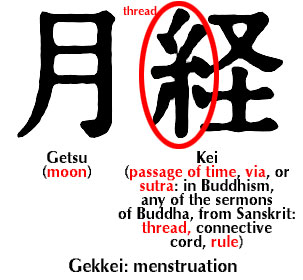 |
The only two expressions in
Japanese for menstruation [but see
a Japanese translator's many
contributions, below] that I could
find contain the interesting Kei,
which might be just a phonetic and
not reflect the component
characters' meanings, as happens
often in what someone called the
most unnecessarily difficult
language today.
But the character circled in red
means "thread," and might relate
to "rule," a word appearing in
other languages (see the entries
for French, German and Spanish on
this page). But that seems
far-fetched.
The familiar "moon" appears, as
it does in the word "menstruation"
in the form of "month,"
"menstruation" being a widely used
word in the West.
See these characters used at the
bottom of
this page.
My information comes from "The
Kanji Dictionary," by Spahn,
Hadamitzky and Fujie-Winter
(Tuttle, 1996).
|
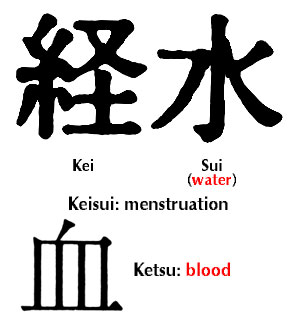 |
"Water" gives an idea of flowing
and appears with the character
Kei, as above.
Strangely enough, the character
for blood is missing in these
expressions - but it's missing in
the European word "menstruation."
To me, menstruation is blood and
is the, um, shocking thing about
it. Isn't it odd that blood is
missing from the most common
expression in English and in
Japanese? What is standard seems
to be a euphemism. Germans do say
Monatsblutung, but just catch
someone in an Anglo-Saxon country,
and probably Japan, saying
"monthly bleeding" in public!
|
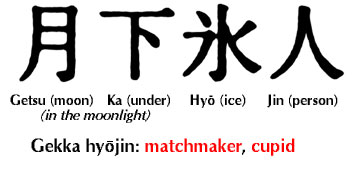 |
In researching the above
expressions I found Gekka hyojin
in the The Kanji Dictionary, a
phrase I find hilarious. The only
way I can interpret "ice person"
is as an "ice breaker," but
Japanese being what it is, it is
undoubtedly something else. (A
Japanese translator explains the
expression, below.)
|
|
I'm attaching a GIF of all these
expressions in the hope that you
can put it to some use on your
site [above].
Thanks, and keep up the good
work! I'm really enjoying your
site. :)
Nora
Nora Stevens Heath
[She later added:]
Hi, again,
I'm glad you can use the
Japanese contribution on the MUM
site! It's a great resource, and
I'm happy to be able to add to
it.
The survey (in Japanese) is
here:
http://www.kao.co.jp/mag/laurier/
It seems to have been
sponsored by Kao, a company that
manufactures the Laurier brand
of sanitary pads (among many
other products). I'd be happy to
provide more info if you'd like
to include it.
The entire survey, of which
this is only a tiny part, is
actually quite interesting. It
reveals how Japanese women feel
about their 'gekkei' (this term
is used as the neutral,
technical term throughout the
survey), what their main
physical complaints are, and so
on. Maybe if there's a Japanese
MUM in your future...? :)
As for the kanji [Japanese
character] for 'go-between',
well, I certainly can agree that
'under-moon ice person' doesn't
sound like a traditional
go-between to me! Apparently
it's a mix of 'under-moon old
person' and 'ice person', both
of which denote 'go-between' and
have their origins in China.
Here's the 'under-moon old
person' story:
On his way to the palace, a
traveler came across an old
man sitting beside a bag,
reading a book in the
moonlight. There was a red
cord in the bag, and the
traveler asked the old man
what it was. The old man
replied that it bound two
fates together by tying
together the feet of a man and
a woman who were to become
husband and wife. He then
proceeded to tell the traveler
who he would marry. Fourteen
years later, he married the
same woman the old man had
said he would.
And here's the 'ice person'
story:
A fellow dreamed he was
standing on ice and speaking
with a person below it. He
consulted a fortune-teller who
told him that, because he was
speaking from a yang place
(above the ice) to someone in
a yin place (below the ice),
it foretold that he would
become a matchmaker. Indeed,
soon after he was called to be
the go-between for his
master's son.
So that explains things, in a
way. I love researching the
origins of words and expressions
in just about any language. Now
we've both learned
something--and I know as soon as
I dip back into the MUM site,
I'll be learning things left and
right. Thanks again for all the
hard work you put into that
terrific site!
Take care--
Nora
|
"Hi there,
I'm a Japanese translator and
surprised to find 'gekkei' and
'keisui' listed on your site as
'standard' Japanese expressions
for menstruation. Yes, 'gekkei' is
the official term, like
'menstruation', but who uses it?
Certainly the most common is the
euphemism "seiri," which literally
means "life logic," or
"physiology." An online survey
reveals that 82 percent of
Japanese women surveyed say
'seiri,' while only 1 percent say
'gekkei.'
Related words not mentioned on
your site run the gamut from the poetic:
o
'getsuji' or 'tsuki no mono'
('moon thing')
o
'hatsuhana' ('first flower') and
'shochou' ('first tide'):
referring to one's firt period
o
'tsuki tachinikeri' ('the moon has
risen'): a euphemism used in
Japan's oldest book, the Kojiki,
which was completed in 712
o
'tsuki no sawari' ('moon
obstacle'): denotes a monthly
obstacle or a cloud over the moon
the very
indirect:
o
'are' ('that'): 11 percent of the
survey respondents use this word
the more lighthearted:
o
'ichigo-chan' ('Little Miss
Strawberry')
o
'okyakusama' ('guest'): a formal
word used humorously here
o
'irasshaimase' ('welcome'): also
formal
o
'ketchappu' ('ketchup') and
'tomato'
and the more historical:
o
'Anne no hi' ('Anne's day'), from
The Diary of Anne Frank,
when Anne discusses her period.
Apparently there was also a brand
of sanitary napkins named 'Anne'
for this reason. There was for
sure a tampon
named for Ms. Frank.
o
'hi no maru' ('rising sun'): the
name for the Japanese flag, a big
red circle on a field of white.
[Continued in the left-hand
column.]
|
|
The modern Japanese
character, or kanji, AN,
which means "restful,
ease, or cheap." The
figure under the "roof" is
the modern Japanese
character for women.
|
|
The ancient Chinese
forerunner showing a woman
sitting on menstrual cloth
(?) at home (shown by the
wish-bone shaped roof).
|
All drawing
from Kenneth Henshall, A
Guide to Remembering
Japanese Characters, Tokyo
& Boston, 1998.
|
|
While reading Kenneth Henshall's
"A Guide to Remembering Japanese
Characters," my eyes popped when I
came across the character AN (at
left). I saw the familiar symbol
for woman under the drawing for
roof, which indicates a building.
AN today means restful, ease or
cheap.
Henshall explains all is not
what it seems. The ancient
character from China - the
Japanese imported Chinese
characters roughly 2000 years ago
to give themselves a written
language - originally showed a woman sitting
on a flat object under a roof
(see second character at left).
Henshall writes that she was sitting
on a menstrual pad at home, not
working but resting until her
period was over.
That gave the meanings
above, "cheap" coming from the
associated meaning that "there was
no cause for concern." With
passing time the character's form
changed, as happened with most of
the thousands of characters in
Japan and China.
I wonder if this means that
women at the time of the original
Chinese character sat in one place
in the house during their period.
Were they confined, as some women in
India and elsewhere are
today? And what exactly did they
sit on? Cloth? Straw?
See more Japanese and Chinese
characters, plus other languages,
in Words
and expressions about
menstruation.
While I have the book open, let
me crack you up with the kanji -
Japanese character - for "cat."

Cat
|
 Japanese
for Dog,
derived from
character below. Japanese
for Dog,
derived from
character below. |
 Ancient
Chinese character
for dog,
showing it
standing on hind
legs, with pointed
ears and barking
(mouth open at
upper left. Ponder
it.). Ancient
Chinese character
for dog,
showing it
standing on hind
legs, with pointed
ears and barking
(mouth open at
upper left. Ponder
it.). |
|
The jagged left side of
the kanji normally
designates dog,
believe it or not, but
here is the
simplification of a
character meaning clawed
beast. The
two-part right-side
character means a seedling
or offspring, but
is used here just for
its sound, a very common
practice in Japanese.
That sound is MYOO
- or meow. So a
cat is the clawed
beast that meows!
MYOO comes from Chinese
and is used in some
Japanese compound words,
but Japanese kids first
learn their native word
for cat, neko.
The word for "Japanese
style" is wafu.
If I ever get another
cat I'm naming him/her neko
wafu after my
favorite candy, Necco
Wafers. (Let me
head off critics by
saying yes, Japanese
adjectives precede
nouns, but that won't
work here. Hey, I've got
a cat named Prof.
Dr. Max C. Padd.
More about cats here.)
Strangely enough,
Japanese children learn
the character for "dog"
(at left, different from
the one usually used in
compound characters,
above) in the first
grade but are not
required to know the one
for "cat" until after
the sixth grade.
That must have cultural
meaning, maybe that cats
meant little in Japanese
and Chinese society. My
father ate in a Taiwan
restaurant that cooked
puppies; kittens were
not on the menu. Pop did
not partake. The modern
symbol meaning "dog" is
very simple and direct,
unlike the "clawed beast
that meows" for "cat,"
which lends credence to
my hunch that dogs - as
meals? - were more
important. I'm not a
vegan for nothing.
I'm always interested
to know what different
cultures call cats and
why.
|
|
Kyrgyzstan
Guests came
"I think this word combination is common,"
wrote the 22-year-old Alfiya in Kyrgyzstan,
the contributor, who did not supply the
expression in her own language, but
translated it. (March 2001)
Damnation
"This, I think, is concerned with the
Biblical subject about Eve. I call it so
because it's a habit, but I don't understand
why it is called such." Again, from Alfiya,
as is the one above. (March 2001)
Mexico
Camadre "Regla (translated
Rule) basically is a rule that you will have
it every month, something constant. We'll
say something like 'I'm
on my regla.' Comadre (kind of
similar to the 'Aunt' reference in English)
is like your companion, very close to you.
In Spanish a comadre is someone who is
related to you because they are the
godmother of one of your sons/daughters, so
is a very close and special person, many
times a relative, that you should respect.
We'll say something like 'My comadre came to visit.' I'm a female,
Mexican, living in the U.S. and I'm 22, a
college student." (April 2007)
Cookies "Hi!
I just wanted to share this with you. When
I'm on my period, and I don't have any pads
and that stuff I ask my mom to buy me
'cookies' just because I didn't wanted to
explain about my period. Also, when I had my
first period and my brother asked my what
happened I tried to explain him not using
words like 'menstruation' and stuff, he got
the point and said 'Qué sangrona eres.'
We're from Mexico, and to say that someone
is really mean or selfish we say 'ella/él es
sangrona/sangron' (she/he is mean or
selfish). Now, you notice that word has
sangr- on it and it looks like sangre, which
means blood. I really don't know why we use
'sangrona' for selfish or mean people. It's
kind of funny associating this to 'that.'
****, 16 years old." (October 2005)
Dolorosas to
have pain or discomfort. The female
American contributor writes, "Mexican
friends of mine (female) use the delicate and subtle
word 'dolorosas' (to have pain or
discomfort). It's a contextual thing as the
word can also be used in the context of
childbirth and menopause. The root verb
'dolor' means pain: 'Yo tengo dolor aqui' (I
hurt here), but dolorosa
seems to be used almost always in a
feminine context concerning feminine
things."
Ella/él es
sangrona/sangron see Cookies
Estoy en mis
días "'I'm
in my days,'" writes the
contributor, who also sent the items with an
* and adds, "in
Merida, México, we use many terms, and you
just have one [dolorosas], which we don't
even say." (June 2001)
llegó Andrés* "Andrés
is a name, and it means Andrés arrived,
because it rhymes with 'el que viene cada
mes,' the one that
comes every month.'" See also Estoy en mis días.
(June 2001)
Me bajó* "Bajar
is go down,
and it's in past tense; me is to me," writes the
Mexican contributor. See also Estoy en mis días.
(June 2001)
Me llegó mi visita*
"My visit arrived." See also Estoy en mis días.
(June 2001)
Qué sangrona eres
see Cookies
Regla see Camadre
Vampiritos
for tampons "My Latina girlfriends (from
Uruguay, Mexico and Colombia) and I (U.S.A.
with a Mexican soul) all call it Andrés
(from 'él que viene cada mes' - "he who
comes every month"). My husband, born in
Mexico, refers to tampons as 'vampiritos'
(literally, little vampires, because they
suck blood). We both also refer to 'black
towel time' because we toss one on the bed
to protect the sheets if we want to play.
Great site," writes the contributor. (August
2002)
Nepal
Chaupadi
The custom of banning women to menstrual
huts during menstruation. See 19
photos about this in one of
Germany's best newspapers. (March 2014)
(The)
Netherlands
(*The male Dutch
contributor of the phrases with an asterisk
[*] wrote, "It occurs to me that a lot of
nicknames have the same meaning in other
countries.")
Aan de rooie zijn
being on the red.
Also: "De tomatensoep is overgekookt (The
tomato soup overcooked); De rode bieten zijn
overgekookt (The red beets overcooked); Mijn
dam is gebroken (My dam has broken), as when
you're leaking through your Tampax. (Must be
typical Dutch I guess, haha!); De rode zee
is overstroomd (The Red Sea has flooded); De
dam van de Rode Zee is gebroken (The dam
from the Red Sea has broken) - this means
just that your period has started; Heb je
een dam voor (overstroming van) de Rode Zee?
(Do you have a dam for the [flooded] Red
Sea?), used if you're asking someone for a
sanitary towel. These expressions I've heard
and used in high school, but also I heard
them later on in life used by various women.
I hope they can be of any use for your funny
'museum' site! Best wishes, ****** (f),"
writes the contributor. (February 2002)
Classicol "That
is the term in goerree overflakkee [an
island of south Holland about 50 km from
Rotterdam, writes the contributor] in Dutch.
It's a red oil, and the name is given by the
fisherman here by the harbour in Stellendam
who say,"My wife has CLASSICOL." Greetings
*** (June 2003)
De dam van de Rode Zee
is gebroken the
dam from the Red Sea has broken.
"This means just that your period has
started," says the contributor. See Aan de rooie zijn. (February 2002)
De gang wordt weer (rood) geverfd the corridor is being
painted (red) again. "Just wanted
to say I absolutely loooove your site - all
these words are awesome! Good to talk about
your period without those dumb guys knowing
what you're talking about. I am from the
Netherlands, and here is another one me and
my friends call our period: De gang wordt
weer (rood) geverfd (the corridor is being
painted [red] again). We sort of compare
blood with red paint, that's why," writes
the contributor. (February 2002)
De rode bieten zijn
overgekookt the
red beets overcooked. See Aan de rooie zijn. (February 2002)
De rode zee is
overstroomd the
Red Sea has flooded. See Aan de rooie zijn. (February 2002)
De rooie bus
staat voor de deur "Meaning, 'the
red bus is standing in front of the door.'
What it means is that nobody can come in
because the door is blocked. Greetings,
****" (September 2003)
De tomatensoep is
overgekookt the
tomato soup overcooked. See Aan de rooie zijn. (February 2002)
De vlag hangt uit* the flag is out
De Russen zijn
er the
Russians are here. (sent by the Ik heb Russen e-mailer)
(January 2001)
Feest "My
sisters and I (by this time my daughter too)
always use the word 'feest' (party time) for
our period. Because it doesn't feel like
party time at al," writes the Dutch
contributor. (June 2002)
Give me two things:
chocolate and space see I got a visit to the red
light district
Hangmattentijd*
hammock time
Heb je een dam
voor (overstroming van) de Rode Zee?
Do you have a dam for
the [flooded] Red Sea? "used if
you're asking someone for a sanitary towel,"
says the Dutch woman. See Aan de rooie zijn (February 2002)
Het haasje
zijn* being
the rabbit
The "July woman" (see ongesteld) comments,
"I don't know this saying referring to
menstruation, but obviously someone does.
It has another meaning: being the one who
is picked on, the one who always suffers/
always has to do the chores." (July 2001)
Het stopje
vervangen change
the cork (or stopper), also sent by
the Ik heb Russen e-mailer.
(January 2001)
I got a red to the red
light district "I've called it two
different things: 1) 'I got a visit to the
red light district.' I'm Dutch, and well,
sometimes me and my family joke on if we go
to Holland to visit family well, make a trip
to the red light district, but not really.
2) 'Give me two things: chocolate and space'
says it all." (February 2007)
Ik ben jeweetwel
"I am you-know-what," writes the
contributor. (October 2003)
Ik ben "O" "Ik
ben 'O' = I'm O= is like 'I'm having M.' We
use it very often - not that the guys don't
understand us, but that doesn't matter. Cya
[cover your ass, "protect yourself"], or
not, of course, haha, bye." She also wrote,
"We, the Dutch, all speak English. We learn
it at school, since we are 10." (June 2002)
Ik heb Russen I'm having/ I have
Russians The contributor writes,
"My mom, my sister and I usually refer to
our periods as [this]; it probably has to do
with the red color, communism, etc., where
the Americans say 'the Reds are here'; this
Dutch woman also sent the following one,
which the same family members use. (January
2001)
I'm laying an egg
(July 2003)
[een] Kruisraket
lanceren A Dutch woman writes, "I
use the expression 'een kruisraket
lanceren,' 'to launch a cruise missile' -
'to replace a Tampax,'" something pertinent
to this age. (January 2003)
Menstrueren to menstruate "the
medical word," writes the "July woman" in ongesteld. (July
2001)
Mijn dam is gebroken
my dam has broken, "as
when you're leaking through your Tampax. Must
be typical Dutch I guess, haha!" added the
contributor. See Aan de rooie
zijn.
(February 2002)
Ongesteld zijn
having your period,
sent by the Ik heb
Russen e-mailer (January 2001). A
Dutch woman e-mailed (July 2001) that
"'ongesteld' is an old-fashioned word for
being ill, unwell, but it has become the
normal word for menstruating." So, she says,
"'ik ben ongesteld' means 'I am unwell' and
is the mainstream word; the others are
slang."
Opoe op bezoek hebben*
to have grandma on
visit
Verkeerde tijd
van de maand* wrong time of the month
Vrouwenzaken*
woman's business
New Guinea
An Australian woman
contributed (June 2001) these entries; her
husband spent 18 months in New Guinea. She
gives words in pidgin, a language formed to
allow conversation between two groups of
people who barely know one another's
languages. About 1000 of the world's 6000
languages are native to New Guinea, far more
than any other spot in the world. She
writes, "I would like to add that I am no
expert in pidgin. This is what I can make
out from the Pidgin-English translation
dictionary we have at home."
I lukim meri woman's visitor [in
pidgin], i.e., menstruation "where
'lukim' translates as 'to look at, to see,
or visit. 'Meri' (Mary) is the word for
'woman' (missionary origins)"
Mun i kilim moon
of injury [in pidgin], i.e., menstruation
"'Mun' can be translated as either
'moon' or 'month' and 'kilim' ('kill him')
means injure.' 'Kilim pinis' ('kill him
finished') means 'kill.' An 'abortion' is
'kilim pikanini' ('kill him picaninny')"
Sik mun menstruation
"The pidgin term 'sik mun' is derived from
(and pronounced the same way) as the English
words 'sick moon.' When I have my period
(which me and my Australian friends call
'Fred') my husband says 'The sick moon fairy is
visiting,'" writes the contributor.
(June 2001)
New Zealand
Having my friend
see Having my mate
Having my
George see Having my mate
Having my mate "Here in rural New
Zealand, I have often heard it referred to
as 'Having my mate.' This was also used
when I was at boarding school, so I am
picking it is a nationwide term. It is
the same thing as 'Having my friend,'
implying that means that one is not
pregnant, hence a mate, or something to be
welcomed. Another one that was common in the
whole school was to say 'I've got my
George.' Goodness knows where that came
from. Thanks, ****" (April 2005)
Inconvenient visitor see Red sails in the sunset
Mrs Noodles "One of my ex's
and I used to call menstruation 'Mrs
noodles' because of the similarity between
the title of the Japanese film 'Tampopo'
(about a woman who desparately wants to be a
noodle chef) and the word tampon. Supid, but
there you go. In addition, it meant that PMT
was 'packet noodles.'" (November 2002)
Packet noodles
see Mrs Noodles
Period, schmieriod see Strawberry jam time
Red sails in the sunset the
contributor writes, "Wow, I love this site.
I had no idea there were so many different
names for that inconvenient visitor. When I
first got my period I had to ring my sister
and say, 'Red sails in the sunset.' Since I
have had babies my cycle has had a mind of
its own; it's like a bad door-to-door
salesman arrives and departs when you least
expect it and at inappropriate moments, but
this site gives us all something to laugh
about." (March 2002)
Strawberry jam time
"Hello, my name is ***. A few years ago an
old lover of mine refered to my menstruation
as 'strawberry jam time.' I still call him strawberry jam man.
Also, 'period, shmeriod.' These New Zealand
men have no problems about women's bodies.
Well, these two blokes don't; I'm not sure
about the rest," writes a woman from New
Zealand. (August 2002)
Nigeria
Clock "This
expression is a euphemism for time. In some
local Nigerian languages the words for
'time' and 'clock' would be about the same.
A girl would give her boyfriend the shocking
news that she has not seen her monthly
period by saying, 'I can't find my clock' or
'I am still looking for my clock.' [see also
'Doing time,' from the same contributor.]
Congratulations on such a fascinating page.
I cannot remember last time I spent so much
time on any one page on the Internet. This
page deserves to be in the Guiness Book of
Records as the most engaging page on the
Web. Here are two Nigerian expressions for
menstruation which I did not see in on the
list ["Clock" and "Doing time"]. Keep up the
good work." (February 2003)
Doing time
"Girls would talk of themselves as 'doing
time'; and when they say they are not ready
for sex their boyfriends would ask them if
they are 'doing time.'" [See more at Clock, from the same
contributor] (February 2003)
Northern Ireland
On the blob "These are both
from Northern Ireland: On the
blob: a male friend used this when
he lived with me (because it blobs out,
basically). Up on blocks:
Useless old cars without wheels are propped
up on blocks in driveways. Some men think women on
their period are not fit for their primary
purpose (sex), and are therefore 'up on
blocks' awaiting becoming usable again!"
(January 2007)
Up on blocks
see On the blob
Norway
(c=from the TBG Blad [newspaper], Tønsberg,
Norway, 1995). Harry Finley translated the
words.
Besøk af tanta Rød
fra Potzdam visit
of Aunt Red from Potsdam (c)
Den tiden i
måneden. The
17-year-old contributor writes partly in
Norwegian, which I translate in brackets:
Hallo! Jeg er en jente på 17 år fra
Norge (som om du ikke har forstått det alt
:-D), og jeg har lest listen over "Words and
expressions" med stor glede! Den var
virkelig morsom. Resten av siden din er også
veldig bra. Veldig underholdende, og veldig
lærerik! Takk! :-) Jeg har noen norske
uttrykk som kanskje kan være av interesse.
[Hello! I'm a girl of 17 from Norway {as if
you didn't understand that :-D} and I read
the list of Words and expressions with great
enjoyment! They were really enjoyable. The
rest of the pages of your site are also
really good. Really entertaining and really
instructive! Thanks! :-) I have some
Norwegian expressions that might be of
interest.] I know you understand a whole lot
of Norwegian, but since I'm not sure of
exactly how much you know, I'll write the
rest in English. No offence! When you have
your period and don't want to participate in
gym class, one of your parents (mostly the
mother) writes a note for the teacher,
saying "Vanlig grunn". (Or, like you've
already put on the Words... list,
"det vanlige".) This is very common, and has
been for at least 30 years. Usually, the
note goes something like this: "12
September '03. Vanlig
grunn. [usual reason] X.X.
[Parent's name.]" Other words and
expressions: "Menstruasjon."
"Menstruation."
Formal. Used in the same ways as the English
word. "Mensen
or mens." Used
exactly as the English word "period." Short
for menstruasjon.
"Jeg har mensen."
Used like the English expression "I'm on my
period." This is an extremely common
Norwegian expression - the
expression, so to speak. But even though
it's so common, some girls feel it
awkward/embarrassing to put it that way, and
prefer to say "Jeg har
den." [I have it.] "Jeg har Saba."
According to a novel I've read, this
expression was used to some extent in Norway
in the 60's. I don't know if it really was.
Anyway, it refers to the Norwegian pad brand
Saba Self Sit. [See and read
something about the history of the Saba company.] That
brand is, by the way, still quite popular,
but mostly bought by middle-aged women. "De krekslige*, månedlige greiene."
[Monthly affairs] (*Krekslig =
disgusting, yucky, sickening - a dialect
slang word used in Southern Norway.) My
mother's colleague used this expression
once. "Jeg har vondt
[pain] i magen." Said in a way that
makes it obvious that you're talking about
menstruation. "Jeg kan
ikke ha gym i dag." The same. "Den tiden i måneden."
[Time of the month] "Det
månedlige." [The monthlies] "Jeg blør." Not the
most usual expression, but it's being used.
"Jeg må kjøpe noen
nødvendigheter." Means you have to
buy pads or tampons. Håper disse er til
nytte! Jeg elsker siden din, den er utrolig
bra!!! Tusen takk for alt du har gjort så
langt, da! Lykke til videre! ;-D Med vennlig
hilsen, Jorunn, southern Norway. [Hope that
this is useful. I love your pages, they are
unbelievable good! Thousand thanks for all
you've done so far. I wish you more luck!
With friendly greetings, Jorunn, southern
Norway.] (October 2003)
De krekslige see Den tiden i måneden
Det it
(c)
Den tiden i måneden see Den tiden i måneden
Det vanlige the usual (c)
Greiene
the affairs, business (c)
Jeg blør see Den tiden i måneden
Jeg har den see Den tiden i måneden
Jeg har mensen see Den tiden i måneden
Jeg har Saba see Den tiden i måneden
Jeg kan ikke ha
gym i dag see Den tiden i måneden
Jeg har vondt i
magen see Den tiden i måneden
Jeg må kjøpe
noen nødvendigheter see Den tiden i måneden
Kommunister i
lysthuset Communists
in the arbor, or summer house (c)
Mensen
or mens see Den tiden i måneden
Menstruasjon see Den tiden i måneden
Månedlige greiene see Den tiden i måneden
Vanlig grunn see Den tiden i måneden
Pakistan
Mahwari
literally means monthly
(from a 24-year-old male Pakistani
physician, September 2000)
Technical problem,
having a an American e-mailer
writes, "A friend of my mom's who was doing
some research in Pakistan got food poisoning
and a local doctor was called in. After
hearing some of her symptoms (stomach
cramps, vomiting) he first asked her if she
might be pregnant. When she said no, he next
asked her if she was 'having a technical
problem?' The way he said it, she knew he
meant having her period! I don't know how
healthy it is to think about a natural
bodily function this way, but I think it's
pretty funny. Please try back later - we are
experiencing technical difficulties. Keep up
the good work -- I love your site!" (May
2002)
Peru
La tante rouge
the red aunt.
The contributor wrote "used by my Peruvian
mother." It looks French. (December 2000)
Periodo "When I
was a young teenager in a Spanish grammar
class a professor named Sr. Cuevas, also
known as 'Tramboyo,' went on a long
dissertation telling us the correct
pronunciation of the word periodo, one
meaning a) an amount of time, and the other,
b) meaning menses. The only difference was
where you placed the tilde. To make a long
story short: many years have been by, and I
still do not know which one is the correct
pronunciation." The writer also contributed
Menses, Regla, Flujo,
El mes and Las
buenas nuevas (August 2001)
Menses (August
2001)
Regla (August 2001)
Flujo (August 2001)
El mes (August 2001)
Las buenas nuevas
"good news: you are not pregnant," writes
the contributor of Menses,
Regla, Flujo, El mes and Periodo (August 2001)
Philippines
Buwanang dalaw
"I'm Bebang, 23 years old, from Manila. Your
site is very interesting. I noticed there
was no contribution from the Philippines.
Here are two examples: the elders usually
refer to menstruation [in the national
languag] as "buwanang dalaw." It means
monthly visit. But in a casual manner, we
say "meron ako," which literally means 'I
have . . . .' We don't really have to say
what is it that we have. It is understood
that a woman is having her menstrual period.
" (April 2003)
Dalaw visitor see also Buwanang dalaw "For some reason women
have associated menstruation with having a
visitor every month," writes the male
Filipino, who continues, "Here in the
Philippines we say it two ways," and added
Regla. (July 2004)
Meron ako see Buwanang dalaw
Misred "I have a Filipina
fiancée and she uses the English words Red
Tide or misred to describe her menstruation.
She will not take a bath or shower during
this period as she believes an ill wind will
enter her vagina. She does however wash
locally but no bath or shower." (October
2006)
Red tide see misred
Regla related to many European
words for menstruation and probably
introduced by the Spanish during the time
Spain owned the Philippines. See also Delaw. (July 2004)
Poland
The
contributor of the starred * words writes (August
2001), "There are probably more words used
regionally, but these are very common and
known by mostly all (I live in Quebec,
French Canada, and have contacts with
Polish immigrants from different parts of
the country).
All my efforts are
in vain. Do you know how to get the thing
moving? [original
in Polish] German literary critic Marcel
Reich-Ranicki found this in a letter from
a female Polish soldier in World War II
when he worked as a military censor. The
German translation reported in his
autobiography Mein Leben is "Alle meine
Anstrengungen sind vergeblich. Weißt Du
nicht, wie man die Sache in Schwung
bringen kann?" [November 2001]
Ciocia z Moskwy
"I am Polish and I noticed you do not have
listed the most widely used phrase in my
part of Poland when I was growing up, beside
okres: 'ciocia z Moskwy' or Aunt from
Moscow. It was used a lot around Bialystok
area at least from 1970s on. I haven't been
there in a while so I can't say what is used
now. I have to admit I have no clue what
those first two sentences in the Polish
section are about," writes the contributor.
(June 2002)
Ciota "vulgar - I believe it's
derived from the word 'ciotka,' which
means aunt (also used to describe a
wussy man)."
Menstruacja*
menstruation
Miesiaczka* "Could be translated as
'the monthly,' less common, not vulgar
either."
My [American]
Indian isn't coming [original in Polish]
German literary critic Marcel
Reich-Ranicki found this in a letter from
a female Polish soldier in World War II
when he worked as a military censor. The
German translation reported in his
autobiography Mein Leben is "Mein Indianer
kommt nicht." [November 2001]
Okres*
"literally 'period.' I believe this is the
most common description of the period -
it's used by everybody - it's not vulgar."
I am very upset
because there is no sign of the Chinese
[original in Polish]
German literary critic Marcel
Reich-Ranicki found this in a letter from
a female Polish soldier in World War II
when he worked as a military censor. The
German translation reported in his
autobiography Mein Leben is "Ich bin sehr
unruhig, denn der Chinese läßt sich nicht
blicken" [November 2001]
Portugal
*sent
by a Portuguese 16-year-old girl in June
2001
Benfica* (see
O Benfica . . .)
(June 2001)
Chegaram os Ingleses
the English arrive in
Portugal (June 2001)
Estou com a fita
vermelha na máquina I have the red label in
the old typewriter (June 2001)
Menarca* the menarche [June 2001]
O Benfica joga em casa
The Benfica
plays at home.
The contibutor
writes, "Benfica is a football club [soccer to Americans], very well
known in the world, whose colour is red."
The contributor also sent Tuo com o Chico and
Periodo. (April
2001)
Periodo period [April 2001]
Regras* laws [June 2001]
Ser Mulher*
being a woman [June 2001]
Tou com o Chico
no translation of this from the contributor
of Periodo and
O Benfica joga em casa [April 2001], but
a Portuguese (who sent the contributions
marked with *) e-mailed in June 2001 that
it's "almost the same as Joe's coming or
Aunt Mary is coming to visit."
Puerto Rico
La regla the ruler see Te canto el gallo?
Te canto el gallo Did the rooster already
sing? "I'm
from Puerto Rico. The term that most mothers
and grannies use when referring to
menstruation is 'Did the rooster already
sing?' I got my period when I was just a
nine-year-old and everybody kept asking me
'Te canto el gallo?' Our native language is
Spanish. Girls referred to it as 'La regla,'
the ruler,' in school," writes the
contributor. It's interesting that a male
animal should be significant in a code for
menarche. (January 2002)
Russia
* marks those sent by a
15-year-old Russian girl in May 2001
Chronic delay see Critical days
Critical days "Hello, Your site
is just out of this world! I should never
have thought that such a crazy idea could
ever strike someone. I'm just blank! Well,
concerning this sort of thing, I'd say that
there're some euphemisms to conceal 'the
whole gravity' ;-) of the situation and
every girl chooses the one she likes best.
There are some of common use, just like
you've got at your site, as well as unusual
ones. For example, 'a Japanese flag.' If you
know what it looks like, you'll find it very
funny. ;-) Or, for instance, the one my
friend and I invented two years ago. The
origin of this word must have been really
interesting and it was somehow connected
with the German sound 'U umlaut' [ü] -
though I can't remember exactly. This word
was 'klin.' It had nothing to do with a
Russian word which means 'wedge.' It was
just something to let each other know that
we have our "critical days" (this expression
is very common in the ad of sanitary towels
and also in the joke 'Every critical day
requres its blow-job.'). But no one else on
Earth would ever guess what we meant. The
most ridiculous thing about all that was the
day when I finally had a 10-days delay. Then
my pretty witty friend called it
'khronicheskoye besklinje' - 'a chronic
delay' when I discovered that I was
pregnant. Now, when I have my beautiful
one-year-old baby girl and I have my periods
again, I also call it 'klin' and my husband
is now also aware of what I mean. As for
sports and school, we used to tell our
teacher, 'Well, I'm sorry, I just can't.'
And that was all. He got it OK. But, I'd
like to make clear the meaning of the phrase
'IA TEKU' ('I'm flowing'). In fact, it
doesn't mean you can't have sex now; it's
quite the opposite. It means the girl is
extremely excited and she doesn't need any
extra lubricant, she has enough natural one.
Should you need any further information, I'm
ready to help. Best regards." (August 2004)
Godoviye "Hi!
I'm a 21-year-old Russian female. I've got
several expressions in Russian that mean
getting a period that I'd like to share! Techka [TE-chkuh] -
literally meaning 'drippage,' 'flow.' - Godoviye
[guh-duh-VY-yeh] actually means 'annual,'
but is sarcastic slang for period, coming
from a wish for the monthly period to only
come once a year and be an annual period
instead. - Pyatna na
prostyni - meaning 'spots on the
linens' and referring to a girl waking up in
the morning to discover she's started her
period by seeing a red spot on her linens.
That one we used as young teens in a
summer camp. - Mes.
- an abbreviation for 'mesyatchniye', which
literally means 'monthly' and refers to
period. When girls whisper to each other in
class, they use the abbreviation "mes." so
that the boys won't know what they're
talking about, yet all the girls
will get it. - Monthly
relief - this one we Russians who
live in U.S.A. use, mostly of college age,
to indicate our relief at our not being
pregnant each month." (March 2005)
Guests come to visit (in
translation) ". . . that's what we used as
teenagers. I used to be on a swim team (back
in former Soviet Union) and our coach
actually made up that phrase. When one of
the girls got their period, they were not
swimming; and when other girls asked the
coach 'why so and so is not participating in
the practice' the coach said 'she has guests
visiting.' I still use that phrase, although
my American husband doesn't really 'get' the
meaning :o) but it takes me back to my past.
Thank you, ******* (From former USSR, now
New Jersey)." (July 2002). An e-mailer
commented (May 2007): "I am puzzled by your
Russian entry where someone claims that her
'coach actually made up the phrase.' The
phrase has been standard for decades--and
likely longer--and even been used in film
and in print. It cannot be ascribed to a
single individual--and, the fact that
similar expression exist in other languages
points to a typical folk euphemism."
*IA TEKU I'm flowing See also Critical days
Japanese flag see Critical days
Khronicheskoye
besklinje see Critical days
Klin see Critical days
*LUBIMAYA NEDELIA MESIATSA
favourite week of the
month. The
contributor explains, "I sometimes call
it [this] when I joke with my friends on
this topic."
*MENSTRUATSIJA
menstruation (formal name)
Menstryak "My sister calls
it Menstryak (it is Russian). It is funny
because it's got a Yak in the end, and
Menstr explains everything. Words ending
with -yak are sort of used to be criminal
jargon before, but now have gained a common
acceptance. So yak is being added in the
end, and it doesn't carry any special
meaning, sort of like ie in thingies. And
yes, we are both Russian." (April 2007)
Mes. see Godoviya
*MESIACHNIJEE
menstruation (formal name)
Prazdniki holidays says the
Canadian-immigrant-from-Russia-via-Israel
contributor, "My friend, her mom, my mom, my best friend,
and now my boyfriend all call it this. I'm
not sure why, but this is a very
convenient term. We all now live in Canada
and sometimes use it in English. 'I'm
celebrating,' 'I have holidays.' And this
can be a happy event since it shows that
you're not pregnant." She later wrote,
after I suggested that it could be taking
a holiday from school or physical
education, "Not sure. I left Russia in
grade 3, it is just that I kept
socializing with Russians when I moved to
Israel, and then Canada. I can't remember
anything from Israel, maybe because I was
too young for those terms : ) There is an
expression in Russian, 'red calendar
days.' It means holidays (like Christmas
and such) because they are red on the
calendar. Maybe that is the origin. Your
interpretation is possible too, but
considering that my friend moved away
quite early too, I have no idea about its
correctness : )" ["Red calendar days" also
appears in American booklets for girls
published by menstrual products companies
{see a list
of booklets on this site}. "Red calendar," when
you think about it, could also refer to
Communism; this connection appears in at
least two languages, Norwegian, and Dutch
in The Netherlands {see those categories,
above}.] (June 2001)
Pyatna na
prostyni see Godoviya
*SCHASTLIVIJEE
DENKI happy
days. The
contributor explains, "I sometimes call
it [this] when I joke with my friends on
this topic."
Techka see Godoviya
*U MENIA DELA I'm busy or I've got THAT stuff now, which her friend
sometimes says.
*VREMENNOEE
OSVOBOZHDENIE temporarily free from
visiting PT. The contributor
explains, "In school we have physical
training (PT) lessons and if we have periods
we can miss them (I mean PT lessons)," not
that this needed explanation.
Well, I'm sorry, I
just can't. see Critical days
*ZHENSKIJEE DELA
women's stuff
Scotland
Aunt Bertha the e-mailer, a writer,
does not know where she found it.
(February 2004)
Bleeding like a
banshee from
the contributor of Aunt Bertha (February 2004)
Dabs "DABS is sometimes a word used
in Scotland," writes an anonymous e-mailer.
(February 2004)
Red flag week a woman e-mailer
(September 2000) says it's also used in
Canada
Serbia
Dobila sam
see menstruacija
Imam see
menstruacija
Imam zenske
muke see menstruacija
Menstruacija
"Menstruacija, Menzis, Perioda
menstruation. Women almost never use these
words in everyday life. Instead they say
'Dobila sam,' which means 'I have got it,'
or 'Imam,' which means 'I have it.'
Sometimes they say 'Imam zenske muke,' which
means 'I have female trouble.' There is also
a very rarely used expression 'Tetka iz
Crvenke.' In English that would mean 'Aunt
from the red town.' Keep up the good work!
***" (June 2003)
Menzis see menstruacija
Perioda
see menstruacija
Tetka iz
Crvenke see menstruacija
Slovakia
Kramy the
contributor writes, "I see u do not have
expressions for menstruation in Slovak
language. 'Kramy': very common slang.
'Menzes.' 'Menstruacia.' 'Svoje dni': 'like
her days, or own days.' So, because I almost
never use slang I do not know many
expressions, but at least a little
contribution from Slovakia regarding
menstruation topic :) Best regards, *** ***"
(May 2003)
Menzes see Kramy
Menstruacia
see Kramy
Svoje dni
see Kramy
Slovenia
Festa "Hiya!
I'm just having fun with your Web site and
I'd like to tell you our Slovenian
expressions for menstruation. Menstruacija:
that's how it is called in formal way. Festa [the third
letter is an s with circumflex]: that's the
word that is used in part of country that's
near Italy. It comes from italian word 'la
festa,' which means celebration, party. Ta rdecit [the
fourth letter is a c with circumflex]
literally means 'the red one.' Menstra: girls use
that word and it is short for
'menstruacija.' Hope I helped you a bit."
(May 2004)
Menstra see Festa
Menstruacija
see Festa
Ta rdeca see Festa
South Africa
A bloody waste of
fucking time "I'm 29 and from
Texas and we, too, used 'George'
as the term in high school. I usually just
refer to it as 'that time of the
month.' I used to see a guy who
used to call it 'a bloody waste
of fucking time.' He was 36 and
from South Africa and Great Britain. ****,
DVM."
Chips see My aunt parked her red
Porsche outside
Granny came in
a red Ferrari
"Hi, there, I'm 19 years old, and
currently live in South Africa and have
been suffering since I was 11, but
anyway.... My best friend and I started
round about the same time and we were always
depressed and of course in total agony (and
the only 2 chicks in our grade who knew what
it takes to be a 'woman')! My friend being
the wonderful person she is came up with the
phrase, 'Granny came in a red Ferrari!' It
always made me laugh and we still use it to
this day. If it came late she'd say,
'Granny's stuck in traffic' = P When
Granny's Ferrari is at our house my dad
always looks at me and says, 'Sukke tyd?'
It's Afrikaans for 'That time of the month?'
I call pads 'those dreadful concoctions
of plastic and cotton!' And tampons are just
plain 'thingies' cuz you get the teeny tiny
ones that you can never find in your bag
when you need them! And honestly I would
skip the whole shlep if I could! *SIGH*
Regards, Granny's favorite grandchild =P"
(December 2006)
Granny's stuck in traffic see Granny came in a red
Ferrari
I'm mourning see My aunt parked her red
Porsche outside
I'm sick
see My aunt parked
her red Porsche outside
It's time see
My aunt parked her red
Porsche outside
Hammock season
the contributor writes that it's from the
1970's and based on the pads with elastic
passed through the loops (January 2001)
Jam rags "In
South Africa [in the late 60's] I heard male
friends refer to them as 'jam rags.'"
(August 2005)
Kalender pes
"When I was at university all my female
residence friends (co-ed residence) used to
talk of 'kalender pes.' It is Afrikaans for
calender plague." (June 2003)
My aunt parked her red
Porsche outside the South Africa
contributor writes, "Some of the
terms I've heard around here are:
'Rooi gety' (Afrikaans, meaning Red Tide in
English), 'It's time,' 'I'm sick,' I'm
mourning' (seen in the light that the womb
mourns the 'death' of the unfertilized egg
and her hard work to prepare a home for the
new embryo/baby was all for nothing). At
school I've heard the girls asking for
'chips' if they wanted a pad." (December
2002)
Rooi gety see My aunt parked her red
Porsche outside
Sukke tyd?
see Granny came in a
red Ferrari
Thingies see Granny came in a red
Ferrari
Those dreadful
concoctions of plastic and cotton!
see Granny came in a
red Ferrari
Spain
(Spanish journalist and
writer Margarita Rivière e-mailed the words
with an asterisk
(*) [2000])
La berza "[It's] like cabbage (bad
smell)" (July 2005)
El inquilino
comunista
"The communist guest" (July 2005)
Menstruación*
La maruja The
Spanish male who sent the phrase "me vino
. . . ," below, wrote, "The same friend of mine
uses "la maruja" to designate
menstruation. Maruja in Spanish is a sort
of nickname for elderly women called
"María."
Me vino a visitar mi prima comunista
The Spanish male contributor, who also
contributed "la maruja," did not translate
it; he wrote that he heard a female fiend
say it, the same one who used "la maruja,"
above. [contributed October 2000]. A writer
later translated it as "my communist cousin
came to visit." (January 2001)
Período*
La regla* the
rule
Suriname
See an excerpt from a Dutch book
about words & expressions for
menstruation from around the world including
Suriname
with paintings illustrating some. A former
member of the Dutch parliament who was born
in Suriname wrote the book.
Sweden
Amerikafrämmat, "means
visitors from America" (May 2012, from
contributor of Jag har mens)
Det
månatliga "the monthly" (May
2012, from the contributor of Jag har
mens)
Grejjerna
"the things"(May 2012, from the
contributor of Jag har mens)
Jag har mens "mens is a abbreviation
for menstruation." Jag har
mens
means I'm
having my period. "And a story
about menstrual pads in my family. My
grandmother, born 1898 in Sweden, used
crocheted pads with eagles and string,
it looked almost like the pads
from Norway (and here)
My mother, born 1935, bought modern
pads. She hated the crocheted ones, and
to wash them without a machine, as her
mother needed to do. I, born 1967, first
used modern pads, but know I knit and
sew my own pads, and of course use a
washing machine." (May 2012)
Jag
kan inte bada "means that I
can't swim" (May 2012, from contributor
of Jag
har mens)
Lignonvecka "My name is Ann
C. P-, living in Stockholm, Sweden. First, I
really like this 'place' and second: I was
just reading your list of words used for
'menstruation' in different countries. But,
as far as I could see, you didn't have any
Swedish words! In Sweden (when I was a kid
in the seventies and eighties) we used
(among other words) the words 'monta' and
'lingonvecka.' I suppose 'monta' is an
abreviation of 'monthly' ('månatlig,' or
'varje månad' in Swedish). The second word,
or expression, I don't quite know how to
translate: 'Vecka' means 'week' and 'lingon'
is a berry (I hope I spelled it right?), a
very red berry (you mostly make jam out of
it, it tastes a little bit sour-sweet). I
don't know the word for it in English [my
dictionary says 'cowberry' and
'whortleberry,' and foodreference.com writes
this about cowberry: 'Vaccinium
vitis-idaea. This is an uncultivated
member of the cranberry family and is
primarily used in northern Europe to make
jams and preserves.' And tiscali.co.uk
writes that whortleberry is a form of
bilberry, which is '{a}ny of several shrubs
belonging to the heath family, closely
related to North American blueberries. They
have blue or black edible berries. {Genus Vaccinium,
family Ericaceae}' And vaccinium comes from
the Latin 'vacca,' 'cow.' Vaccinations
started with cowpox; milk maids in England
seemed to be protected from smallpox after
coming down with cowpox. Amazing this
Internet, no?]. Maybe there are more words
in Denise Malmberg(?), 'Skammens röda
blomma' [Shame's Red Flower,' according to
my dictionary] (I don't know if it exists in
English, but it's originally a dissertation
at Stockholm University (I think). Soo long!
And have a nice day and evening and night!
From a quite loyal visitor to your site!!"
(October 2002)
A second
contribution: "Lingonvecka, Lingon
is a red berry, vecka means week" (May 2012,
from contributor of Jag har mens)
Monta see Lignonvecka
Switzerland
D'Russe chömed see
Ich han mini Periode
Ich han mini Periode "On the German
part of your homepage you have a lot of
poetic expressions, but in Switzerland
(German speaking part), you just say: 'Ich
han mini Periode' (Ich habe meine Periode) -
'I have my period.' I've also heard the
following: 'D'Russe chömed' ('Die Russen
kommen') - 'The Russians are coming.' I've
been living abroad for the last ten years,
so I don't know how much this one is used
now :-)," writes the contributor, who also
contributed Megjött
in the Hungary section .(September 2002)
United Kingdom
See England, Scotland
and Wales
Uruguay
Andrés "My
Latina girlfriends (from Uruguay, Mexico and
Colombia) and I (U.S.A. with a Mexican soul)
all call it Andrés (from 'él que viene cada
mes' - he who comes every month). My
husband, born in Mexico, refers to tampons
as 'vampiritos' (literally, little vampires,
because they suck blood). We both also refer
to 'black towel time' because we toss one on
the bed to protect the sheets if we want to
play. Great site," writes the contributor.
(August 2002)
Vietnam
Wearing the red
beret "Bi-re mau do" is red beret
in Vietnamese, according to the contributor.
I wonder if this shows the influence of
France, which once was the power in Vietnam.
(December 2003)
Wales
Henry was here
the woman contributor writes, "I live in a
small coastal town in South Wales, Great
Britain. When I was in school we used to say
'Henry was here,' as only a man could cause
such pain and inconvenience." [December
2000]
The following come
from one e-mailer (March 2011): "Here
are some terms for menstruation in Welsh
(translations provided) which I've come
across during the course of my PhD
studies:"
Cyfarfod
misol - monthly meeting -
equating periods with chapel or church
services!
Mae Mam yn gwneud
jam - Mum is making jam-
strawberry presumably!
Bechingalws -
What-do you-call-its
Dolur Misol -
Monthly wound
Dod i,Äôm lle -
Coming to my place
Mae hi yn ei bodau
- She is in her flowers.
Zambia
Having visitors see Moon
Moon "In my Zambian culture
menstruation has many names. Among elders it
is known as 'moon.' You would often hear an
elder person asking you if you have seen or
have been to the moon (having periods).
Among my age groups at college we referred
to it as simply 'MP,' Member of Parliament
(monthly period). You would hear a friend
telling you that she is a Member of
Parliament (monthly period) or 'having
visitors.' You would hear somebody asking
you if 'you have seen' (having periods). I
myself like to have my periods though most
of the time it is very inconvenient
especially when you are traveling. But when
you are at home it's a wonderful experience
of womanhood. It makes us different from
men." **** with a UK country code.
(September 2006)
MP see Moon
You have seen see Moon
Sources other than site
visitors' submissions
a The Curse: Confronting the
Last Unmentionable Taboo: Menstruation,
(book) by Karen Houppert (Farrar, Straus and
Giroux; New York, 1999) Read a review.
b Die unpäßliche
Frau: Sozialgeschichte der Menstruation
und Hygiene 1860-1985, (book) by
Sabine Hering and Gudrun Maierhof (Centuarus
Verlagsgesellschaft, Pfaffenweiler, 1991)
c TBG Blad
(newspaper), Tønsberg,
Norway, 1995. See an exhibition about
menstruation in
Tønsberg.
©
2001-2012 Harry Finley. It is illegal to
reproduce or distribute work on this Web
site in any manner or medium without
written permission of the author. Please
report suspected violations to hfinley@mum.org
|